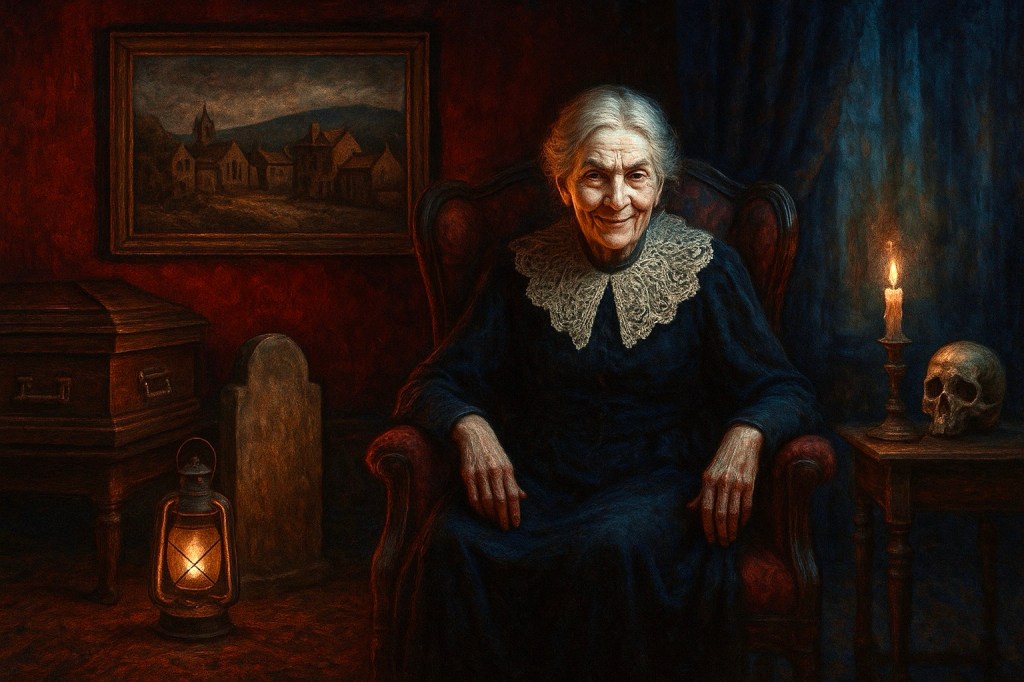
Most of us have at some point been fed cake by a relative we didn’t entirely trust – the sort of woman who keeps porcelain dolls in glass cabinets and refers to you exclusively as “it.” But Walter de la Mare, that poetic custodian of the uncanny, raises the stakes considerably in this morbid little masterpiece. The titular aunt is no fussy matron in lace gloves. She is more akin to a conduit: a wraithlike vessel for vague and eldritch menace.
The story is narrated by an unnamed schoolboy who boards with a classmate, Arthur Seaton. Poor Arthur – pale, sickly, introverted – is already on the back foot, and living under the roof of a woman who seems one part witch, one part prison governor, and entirely steeped in spiritual rot, doesn’t do wonders for his constitution. The aunt presides over her decaying house like a spider in a velvet-draped web. No shrieks, no poltergeist nonsense. Just a slow, suffocating sense of doom, like watching a candle gutter in a sealed room.
What’s so unnerving here is precisely what isn’t said. Like Henry James’ The Turn of the Screw or Elizabeth Bowen’s The Demon Lover, it’s the silence that’s haunted. We are never told explicitly what the aunt is, or what she wants, or even whether she is in fact supernatural. But the clues are there, dropped like coffin nails: the way she stares; the way Seaton appears to be ageing backward into childhood; the way the house seems to absorb time like a sponge soaked in sorrow.
And when Seaton later dies – in a manner both sudden and weirdly inevitable – we feel a grim confirmation. Something got him. Something that sapped his soul before it claimed his breath.
De la Mare, poet of dreams and death, never overstays his welcome. The tale is short, concise, and echoing – like a single toll of a bell in the fog. He understood, as T. S. Eliot would note a few years later, that ‘human kind cannot bear very much reality.’ But we can, perhaps, endure a little unreality – just enough to sense the thinness of the veil, the sharp intake of breath before the curtain twitches.
Seaton’s Aunt is a reminder that the most terrifying rooms are the ones where nothing happens, where the fire crackles and the clock ticks and someone, unseen, listens. It’s the literary equivalent of a shiver you can’t shake, or a memory that didn’t happen.
A Few Stray Threads and Observations
The story has often been seen as a psychological study of childhood trauma. Seaton’s Aunt may well be a metaphor for abusive control – the kind that leaves no bruises, only a broken will. Like Wuthering Heights, it dabbles in Gothic without leaning into parody. The house is almost a character. The air itself is rank with memory. The use of a schoolboy narrator is telling. We observe without power, a voyeur to suffering we cannot interpret or alleviate – like Job’s friends with less sympathy.
If ever there was a tale designed to be read alone, beside a ticking clock, with the wind whispering half-formed words at the window, it is this one. A story that lingers – not like perfume, but like mildew.

 Wording