High time I talked about another piece of art. So…
I’ve long maintained that heaven, if it exists, is probably not a harp-saturated cloudbank filled with recycled hymn lyrics and relatives you were secretly relieved had passed on. But then I stumbled – quite willingly – into Ascent of the Blessed, one of Bosch’s lesser-known but most spiritually resonant works, and I found myself pausing mid-sarcasm.
That’s no small feat. Usually I treat religious art with a mixture of anthropological interest and ecclesiastical eye-rolling. But Bosch – oh Bosch – was different. He painted like a man who had seen it all: angels and demons, fire and forgiveness, vice and virtue, and probably the inside of a bad oyster. And in Ascent of the Blessed, he gave us what is perhaps one of the earliest and eeriest visualisations of that now-famous New Age cliché: the tunnel of light.
The Tunnel as Cosmic Commuter Route
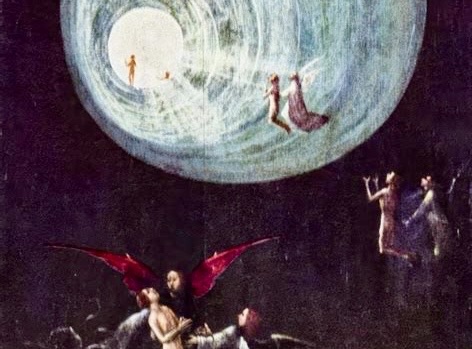
Bosch’s composition is vertical by design and theological by implication. Souls rise like hopeful balloons into the arms of benign angels, who ferry them – without fuss or ceremony – towards what looks suspiciously like the spiritual equivalent of a Dyson Airblade: a gaping white tunnel, narrowing into beatific mystery.
Now, I’m no fan of tunnels. I’ve read too much Freud to trust their symbolism, and too much Beckett to believe they lead anywhere nice. But Bosch makes this one irresistible. It glows. It beckons. It’s like the celestial equivalent of a customer service queue that actually moves. And what’s more, the souls look relieved to be on their way. No queues. No paperwork. No evangelical tract-thumpers telling them who’s in and who’s out. Just the steady guidance of angels with the emotional range of GP receptionists.
It’s almost too modern. Centuries before anyone had a near-death experience and scribbled it down in a bestselling memoir called 90 Minutes in Heaven, Bosch was already sketching the journey: that great departure lounge of the soul. And not with trumpets or golden gates, but with luminous silence.
Angels Without Swagger
The angels are a curious bunch. They’re not the feathery Victorian types with shampoo-advert hair, nor the grim-eyed warriors of Milton or Revelation. No flaming swords, no auditioning for the nativity. These angels are procedural. Practical. They could just as easily work in palliative care or the passport office. They guide the newly dead not with flourish, but familiarity.
There’s something moving about that, I think. The idea that death might be mundane, bureaucratic even – but gentle. That perhaps the worst is behind us, and all we need is someone to take our elbow and lead us toward the light, like an old friend you didn’t know was waiting.
Bodies in Transit
The souls themselves are naked – not in the libidinous Renaissance way, but in the ‘stripped of all pretense and pension contributions’ sense. They look human, unremarkable, which is precisely what makes them remarkable. These aren’t saints or sages. They’re not martyrs or mystics. They’re just people. Possibly even accountants. And yet they’re ascending.
No judgment throne. No hellfire. No cosmic scale weighing your Spotify history against your tithes. Just movement – upward, unburdened.
It’s Bosch’s most radical claim: that perhaps heaven isn’t won, it’s received. Not through moral heroism or doctrinal purity, but through surrender. These souls don’t seem triumphant. They seem…grateful. As if they’ve been let out early for good behaviour.
Medieval Psychedelia
And then there’s the light itself. That white elliptical vortex. Part birth canal, part wormhole, part MacBook screensaver. How Bosch painted this in the 15th century is a miracle of pigment and imagination. It’s not just artistic – it’s psychological. Bosch is reaching into the collective unconscious before Jung was even a glint in Switzerland’s eye.
It calls to mind the ending of 2001: A Space Odyssey, when Bowman is pulled into the monolith and spat out as the star child. It’s also oddly reminiscent of accounts by people who’ve flatlined, clinically died, and then come back with tales of light, warmth, and unconditional love. Bosch didn’t need a defibrillator. He already knew.
I’m not saying Bosch had access to the Akashic Records. But I wouldn’t be surprised if he’d had a strange dream in a cold chapel, somewhere between Vespers and indigestion.
Theology with Teeth
Most depictions of heaven make me yawn. Too much gold, too much moral smugness, and not enough drama. Bosch, even when showing redemption, gives us tension. This isn’t a smug ascent. It’s a cautious one. The souls look fragile. The angels look tired. And the light, though beautiful, is absolute. It doesn’t comfort so much as command.
And that’s the point. Paradise, for Bosch, isn’t cosy – it’s cosmic. Salvation isn’t a congratulatory hug. It’s a terrifying, all-consuming reality.
Bosch reminds me, strangely enough, of that moment in C. S. Lewis’ The Great Divorce when the souls from hell visit heaven and find that even the grass is too real to walk on. That holiness is heavier than sin. That glory has weight. And only by surrendering the self – ego, memory, pride – can one enter the light without being undone.
Final Reflections (ft. Milly the Cockapoo)
Milly, my little cockapoo with her white chin and ecclesiastical black curls, sat beside me as I studied the painting, tilting her head in what I interpret as philosophical agreement. Perhaps she too sensed that Bosch had glimpsed something. That even in a world full of grotesque politics, Tesco’s meal deals, and the onward trudge of life’s great absurdities, there might be an upward passage. A way through.
Bosch didn’t give us wings or choirs. He gave us a tunnel. A route. A surrender. And in doing so, he spoke to the anxious modern soul across five centuries.
We are not damned by default, he seems to say. Nor saved by slogan. We are simply called. And if we dare to follow, silently, steadily, we too might ascend.
And if not, well – there’s always Bosch’s Hell panel to consult next.
Quick Facts & Provenance
Oil on oak panel, circa 1500–1515 Dimensions: Approximately 86.5 × 39.9 cm Series: Part of the Visions of the Hereafter polyptych alongside Terrestrial Paradise, Fall of the Damned, and Hell Current Location: Housed in Venice – formerly at the Gallerie dell’Accademia, now more reliably in Palazzo Grimani or the Ducale complex.
Visual Description
The panel unfolds in three distinct strata: Lower Zone: A collection of nude souls, stripped of earthly identity, lifted gently by pairs of angels emerging from a dark, clouded expanse. Mid‑Section: The angels mirror evolving roles – initially double escorts (two angels per soul), gradually reducing to one-to-one as ascent progresses – perhaps symbolising spiritual lightness. Top: The iconic ‘tunnel of light’ – a circular, ribbed aperture glowing with blinding salvation. A sole angel and soul advance into it, while silhouettes await at its vanishing point.
Interpretative Insights
Tunnel Symbolism: Bosch visualises what near-death experiencers describe centuries later – a funnel of expansion and transcendence. Not Idealised Figures: Souls and angels alike lack individualising features – anonymous humanity meeting faceless divinity. Bosch offers no glory, just the raw process of passage. Dichotomy of Hereafter: With its serene clarity, this work juxtaposes sharply against Bosch’s hellish visions – upwards simplicity set against downward chaos.
All this thinking is thirsty work. So why not Buy Me a Coffee

 Wording