I’ve always had a fondness for stories that creep in sideways. Not the grand, operatic ones that march on with banners flying, but the sort that slip in under the door, uninvited and half-mistaken for something real. Arthur Machen’s The Bowmen is precisely such a story – a modest tale of supernatural salvation that, with one puff of Edwardian imagination, metastasised into one of the most enduring myths of the Great War: the Angels of Mons.
Now, Machen didn’t mean to start a national hysteria. Like many writers, he simply wanted to blend a bit of history with a ghost story, toss in some ecclesiastical mysticism, and send it off to the Evening News to pay the bills. But such is the alchemy of belief. What was meant to be fiction – a dream in print – was read as gospel. Machen had unknowingly lit the taper on a spiritual powder keg.
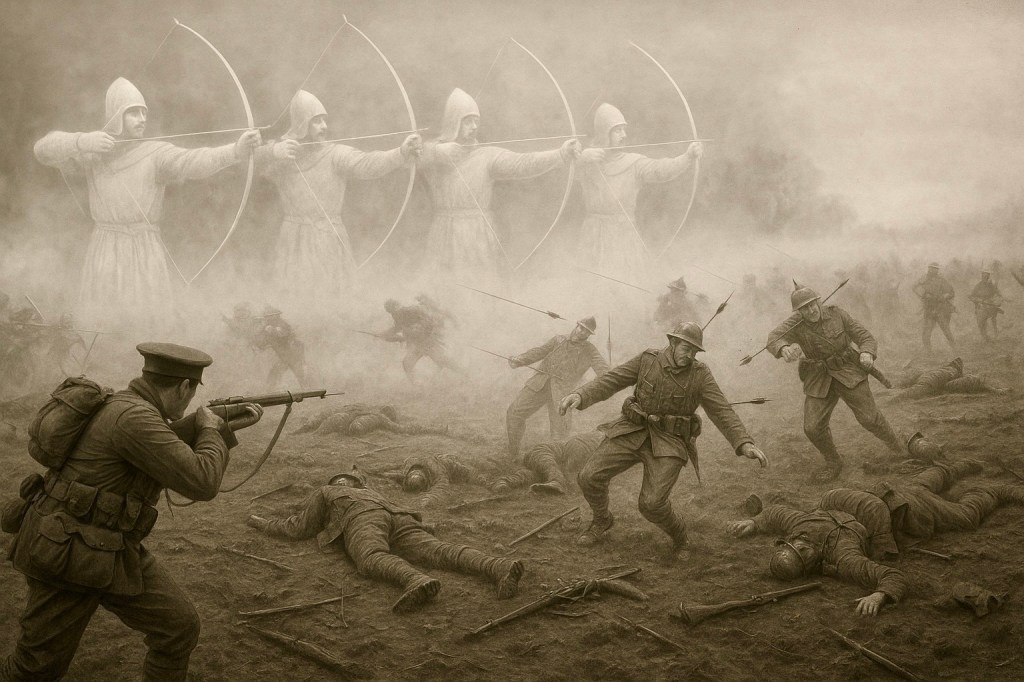
The story itself is not long. British soldiers, retreating from the overwhelming German advance during the Battle of Mons in August 1914, are at their breaking point. One among them, grasping at the last straws of hope and memory, murmurs an invocation to St George – our patron of dragons and Englishness – and lo, spectral bowmen appear, long-dead archers of Agincourt, unleashing ghostly arrows upon the enemy. Germans fall in heaps, untouched by bullets, and the British line holds. Not because of tanks or tactics, but thanks to the ghostly longbow and the whispered prayers of a desperate Tommy.
There’s something beautifully British about it all. That in the face of industrialised slaughter, we should imagine medieval phantoms coming to our aid. Never mind the machine guns – we’ve got ghosts with longbows. In a nation that had only just put the cavalry out to pasture, the idea that spectral yeomen were galloping in from beyond the veil felt, I suppose, rather plausible.
What fascinates me is not the content of the tale itself – though it has all the charms of ecclesiastical Gothic – but the reaction it provoked. The story was published anonymously at first, as was the fashion of some periodical fiction, and many readers mistook it for a factual account. Letters flooded in, not to Machen but to newspapers and religious periodicals, from men claiming to have seen the angels themselves or to know someone who had. Clergymen sermonised on it. Soldiers repeated the tale in the trenches. Even Field Marshal French, no less, reportedly took the story as evidence of divine favour.
Machen was horrified. He issued a statement declaring it all make-believe, a piece of fiction from start to finish. But by then, the myth had grown legs – wings, even. It no longer mattered what the author had intended. The public needed angels more than it needed authors.
And isn’t that the crux of it? The Bowmen is less about what actually happened than about what people needed to believe. The war had only just begun and was already chewing up men like raw meat. There was no poetry in it, no pageantry, no stiff-upper-lip heroism. Just mud, fear, and the shriek of shellfire. In such a world, myth was not an escape – it was a balm. A spiritual morphine, taken to dull the horror.
There’s a curious parallel here to the theological idea of intercession – the belief that saints can act as advocates or protectors from beyond the grave. Catholic soldiers might invoke St Michael or Our Lady; Protestants, lacking such intermediaries, had to get creative. And so, in Machen’s story, it’s not Saint George himself who appears but the long-dead soldiers who once fought in his name. Not the saint, but his army.
It reminds me a little of Tolkien’s dead men of Dunharrow – the ghostly legions who rally to Aragorn in The Lord of the Rings. Both Machen and Tolkien were writing from the shadows of war, and both imagined salvation not in tanks or treaties but in the return of ancient, sleeping powers. And both knew, consciously or not, that the deepest myths are the ones we whisper to ourselves when all else has failed.
Critics of the time accused Machen of gullibility, or worse, of trickery. But Machen was neither. He was a mystic of a particularly Anglo-Catholic flavour, a believer in the thinness of the veil between the seen and the unseen. For him, the spiritual world was not a metaphor – it was geography. He just didn’t expect the rest of the country to start drawing up maps.
As for the supposed witnesses who came forward, swearing blind they’d seen angels in the smoke of battle – I’ve no doubt they were sincere. War does strange things to the soul. There are stories of men in the trenches hearing choirs at night, or feeling the hand of a loved one guiding them away from danger. Whether such visions are real in the empirical sense is, to me, irrelevant. They are real in the sense that matters. They comfort, they steady, they give meaning. And sometimes, that’s all we have.
Machen would go on to write The Great Return, another tale of miraculous appearance – this time the Virgin Mary returning to a remote Welsh village – and again he would watch with a mixture of awe and alarm as his fiction became folklore. But The Bowmen remains the most potent of his accidental conjurings.
I reread it now with a strange reverence. Not as a war story, or even as a ghost story, but as a kind of liturgy. A prayer on paper. Not quite true, and not quite false. Just true enough to be needed.
And perhaps that’s the real miracle – not that phantom archers appeared over Mons, but that one man’s short story could become a national act of faith.

 Wording