“All men dream: but not equally.” – T. E. Lawrence
“The machine does not isolate man from the great problems of nature but plunges him more deeply into them.” – Antoine de Saint-Exupéry
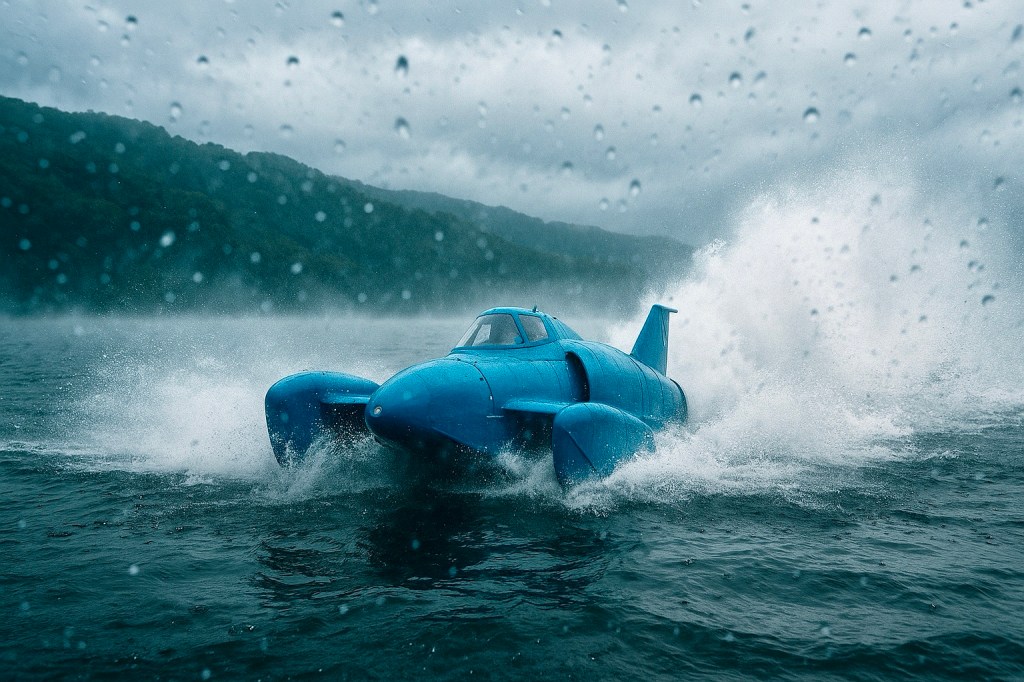
I’ve always been haunted by that final film clip: the blue hull slicing across Coniston like a bullet skimming a baptismal font, followed by a sudden splash, a plume, then absence. No scream, no cinematic final words, just the hiss and silence of a man vanishing – Donald Campbell, martyr of velocity, son of thunder.
There’s something deeply English about Donald Campbell. That mixture of repressed sentiment, do-or-die showmanship, and a quiet faith in the nobility of purpose, even when that purpose is madness in a racing suit. He wasn’t the typical daredevil – he was no Evel Knievel in sequins or a braggart chasing headlines. He was nervous, deeply superstitious, plagued with self-doubt. And yet, he climbed into Bluebird K7 time and again, as if trying to outrun his own fear.
I suspect it was his father who lit the fuse. Sir Malcolm, the archetype of Empire-speed and motorised masculinity, had cast a long shadow. Donald didn’t just inherit the name; he inherited the silence, too – the unspoken expectation to be heroic, unflinching, machine-like. And so he spent his life strapped into something louder than his own mind.
Psychologically, Campbell’s pursuit smacks of what Freud might have called a repetition compulsion – a doomed loop of proving worth, chasing identity through near-death. He wasn’t just racing water and tarmac; he was racing his father’s ghost, and, perhaps more tragically, his own self-doubt. There’s a touch of Icarus in it, yes, but also Hamlet: “O, what a rogue and peasant slave am I,” speeding toward the tragic denouement.
He died chasing a number. 300mph. A clean, round, mythic thing. He’d already broken the record once that day. But he turned back for another run – faster, finer, more fatal. Why? Because it wasn’t enough. It’s never enough for the haunted.
There’s something gloriously futile about it all. Like those polar explorers dying beautifully in blizzards, or the poets who drink themselves to death in the name of lyricism. Campbell’s was a romantic death – self-authored, soaked in symbolism, and utterly unnecessary. A Sartrean gesture in a Technicolor age: man making meaning through absurd action. He hurled himself into the abyss, not to escape life but to make life matter.
Theologically, you could almost see it as a kind of baptism – a sacrament in speed. The lake, the ritual, the sacrifice. It calls to mind Christ walking on water, and Peter sinking with doubt. Campbell too, walked the surface of the deep – just for a moment – before vanishing beneath it. His body, like his meaning, was submerged for decades.
And then, in 2001, they found him. Recovered the wreck, the bones, the helmet. Bluebird rose again like a relic from an underwater cathedral. And in a world addicted to safety and irony, something of the sacred returned with him. A man who’d died for something. Not for money, or politics, or followers – but for a line drawn across water, and the need to cross it faster than anyone else had ever dared.
I sometimes think we’re poorer now, without people like him. Poorer for living in a culture that mocks obsession and worships moderation. Donald Campbell reminds me that madness, when married to purpose, can be divine. That risk, real risk, gives life a voltage modernity cannot replicate. And that a life spent entirely on the surface, free of danger, is merely a long, comfortable drowning.
We all have our Bluebirds, don’t we? Some great absurdity we chase – half salvation, half suicide. For some, it’s art. For others, love. For Campbell, it was speed. And in that flash above Coniston, he became something eternal: the man who disappeared chasing something beautiful.
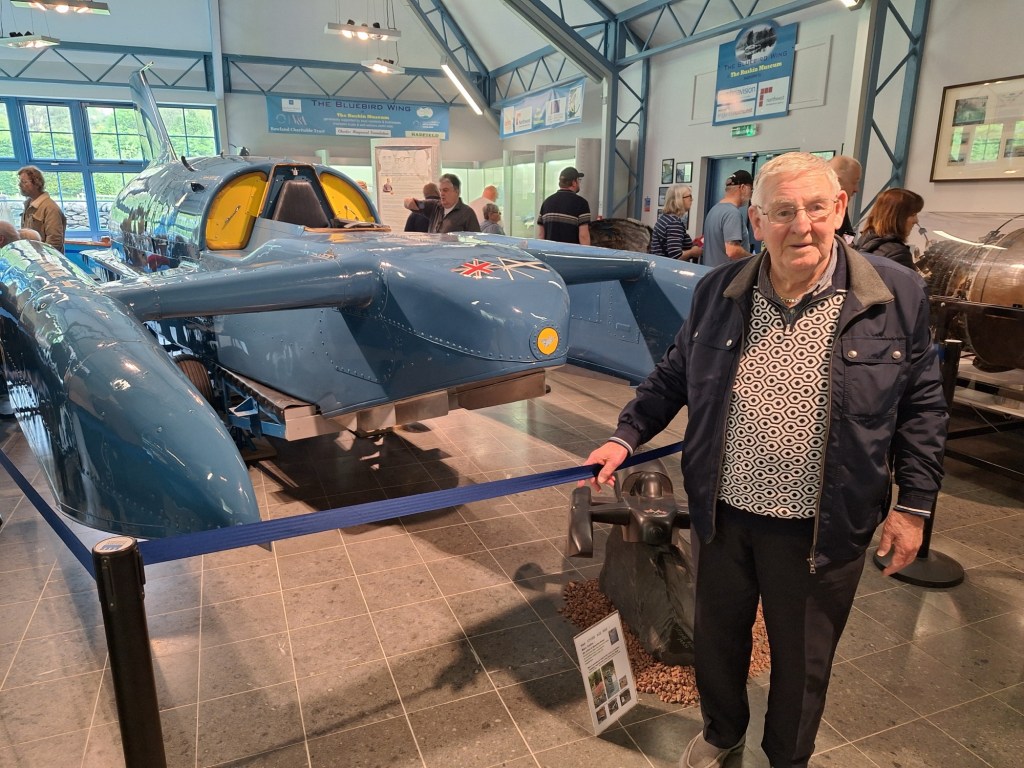
I saw Bluebird with my own eyes last year – resurrected, polished, sanctified. It was last spring, in Coniston, and I took my father. My late father. The word still sits awkwardly in my mouth, like a tooth that doesn’t quite belong.
We made a day of it, the two of us. Him shuffling gently, proudly, as if his legs understood the reverence of the occasion. We didn’t speak much. We rarely needed to. But as we stood before that cobalt leviathan, now docked and demystified, I caught the gleam in his eye – a boyhood rekindled, perhaps, or just a nod of recognition between two men who’d both lived long enough to see relics return. I remember him muttering, “Bloody beautiful, that,” as if it were a Turner or a cathedral.
And it was. Not just the machine itself, but the stillness around it. The way people didn’t chatter, didn’t selfie, didn’t dare diminish it. It was like standing at a tomb – but one that had cracked open and come back not with vengeance, but with velocity.
When I go back – and I will – it won’t be the same. I’ll look at Bluebird, and Bluebird will look at me, and there’ll be a third ghost in the dialogue. Grief has that strange ability to animate the inanimate. The machine won’t have changed, but I will. It’ll be as if he is still beside me, hands in his pockets, mumbling opinions, smiling at the engineering. I might even pretend to argue with him, just to keep the theatre of memory alive.
We always think we’re visiting objects, but often it’s the objects that are visiting us – summoning up everything we’ve buried. And that blue hull, shaped like a prayer in fibreglass, does just that. It reminds me that speed is irrelevant. That time, no matter how hard you race it, always catches you. But still – still – it’s worth the run.
So next time I see Bluebird, I’ll stand a little longer. I’ll let the silence do the talking. And I’ll remember that once, just once, I saw a glint of magic in my father’s eyes – and it was painted blue.
Update: And this week, I went back.
Back to Coniston. Back to Bluebird. Back to the lake that doesn’t forget.
I stood before that machine again – less a vehicle now, more a reliquary. The same strange reverence filled the air: part museum hush, part cathedral awe. But this time, I was alone. Not quite alone, mind you – but without the weight and warmth of my father’s voice beside me. And yet, as I stepped toward that burnished hull, the very one he stood beside last summer, I felt him. Not in any ghostly chill or sentimental hallucination – nothing quite so theatrical – but in something quieter. Familiar. As if part of him had been left behind, fused with the place, waiting patiently for me to return and pick it up.

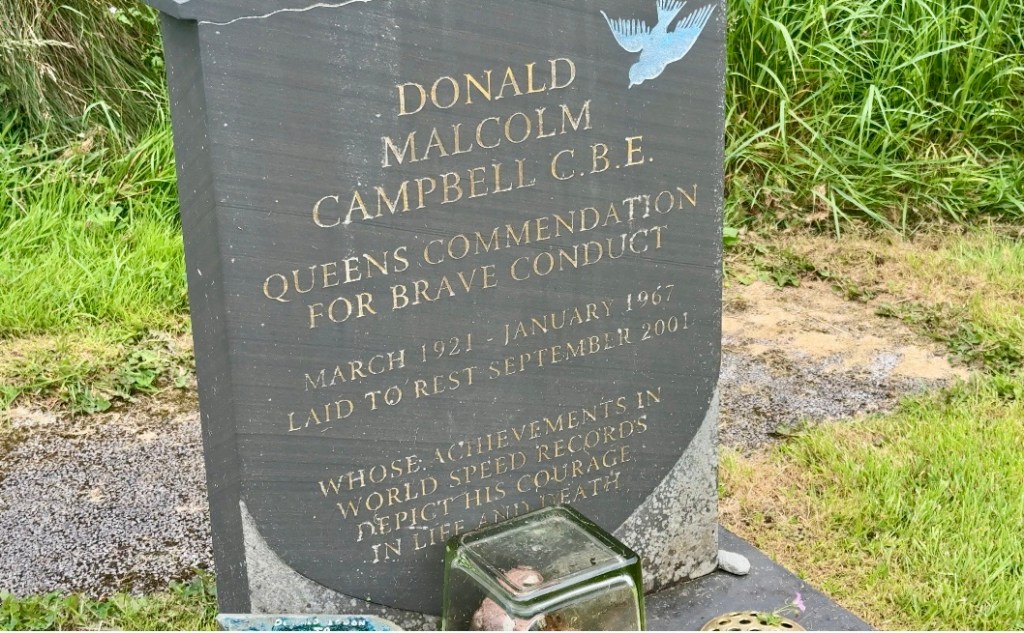
Later, I made my way to Donald Campbell’s grave.
It’s a modest thing, nestled in a churchyard that smells of lichen and old hymnbooks. Nothing garish. No roaring engines or dramatic statuary. Just a slab and a name, weathered slightly by Cumbrian rain. And yet – I found myself oddly undone. There was a small bluebird etched into the stone. Deliberate. Poetic. Fragile.
What do you say to a man like Campbell? A man who defied nature, time, and fear – all in a single, catastrophic moment? I didn’t speak. I just stood. Thought of the line from Ecclesiastes, ‘The race is not to the swift… nor the battle to the strong…’ and realised it isn’t about winning. It never was. It’s about running – however blindly, however imperfectly – toward something meaningful. Toward beauty, legacy, madness, myth.
Campbell ran. My father watched him run. And now I return, tracing their footsteps like a mourner on pilgrimage.
It struck me as I left the churchyard: both men, in their own way, died reaching for something. One for a number. The other for a memory. And here I am – somewhere in the middle – still reaching.

 Wording