I’ve never had the constitution for jazz. It makes me feel like I’m trapped in a lift with a methed-up trumpet and no discernible plot. And yet, somewhere in the post-war fug of America’s caffeine-sweating adolescence, Jack Kerouac managed to convince a generation that the meaning of life could be found in bebop, Benzedrine, and hitchhiking.
I recently revisited On the Road, that amphetamine-fuelled dirge of male friendship and motorway madness, and was reminded – painfully – that this book is less a novel and more a prolonged howl into the night from a man who’d mistaken movement for meaning.
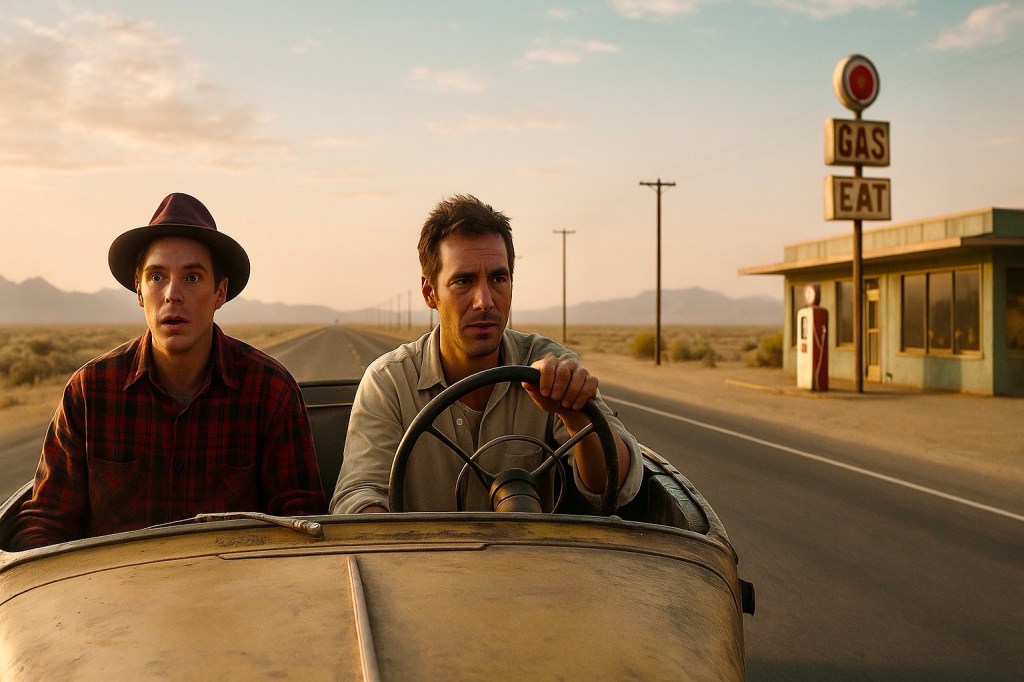
The story, such as it is, follows Sal Paradise, Kerouac’s thinly-veiled self-insert, as he careers across America in search of something – freedom, kicks, God, girls with sad eyes and no surnames, whatever the road coughs up that day. Alongside him is Dean Moriarty, a sort of Nietzschean car crash in human form, described with such obsessive reverence that one wonders if Kerouac fancied him or feared becoming him (probably both). Dean is the kind of man who turns up at 3am demanding you leave your wife and drive to Mexico. Kerouac, of course, thinks this is brilliant. I, meanwhile, would call the police.
It’s a book composed entirely of motion: Greyhounds, Cadillacs, boots slapping tarmac, jukeboxes wailing in twilight diners. Everything is going somewhere, but nothing ever arrives. There’s a frantic, throbbing need to do something – anything – but rarely a moment to think. The prose mimics this: long, sweaty sentences stumbling like a drunk across a service station forecourt. One could forgive the poor grammar if it weren’t so convinced it had discovered a new form of holy scripture. This isn’t so much ‘stream-of-consciousness’ as ‘stream-of-midnight-regret.’
And yet – and this is the maddening part – I still find it romantic. Not because I believe it, but because Kerouac believed it so much. His America is vast, mythic, and slightly mad. The petrol station is the new cathedral. The highway is a hymn. He writes with the naive ecstasy of a man convinced that just one more road trip will unlock the secret of the universe. It won’t, of course. But it might get you laid in a motel in Denver. And that, I suspect, is close enough for the Beat Generation.
There’s a kind of sadness at the heart of On the Road – not the sadness of failure, but the sadness of youth trying desperately to outrun itself. Every party ends in a grimy flat. Every friend drifts away. Dean becomes a ghost of his former mania. Sal ends up alone, vaguely wiser but still unresolved – we assume. The book, for all its shrieking joy, ends in a whimper. Like real life. Like all things, eventually.
From a sociological standpoint, On the Road is a fascinating prelude to the cultural tantrum of the 1960s. The book laid the groundwork for the idea that rebellion could be stylish, that aimlessness was a form of protest, and that the rules of polite society were a kind of spiritual constipation. It also gave us the modern trope of the ‘sad man in motion’ – a man who cannot commit to anything, so instead commits to the void. Think of every travel vlogger, Instagram nomad, or lad in a van with ‘FREEDOM’ tattooed on their shin. They owe it all to Kerouac.
As for me? I read On the Road in a static house, with a cup of tea and a deadline. I didn’t feel the need to drive west, drop acid, or lose myself in the arms of a New Mexican waitress. But I did feel, oddly, a pang of gratitude. Because for all its flaws, On the Road reminds us of a time when literature still thought it could change the world. It didn’t. But oh, how gloriously it tried.

 Wording