
Preface: Why I’m Writing This
I didn’t set out to become some kind of armchair town planner, nor do I claim to possess a degree in civil engineering, but I do possess a pair of eyes, a memory, and a moderately reliable toilet. And in recent years, all three have been sorely tested.
This piece isn’t just a tirade about architecture or the colour beige – it’s a lament for the erosion of common sense, the absence of foresight, and the slow death of joined-up thinking. I’ve watched once-quiet villages become corrugated grids of concrete, with no thought given to whether the schools, doctors, or drains can cope. The result is a sort of accidental dystopia: homes built without hope, neighbourhoods without nourishment, and services stretched so thin you could read the Daily Mail through them.
So no, this isn’t a technical briefing. It’s a personal reflection, a social commentary, and, to be perfectly blunt, a howl of frustration – because when the bog backs up and the A&E waiting time is measured in lunar cycles, it’s not just a planning failure. It’s a failure of responsibility.
And someone needs to say it. So I will.
Why Social Commentary?
This blog, as I imagined it, was meant to explore the arts – literature, painting, music, and the poetic rhythms of life. But art doesn’t exist in a vacuum. It grows in soil, often poor, sometimes poisoned, always political. And if I now find myself writing about sewage systems and school places, it’s not because I’ve strayed from the path – it’s because the path itself is sinking under new tarmac and poorly mixed concrete.
Art, after all, has always held a mirror up to society. Dickens gave us child labour and debtors’ prisons, Orwell gave us bureaucrats and boot stamps, and Hogarth painted the gin-sodden truth of London’s slums. My little contribution to this tradition is to scribble about housing estates, planning idiocy, and the slow, bureaucratic sabotage of the common good – because it is, in the end, all part of the same human play.
And if we are not to shout into the void, we might as well decorate the void with words.
There’s something faintly dystopian – almost Orwellian – about the way new housing developments now seem to spring up like fungi after rain, colonising every spare field, every green verge, every stolen paddock. Not because people shouldn’t have homes (they should), but because what’s so often missing in these ambitious erections is any serious thought for what lies beneath – or around, or even above. We are, quite literally, building over our own sewage without first asking whether the pipes can cope.
I drive past one such estate regularly. It’s a neat grid of identikit boxes, all rendered in grey. Not even a cheerful grey – not the kind that whispers of Cornish slate or fog on the moors – but a sort of haunted, municipal grey, like the colour of compromise. The homes themselves are undoubtedly ‘affordable’ (whatever that word means now), but there is no doctor’s surgery nearby, no additional school places, no upgrades to the already wheezing local bus service. The estate is a dormitory without a dream. And it’s built, as far as I can tell, over what used to be a hill, bulldozed into blankness.
The developers, of course, speak of ‘sustainability.’ That word, now so limp from overuse, is stretched thin across glossy brochures like clingfilm over rotting meat. What it usually means is that someone’s managed to stick a solar panel on a roof without bothering to check if the local GP is already seeing 3,000 patients a week. Or whether the school has any room left that doesn’t currently house a temporary cabin with mould on the ceiling.
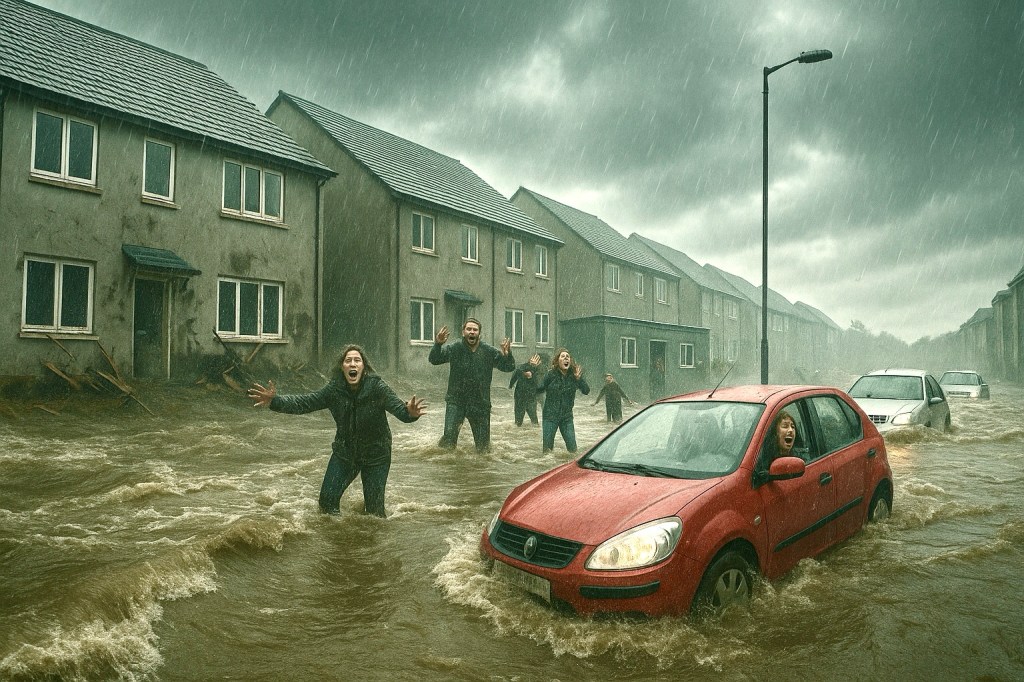
More galling still, many of these new builds are plumbed – if that’s the word – into ancient Victorian sewer systems never designed to support 21st-century flush frequency. The result is overflows, stinks, and a weary population of existing residents wondering why their bogs gurgle every time it rains.
This is the sort of planning that isn’t planning at all. It’s arithmetic – the sort done by men in offices with spreadsheets instead of maps. A thousand houses equals a certain return on investment. But no one calculates what happens when those thousand homes are occupied by actual human beings with actual bodies and needs. Who will educate their children? Who will stitch their wounds? Who will pick them up when the metaphorical roof falls in?
It’s a bit like building a theatre with no backstage, or a church with no sacristy. All performance, no structure.
Dickens, if he were alive today, would have had a field day with it – entire novels could be set in ‘Mill Row Estate’ where the fog isn’t on the Thames but coming out of a failed heat pump. Hardy, too, would have offered a tragic tale of Tess of the Two-Bed Semi, forced to walk miles to the nearest nursery while her child coughs in damp. We are, I fear, back in the realm of rural poverty in suburbia’s clothing.
And all this in the name of ‘growth.’
I don’t mean to sound like a medieval serf clutching onto his pasture, but there is something indecent about how quickly this all happens – how land is re-designated, dug up, concreted, and sold off before a single council planner has thought, “Hang on, can the water treatment plant down the road handle 4,000 more people flushing their loos?”
In truth, this isn’t just bad planning. It’s civilisational laziness. A refusal to build holistically – to build with human lives in mind, not just numbers on a sheet.
Postscript: A Tap Without a Pipe
I sometimes think we’re treating housing like it’s the only ingredient in the recipe of civilisation. As if homes can exist in a vacuum, with no need for roads, drains, shops, parks, surgeries or schools. But a home without infrastructure is just a box with a view of disappointment.
We are, in a way, flushing common sense down the very sewers we forgot to reinforce.

 Wording