It’s a while since I thought about a piece of music, so, let me remedy that. And it’s perhaps the wrong time of year for this piece, ah, but so what? I wrote this piece years ago after a freezing cold winter’s day at work. So, here we go.
There’s something altogether mad about Winter. Not the actual season, though that has its madness – cracked lips, bare trees like skeletal hands, heating bills so steep they might as well come with Latin inscriptions and a wax seal – but Vivaldi’s Winter. That manic little concerto that sounds like Jack Frost has had six espressos and a grudge.
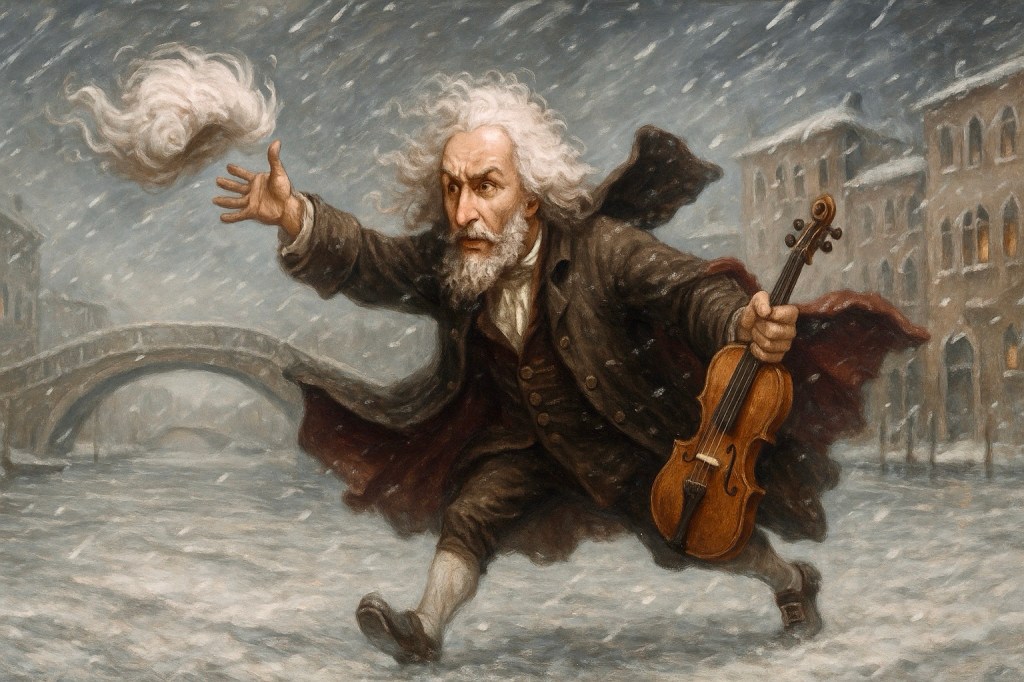
It opens in staccato – a musical interpretation of being bloody freezing. The strings chatter like teeth, and there’s a very real sense of movement across icy ground. You can almost picture someone slipping on a cobbled street in Venice, trying to retain dignity while their wig goes one way and their violin case another.
This is not the soft, melancholic winter of Thomas Hardy, nor the serene snowscapes of Wordsworth’s ‘frosty but kindly’ verse. No. This is winter as beast. Winter as attack. The kind of cold that makes you swear loudly and repeatedly as you try to open your car door with numb fingers.
I. Allegro non molto – ‘Frozen and Afraid’
The first movement isn’t so much music as it is survival. Vivaldi himself provided little sonnets for each concerto – and in Winter, he speaks of trembling in the cold, feet stamping, teeth chattering. And you can hear it: the relentless trills are like shivers, the sharp bow strokes like the icy bite of wind across exposed skin.
This isn’t decorative. It’s documentary.
If Spring is the rising sun, Winter is the slammed window.
II. Largo – ‘The Hearth, at Last’
And then – peace.
The second movement is warmth. It’s a dog asleep by the fire, a woollen blanket over frostbitten toes, a steaming mug held by trembling hands. The pizzicato in the lower strings mimics falling rain, but the melody above soothes – like watching it all from inside, the window misted with breath and the world mercifully silent.
This is the one moment in Winter where you breathe. And it’s glorious. You’ve made it home. You’ve survived the howling outer world.
It’s music you’d like to hear in a small candle-lit room, wearing slippers so thick they could double as coffins for your feet.
III. Allegro – ‘Back Into the Storm’
And then back into it.
The final movement launches us into a storm on horseback. Horses gallop over ice, wheels skid, branches snap. It’s as if the cold has teeth again. But unlike the fear in the first movement, this one is almost defiant. The rider knows the risks and charges anyway.
This is not Hardy’s winter. This is Macbeth’s battlefield. One last mad burst of fight before the year gives up its ghost.
Postscript – The Baroque Apocalypse
What I’ve always loved about Vivaldi’s Winter is its refusal to romanticise cold. So much modern winter media is cosied-up and sanitised: all hygge and hot chocolate. But Winter as composed by Signor Antonio is perilous, breathless, beautiful in its brutality. There’s majesty in danger, and something almost existential in enduring it.
Indeed, if The Four Seasons is a musical mirror of life, Winter is the dark last chapter – not quite death, but very much its prelude. A kind of memento gelum: remember you will freeze.
And yet, beneath the shriek of the wind and the slither of hooves, there’s a thread of resilience. You make it to the fire. You go back out. You ride.
Even in the most baroque of tempests… you play on.

 Wording