Photo courtesy of Morbidology (2024)
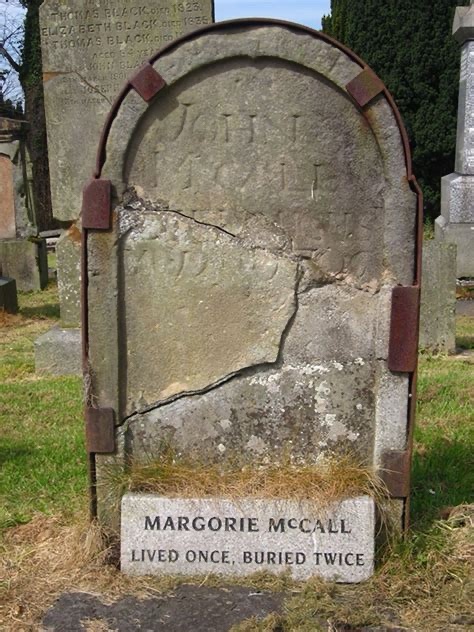
There are many epitaphs in the world that make one pause. Keats had his “Here lies one whose name was writ in water,” and Shakespeare, ever the property lawyer, threatened to curse anyone who moved his bones. But Margorie McCall of Lurgan, County Armagh, went one better – or worse, depending on how you measure your afterlife PR strategy. On her gravestone is chiselled the immortal line:
Lived Once, Buried Twice.
Now, that’s brand management. Eat your heart out, Coca-Cola.
The story is simple – or as simple as anything becomes when filtered through centuries of Irish folklore, premature burial anxieties, and an eighteenth-century undertaker whose diagnostic test for death probably consisted of shouting “Are ye dead?” into a lady’s ear before hammering shut the coffin lid. Margorie, so the tale goes, fell ill, ‘died,’ and was buried with indecent haste (this was Ireland, after all – landlords were never shy about repossessing property). That very evening, grave robbers cracked open her resting place to nick a ring off her finger. Unable to slide it off, they went for the trusty option of hacking it off – only for Margorie to wake mid-surgery.
Now, pause and picture this: you’re a petty thief, elbow-deep in someone’s grave, and the ‘corpse’ sits up and asks if you’ve tried olive oil. You’d drop your tools, soil your breeches, and probably sprint faster than any Olympic hopeful on steroids.
And thus, Margorie, having been resurrected not by Christ but by a botched robbery, toddled home, knocked on her own front door, and gave her husband such a fright that he fainted dead away. (To be fair, imagine you’ve just buried your wife and she’s back at the door, hair tousled, frock in tatters, smelling faintly of wormwood. You wouldn’t think ‘resurrection,’ you’d think ‘zombie apocalypse.’)
Now, psychologists talk of trauma, Freud of repression, and Sartre of nausea. But imagine this particular existential predicament: you die, only you don’t. You awaken in pitch darkness, inside a coffin, with damp soil pressing against you, and just when you think it can’t get any worse, a man with a rusty blade is sawing at your hand jewellery. Truly, Kierkegaard’s Fear and Trembling feels like a light beach read by comparison.
And yet, Margorie McCall provides the comic antidote to all this dread. For she became – unwittingly – the world’s first practical joke corpse. Imagine her husband at dinner parties:
“So, John, how’s the wife?”
“Well, she’s fine now. We buried her last Tuesday, but she walked it off.”
Here, of course, comes the temptation to interpret the whole affair as a minor Gospel. Lazarus, you’ll recall, had Jesus. Margorie had grave robbers with bad manners. Both rose from the grave. Both were surrounded by confused crowds. The difference being that Lazarus was hailed as a miracle, while Margorie was probably hissed at by the neighbours for turning up to her own wake and drinking her own sherry.
If St. Paul were alive, he’d have written an epistle about it: “Brethren, I would not have you ignorant concerning them which are asleep, unless, of course, they’re only pretending, in which case check the rings.”
Sociologists will tell you that folklore like this reflects a cultural fear of premature burial, widespread in the eighteenth century. Bells were installed in coffins so that ‘corpses’ could ring for service should they wake up mid-interment – there were also such things as waiting mortuaries. (Imagine being the gravedigger on that shift. You hear ding-ding-ding from below, mutter “Not again”, and put in for a pay rise.)
But Margorie’s story goes further. She becomes not merely a victim of these anxieties but a full-on legend. Her tombstone is now a tourist attraction. She’s achieved what most of us can only dream of: posthumous celebrity, without ever having written a single sonnet, painted a Madonna, or invented TikTok.
Nietzsche famously declared that ‘God is dead.’ Margorie, on the other hand, declared herself not dead, and then promptly died again some years later. Camus would have loved her: the absurd heroine who shook off the suffocating weight of the soil, only to return to the banality of housework, stew, and telling the kids not to kick the dog.
Her epitaph might as well be the motto for human existence: buried alive, resurrected briefly, buried again anyway. Isn’t that life? An endless comedy of errors between misdiagnosis and finality.
And so, Margorie McCall – doctor’s wife, premature corpse, folkloric prankster – teaches us that history is not a straight line but a farce. She lived once, buried twice, and has lived forever since as a punchline in the graveyard of human absurdity.
If ever you feel down, remember this: one day you too will shuffle off this mortal coil, but unlike Margorie, you’ll probably only get the one funeral. Unless, of course, the undertaker is as careless as her husband. In which case, do try to come back with a good story.
The Premature Burial Industry
We laugh, of course, but this was a thing. The eighteenth and nineteenth centuries were rife with tales of ‘safety coffins,’ rigged with bells, flags, or tubes for the allegedly dead to signal that they were in fact merely napping with extreme commitment. One can imagine Poe gazing at these contraptions with a mixture of relief and despair:
“Yes, splendid, I shall simply tug this bell when I awake in suffocating panic underground. Assuming, of course, that I can move. Which I cannot. Excellent.”
This is the same man who turned anxiety into architecture: The Fall of the House of Usher is basically a Gothic Airbnb where the walls sigh, the foundations crumble, and your sister claws her way out of the basement because you’ve mistaken her cataleptic fit for a death certificate. The Premature Burial goes further, reading like Poe’s private diary of neuroses: Dear journal, today I was not buried alive. Splendid. But tomorrow is another matter…
Philosophers tell us that life is absurd – Kierkegaard with his leap of faith, Camus with his rock-pushing Sisyphus. Poe, however, takes the absurd and straps it into a coffin. His ultimate horror is not the noble death, nor the heavenly release, but the bureaucratic error of being buried while still technically on the payroll of existence.
What does that tell us? That death isn’t the grand terror, but rather our fellow human beings armed with shovels and incompetence. It’s not God one must fear, but the parish doctor with his fogged spectacles declaring: “Aye, she looks a bit peaky. Best bury her.”
And yet, I can’t help but laugh. Picture Poe at a dinner party:
Host: “So, Edgar, what’s your greatest fear?”
Poe: “Oh, just being buried alive.”
Host: (sipping wine) “Ah, ha ha… wait. You’re serious?”
Poe: (staring gloomily into the middle distance) “Always.”
Meanwhile, his readers lap it up, thrilled and chilled, while Poe himself sits trembling in the corner, listening for the sound of grave bells that never rang.
Poe’s dread of premature burial was more than a phobia – it was a metaphor for the human condition. We’re all half-alive, half-dead, clawing at the lids of existence, terrified of being forgotten before our time. Only, in his case, the metaphor came with actual fainting fits and the very real danger of waking up beneath six feet of sod.
Margorie McCall, of course, beat him to it. She lived his nightmare – and then turned it into a farce. Where Poe screamed in gothic prose, Margorie simply rolled her eyes, brushed the dirt off her frock, and asked for supper.
Perhaps that’s the true moral: the poets imagine coffins, the Irish climb out of them.

 Wording