When I first took up Hardy’s A Pair of Blue Eyes, I braced myself for the usual experience: a young woman falls in love, society disapproves, a man dangles from a cliff, and everyone ends up in a metaphorical ditch by chapter thirty. Hardy’s nothing if not consistent. He’s the grim reaper of literature – always punctual, always overdressed, and always turning up at the end of the novel with his scythe polished and ready.
Here, though, we meet Elfride Swancourt: bright, naïve, and possessed of the sort of ‘pair of blue eyes’ that set men babbling poetry at her like leaking fountains. Hardy might as well have titled it Fifty Shades of Blue, but Victorian publishers were squeamish.
Two suitors appear. First, Stephen Smith: an architect’s assistant with a decent brain and no pedigree, who spends most of his time trying to look respectable while his social betters look at him as though he’d tracked mud onto the Persian rug. Second, Henry Knight: a pompous man of letters, who has that peculiar Victorian ability to turn every compliment into a sermon. Knight’s the sort of chap who, if you told him you liked the sunset, would respond with a 400-line sonnet beginning, “Ah, but dost thou comprehend the solar decline?”
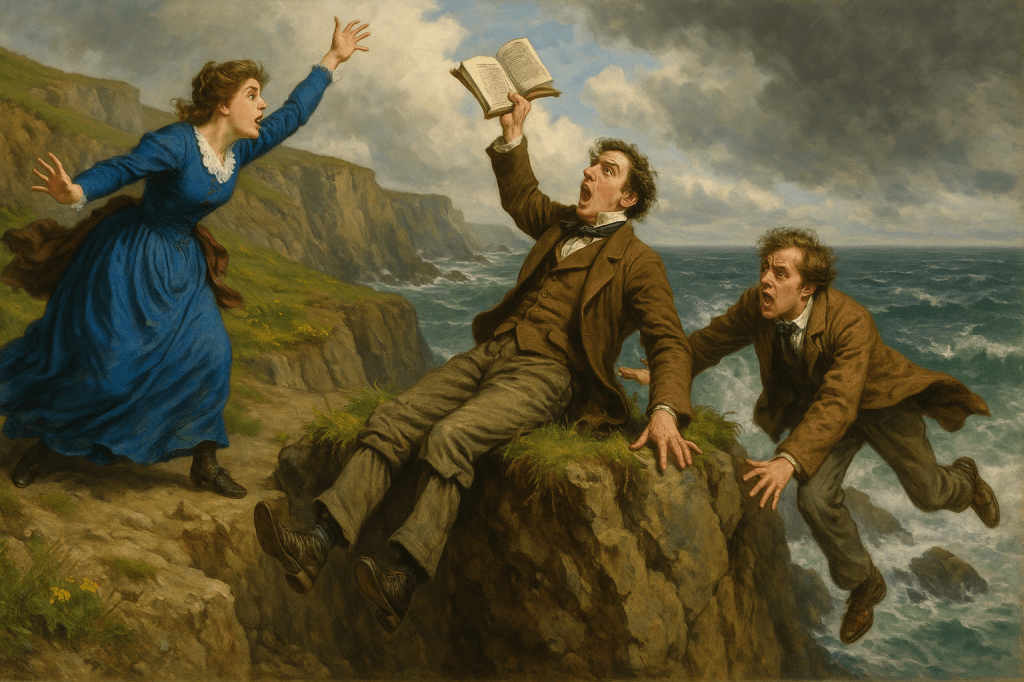
Now, the famous scene: Knight hanging by his fingertips over a Cornish cliff. This is Hardy’s great party trick, the moment that makes the novel. Dangling over eternity, what goes through Knight’s mind? Not, “I wish I’d eaten fewer scones this morning.” Not, “Tell Elfride I loved her.” No – he starts philosophising about fossils. There he is, seconds from plummeting to his doom, and his last thoughts are: “Ah! Behold, a trilobite! How exquisitely stratified!” Truly the mark of an intellectual: even as you’re about to die, you’re still writing a journal article in your head.
Elfride, meanwhile, does what Victorian heroines do best: she swoons, gasps, and emits dialogue so melodramatic it could curdle milk. I can almost hear her crying out in iambic pentameter:
“O Knight, O Knight, unhand thy crumbling ledge,
Thy fingertips are slipping from the edge!
And shouldst thou fall, the cliff thy bones shall bruise,
A tragic fate – all thanks to Hardy’s muse.”
Stephen, bless him, is hardly better. His solution to every crisis is essentially “Work harder, be respectable, and maybe one day the vicar will stop looking at me as if I’ve stolen the communion wine.” He’s like a Hardy-version Job: endlessly hopeful, endlessly kicked in the teeth.
But the comedy – oh, the comedy – is Hardy’s sly gift to us. The whole novel’s a satire on class and snobbery: Stephen isn’t good enough, Knight’s too good (or at least thinks so), and Elfride’s trapped between them like a hare caught between two pompous foxes reciting Latin. The Victorian obsession with ‘rank’ is everywhere; one half expects a butler to appear, measuring skull sizes with calipers and declaring, “Yes, madam, I regret to inform you: Stephen is three phrenological bumps short of eligibility.”
And of course, being Hardy, none of this ends well. The ‘pair of blue eyes’ are less windows to the soul than target practice for social hypocrisy. Elfride’s beauty becomes her curse; the men’s pride becomes their downfall; and we, the readers, are left to laugh hollowly, pour another whisky, and wonder if Hardy ever once went to a wedding without muttering, “It won’t last.”
So what’s A Pair of Blue Eyes really? It’s Hardy’s early experiment, a gothic melodrama dressed as a love story, with the fossils of modern existentialism poking through the Victorian soil. It’s both tragic and ridiculous, earnest and absurd. It makes you laugh, then sigh, then laugh again – because Hardy knew the cosmic joke: that life itself is one long cliff-hanger, and none of us make it to the final chapter without letting go.

 Wording