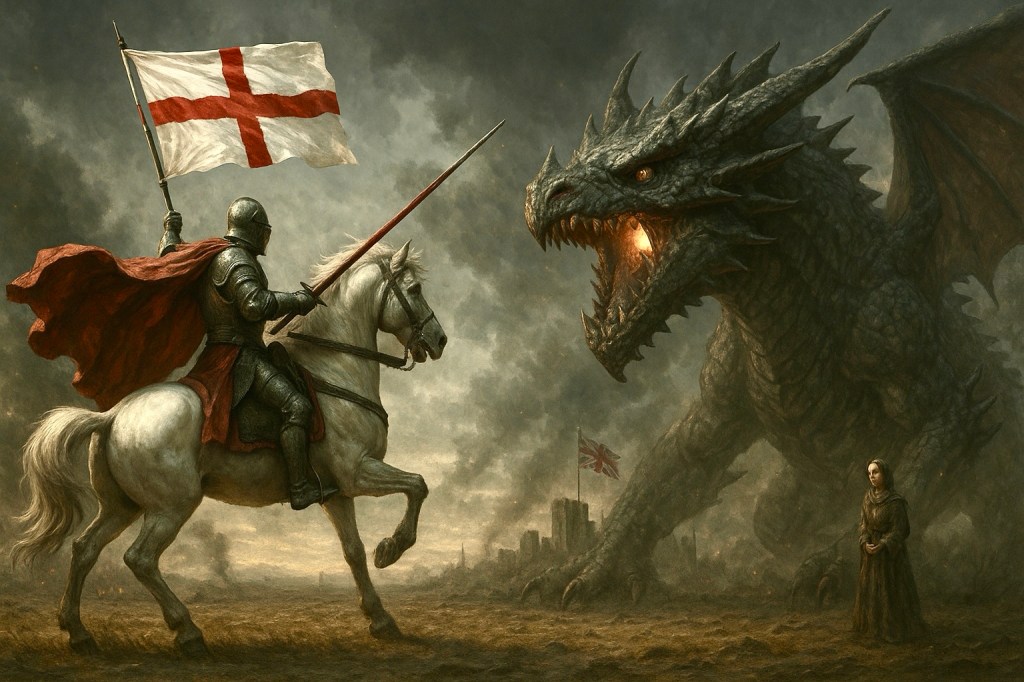
There he stands – or rather, rides – our St. George, spear braced, horse rearing, dragon writhing beneath (featured image below). It’s an image both timeless and terribly timely. Though centuries have passed since this tale was first illuminated in parchment or carved into stone, its symbolic force remains more urgent now than ever.
For St. George is no mere storybook knight. He’s the archetype of courage in the face of chaos, the emblem of order where there’s disarray, and the patron of England precisely because his myth embodies a truth our people once understood: that civilisation survives only when men and women of faith, loyalty, and conviction are willing to confront the dragons of their age.
And what are dragons, if not the eternal embodiment of destruction? They devour, they poison, they sow terror. In Beowulf, the dragon is the final adversary, hoarding wealth while the land decays. In Revelation, the dragon is Satan himself, cast down from heaven yet waging war on the saints. In every mythology, the serpent or dragon is the adversary – the deceiver, the corrupter, the despoiler. In every age it assumes new forms. Today, the dragons are not scaled beasts but bureaucracies without souls, ideologies without roots, and mobs without shame.
St. George, by contrast, isn’t only a knight but also a standard-bearer. He raises the cross of Christ, that red cross on white field which became our flag – the banner of a people who once carried their faith into every battle and their honour into every covenant. That red cross has flown over fields from Agincourt to El Alamein, and still it waits to be raised whenever the nation remembers itself.
We forget, too often, that George never set foot on this soil. He was a Cappadocian soldier, martyred for refusing to bow to pagan idols. Yet England adopted him because his myth carried what mattered: a man who didn’t yield. A man who raised his standard and fought, not for riches, not for vanity, but for faith and for people. Is this not what we need again?
Shakespeare put it best in Henry V, when he has the king cry, “Cry God for Harry, England and Saint George!” It was never merely a literary flourish. It was the invocation of a spiritual reality: that the nation must unite under the cross, under courage, under conviction. That only then does the dragon fall.
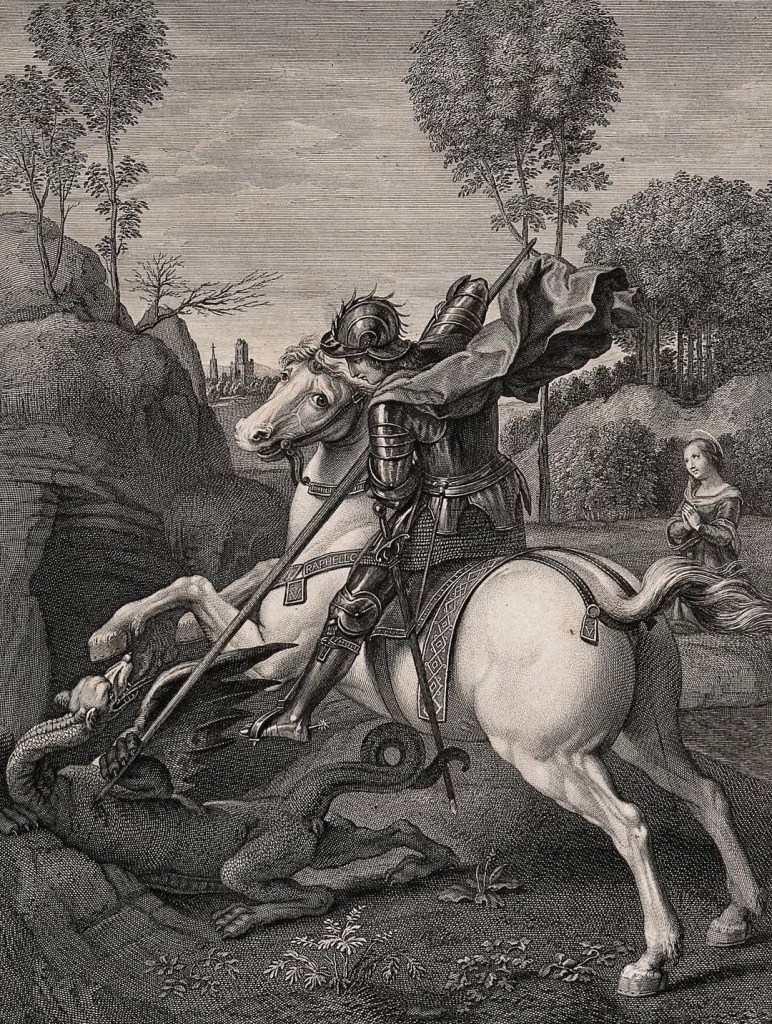
St. George and the Dragon, after Raphael; steel engraving by Nicolas de Larmessin III, c. 1729–1740.
Look closely at the engraving and you see the maiden in the background, watching, praying. She’s not passive decoration – she’s the community, the land, the tradition, the vulnerable inheritance. She represents all that’s at stake. Without George, she’s devoured. With him, she’s preserved. So too with us: our land, our faith, our culture, our very future – these are the maidens awaiting our defence.
And what of the lance, that weapon piercing the beast’s throat? It’s more than sharpened steel. It’s the symbol of resolve, of clarity. For the lance isn’t swung wildly but directed, aimed, guided with precision. A nation that wishes to survive must know its target: not wasting its strength in petty squabbles, but striking at the dragon’s heart.
The state of our country today makes this image almost prophetic. We face a dragon of our own – chaos masquerading as progress, corruption veiled as compassion, and an elite who sneer at patriotism while fattening themselves upon it. The patriot’s duty is to raise the colours, not in nostalgia, but in living defiance. The cross of St. George is no museum relic. It’s the battle flag of a people who refuse to be devoured.
For Scripture reminds us: ‘Resist the devil, and he will flee from you.’ (James 4:7). But resistance requires action. Mere lamentation won’t do. As Chesterton quipped, “The true soldier fights not because he hates what is in front of him, but because he loves what is behind him.” That’s the ethos of St. George. That must be the ethos of us all.
So let the engraving hang not as art on the wall but as a mirror to our souls. Each of us is called to be George – to take up the lance of conviction, to raise the colours high, to face down the dragons of our time without fear. For if we don’t, then the maiden’s lost, the land’s poisoned, and the cross itself is trampled underfoot.
But if we do – if we raise the colours with pride, fight with clarity, and endure with faith – then the dragon shall fall once more. And like that white horse rearing in triumph, England will rise again.

 Wording
Oh man, you’re an Oxford comma guy aren’t you?
Yes, when I remember! 😁 It removes ambiguity.