History, we’re often told, is written by the victors. But in the BBC’s latest offering, King & Conqueror, history is rewritten by screenwriters who appear to have skimmed a Wikipedia stub, lit a few candles in a cowshed, and declared themselves medievalists.
The premise was promising. Harold Godwinson versus William the Bastard – England’s last great stand before the long shadow of Norman rule. A tale brimming with ambition, betrayal, papal politics, Viking incursions, and enough genuine bloodletting to satisfy even the most gore-hungry audience. Instead, what we were served was a lukewarm stew of misremembered facts, bargain-bin costumes, and dialogue so muffled I half-suspected everyone was gargling mead.
The sets resembled not the grand halls of Wessex or Normandy but a damp farmhouse in County Durham, where one half expects the Antiques Roadshow to pop in and appraise the wrong goblet. Not a tapestry in sight, not a single carved panel, just bare walls and modern-looking leather. To paraphrase Eliot, “this is the way the world ends – not with a bang but a whimper,” or in this case, with a flatpack medieval interior.
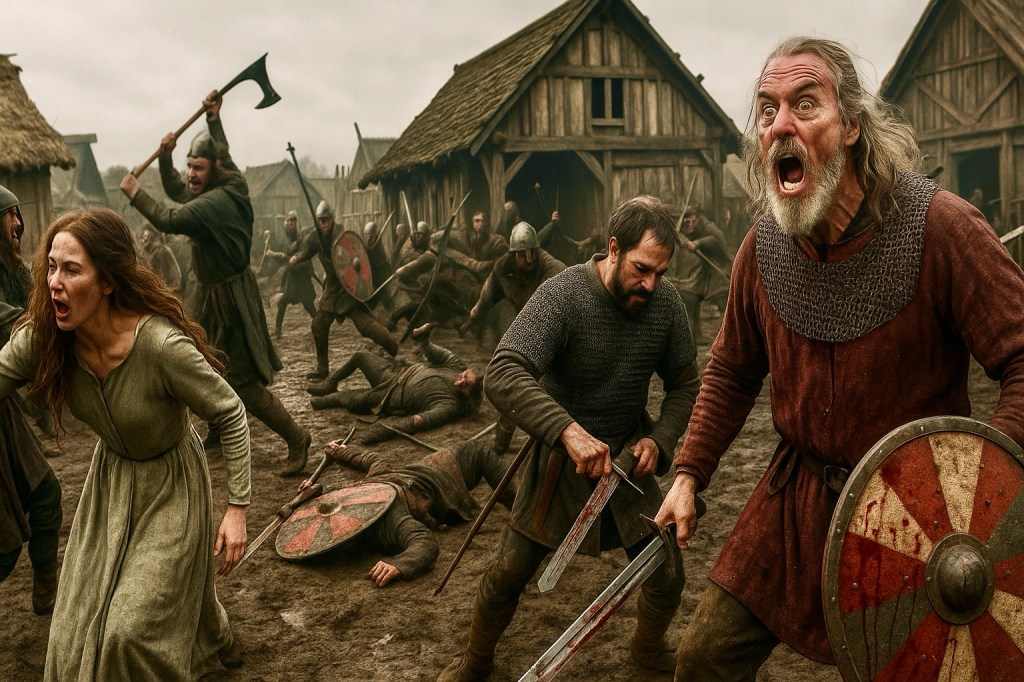
And the costumes – sweet heaven! The noblewomen strut bareheaded, free as Glastonbury revellers, while the men shuffle about looking as if they’ve been dressed by an overzealous LARP club. Harold sheathes his sword with blood dripping from the hilt, which would corrode the blade in minutes – though perhaps he hoped to save on polish.
Then came the crowning insult: Edward the Confessor transformed into a sort of medieval Norman Bates, personally doing away with his mother, Emma of Normandy. This isn’t merely inaccurate; it’s an act of historical desecration. The real Emma died quietly in Winchester, having lived through more dynastic drama than Shakespeare could shake a quill at. Yet here, she’s dispatched like a soap-opera extra, no doubt for the cheap thrill of an episode-ending gasp.
As for William himself, he bellows for Harold to fight him man-to-man at Hastings, clad in an outfit that would shame even a Halloween hire shop. The real Duke of Normandy – the illegitimate son who clawed his way to power – would have laughed this cardboard cut-out off the battlefield before skewering him with administrative efficiency.
What we’re left with is neither history nor fantasy but a confused muddle, lurching from dim-lit melodrama to muddy battle scenes with all the coherence of a drunkard’s chronicle. Even the critics, usually generous to the BBC, have joined in the chorus of despair. The Financial Times called it a “royal mess,” and for once the pink pages spoke plain truth.
I forced myself through the first episode and staggered into the second, more out of morbid fascination than genuine interest. Watching this series is like attending a badly reconstructed medieval banquet: the meat’s raw, the wine sour, and the jester depressingly unfunny – yet one persists, hoping the next course might redeem the experience.
Perhaps the BBC wanted to chase the Game of Thrones crowd, but in doing so they forgot that the Battle of Hastings was already more dramatic than anything George R. R. Martin concocted. When you can’t outdo reality, the answer’s simple: tell the truth well.
Alas, the truth was the first casualty here. The second was entertainment.

 Wording