Some creatures exist twice: once in the flesh, once in the imagination. Wolves, lions, demons, politicians – take your pick. In the wild hills of Gévaudan between 1764 and 1767, one such double-lived beast stalked the countryside. To the peasants it wasn’t simply a wolf, but la Bête – a monster, a terror, and an omen. By the time it was finished, more than a hundred lives had been ended and an entire region traumatised. Yet what’s fascinating isn’t merely the tooth and claw, but the way a frightened people embroidered fact into folklore, and fear into psychology.
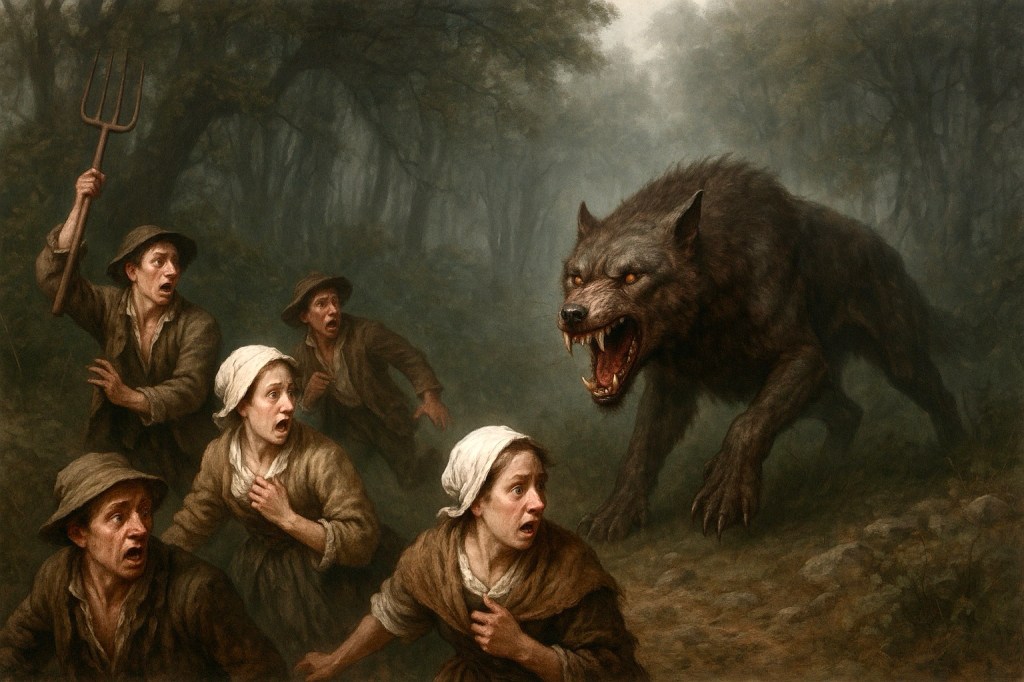
Contemporary reports describe the Beast as ‘as large as a calf,’ with reddish hair, a head like a boar, and a tail like a serpent. Survivors swore it moved with preternatural cunning: avoiding armed men, preferring women and children, striking with surgical cruelty at the throat. If it was a wolf, it was a wolf in need of a literary agent. There’s almost something Wildean in the exaggeration – the truth dressed in theatrical costume. A wolf may kill to eat; but the Beast seemed to kill to perform.
The peasants of Gévaudan were steeped in folklore. The forests were populated not just with wolves but with devils, revenants, and punishments from God. The Beast thus slotted neatly into an existing mythology. Priests thundered that the attacks were heaven’s judgement; balladeers whispered that it was a werewolf. To live in such a world was to see nature as moral theatre: every snapped branch might herald Satan, every howl at night a trial of faith. Voltaire, with his Parisian sneer, mocked such credulity – but from a psychological point of view, the folk imagination gave meaning to chaos, and meaning, even terrible meaning, is easier to bear than randomness.
But the Beast also had a political career. News of each attack made its way to Versailles, where Louis XV dispatched soldiers, dragoons, and royal wolf-slayers. They all failed. Imagine the monarchy, which could command armies, humbled by a single animal in the provinces. The ridicule was inevitable: the king couldn’t protect his peasants from a beast, nor his throne from mockery. One might almost say the Beast of Gévaudan gnawed at the roots of the ancien régime before 1789 ever arrived.
Carl Jung would later call it the Shadow – that dark aspect of the psyche we project outward when it becomes unbearable within. The Beast was precisely this: an externalisation of dread. To the villagers, their own poverty, hunger, and helplessness acquired fur and teeth. By naming the darkness ‘Beast,’ they could face it with musket and prayer, rather than sink into despair. Modern psychologists would say hysteria played its part, each retelling swelling the horror, each mutilation proving the legend. It’s the same psychology that makes urban myths thrive today: we feed our fears by giving them form.
In 1767, Jean Chastel killed what was proclaimed to be the Beast – with a silver bullet no less, blessed by a priest, as though reality were auditioning for Gothic fiction. And yet, accounts differ; some say attacks continued. The ‘real’ Beast may have died, but the legendary Beast lived on. It had, by then, become too useful – an emblem of divine wrath, of political incompetence, of the wildness always pressing at civilisation’s edge.
Perhaps the true terror of Gévaudan is not that wolves kill – wolves always have – but that human beings, when afraid, give their fear a face and let it stalk them. The Beast of Gévaudan was both predator and projection, fang and fable. Even now, it lingers, not in forests but in our need to explain evil. Every time a society whispers about hidden dangers, outsiders, or conspiracies, it resurrects the Beast.
And so the lesson is Wildean in the truest sense: the truth is rarely pure, and never simple. A wolf may have taken lives, but men gave it a legend. In the end, the Beast was less about blood on the grass than about the darkness in men’s minds – red in tooth, claw, and imagination.

 Wording
This story sounds electrying full of suspense. Wonderful, Robert.
That’s lovely of you to say, Hazel. I hoped it would carry a bit of a spark.