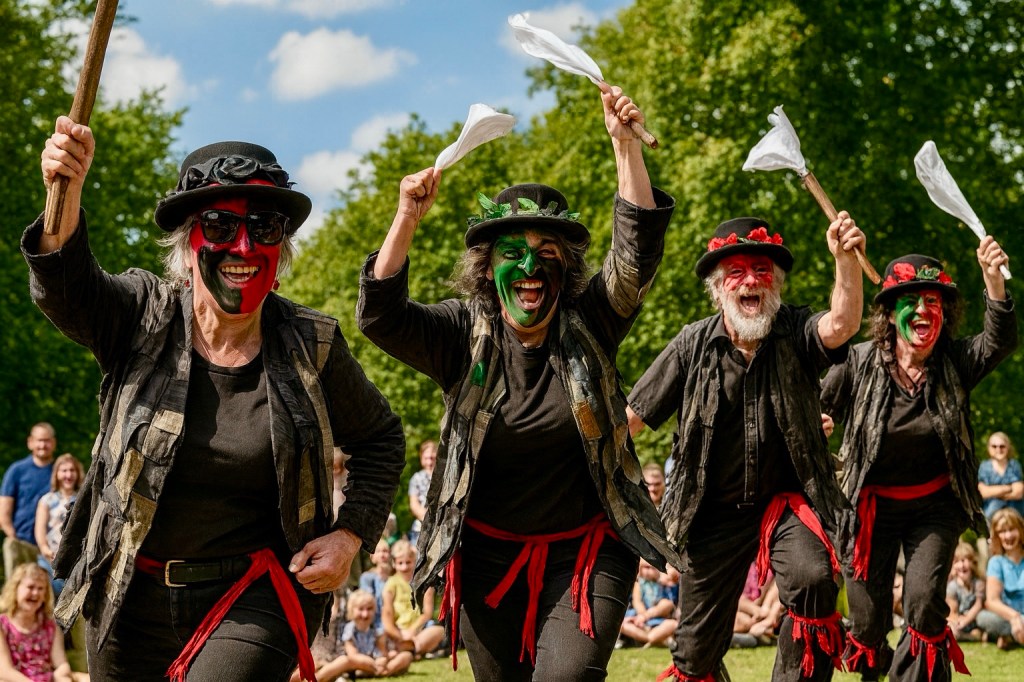
There’s nothing quite so peculiarly English as Morris dancing. Only in this island kingdom could the populace collectively decide that the best way to summon spring, frighten away demons, and cheer up the neighbours was to strap bells to one’s shins, wave hankies in the air, and smack one another with sticks. It’s both sublime and ridiculous – like Shakespeare performed in wellington boots, or a sermon delivered with custard pies.
The history is an untidy mixture of medieval guild processions, Tudor court masques, and rustic field frolics. By the fifteenth century, the ‘Morys daunce’ was already earning mentions in civic accounts, which suggests that even then local treasurers had to endure the awkward business of paying men in tatters and bells to leap about the marketplace. Some say the name comes from ‘Moorish’ – though I suspect it was less about North African elegance and more about English villagers thinking, “Well, that looks foreign, let’s have a go.”
And so it became a fixture of May Days and Whitsuns, of ale feasts and summer revels. The characters multiplied like rabbits: the Fool, with his bladder on a stick, poking fun at the crowd; the Hobby Horse, a pantomime beast galloping about to general bewilderment; the leafy Green Man, half-fertility symbol, half-garden shrubbery. All of it carried on until the Puritans, who disapproved of fun in principle, tried to stamp it out. Thankfully, the dance survived, staggering into the nineteenth century where Cecil Sharp and his folklorist cronies revived it – blowing the dust off old fiddles and insisting that England must never be without its hopping, hanky-waving heritage.
And speaking of survival, we must tip our hat to Victoria Hall – the grande dame of performance and the oldest music hall still standing in England. Imagine her, seated in her brick-and-stone finery, having watched over generations of laughter, gasps, applause, and the odd flying tomato. If Morris dancing is the clown prince of English custom, Victoria Hall is the matriarchal stage upon which such jollity finds its home. She’s outlived monarchs, governments, and entire fashions in facial hair. If walls could talk, hers would sing madrigals, recite Shakespeare, and possibly complain about the smell of spilled porter.
This past summer, she and her bell-decked cousins in the village squares have given us what we needed most: pleasure. Not the shallow pleasure of scrolling a screen until one’s thumb seizes up, but the deep communal pleasure of gathering in the flesh, hearing live music, watching dancers risk a sprained ankle for tradition’s sake, and laughing at the absurdity of it all. For a moment we remember that life isn’t only about earning or spending, but about ritual, theatre, and togetherness. Ecclesiastes may remind us that there’s ‘a time to weep, and a time to laugh,’ but Morris dancing, I think, does both simultaneously.
So let’s celebrate this comic survival: the jangle of bells, the swish of hankies, the venerable bricks of Victoria Hall echoing with merriment. For in these things lies the England we secretly love – slightly bonkers, stubbornly joyful, and always ready to bring a smile, even if it comes with a sprained calf muscle.

 Wording