“We’ll all be free and we’ll all think alike, as a free people does; and them that don’t won’t be allowed to think different.”
What an epigram of our age – though spurious in origin, it speaks truer of our times than many a sanctioned sermon. We needn’t trouble ourselves with the dull bibliographies of attribution; whether T. S. Eliot penned it or some later wag conjured it in the backroom of satire, the line gleams with the paradox that Oscar Wilde loved above all things: liberty as uniformity, thought as compulsion, dissent as unthinkable.
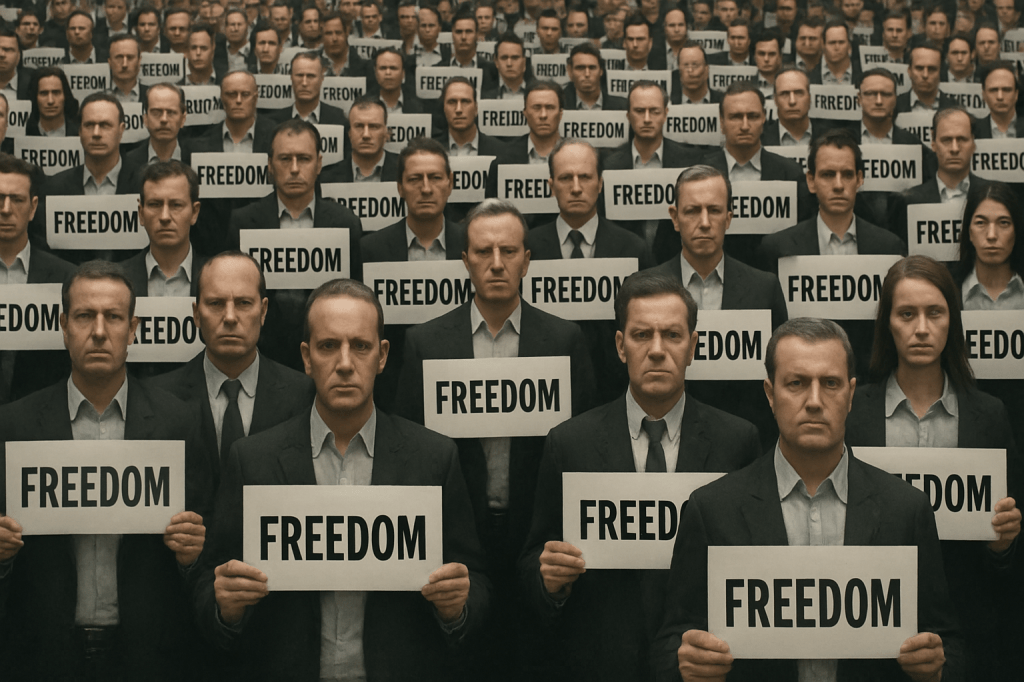
We moderns, like the chorus in The Rock, kneel before our idols of democracy with the same genuflection that earlier ages offered to the golden calf. ‘Freedom’ has become the most tyrannical word in our political catechism. We are free, yes – but only to repeat the slogans, the hashtags, the approved morality plays of the moment. The freethinker isn’t the one who thinks differently, but the one who thinks exactly as the approved collective does. It’s the paradox of liberty transformed into etiquette.
History, as ever, provides grotesque examples. The French Revolution lopped off heads in the name of fraternity, much as Soviet Russia sent millions to Siberia in the name of universal equality. Wilde himself, languishing in Reading Gaol, knew that a society can parade its liberal virtues by day and chain its scapegoats by night. The Ballad of Reading Gaol is less about one murderer swinging on the rope than about the collective lust for moral cleansing – the mob uniting under the pretext of virtue, thinking alike in cruelty.
Philosophy’s no gentler. John Stuart Mill in On Liberty warned that ‘the tyranny of the majority’ could crush thought more effectively than any monarch. Nietzsche, with his characteristic snarl, called it the ‘herd instinct.’ Even Kierkegaard, that melancholy Dane, insisted that ‘the crowd is untruth.’ Yet here we are, still believing that we’re most ourselves when we’re most identical to others.
Psychology adds a darker flourish. Freud’s analysis of group psychology shows how easily the ego dissolves into the mass, how liberating it feels to surrender responsibility and merge with the collective superego. I recall Milgram’s electric shocks or Zimbardo’s mock prison: the frightening ease with which ‘ordinary’ men and women become enforcers of conformity, eager inquisitors for the faith of sameness.
But let’s not grow too grave. There’s comedy in the spectacle, as there always is when human beings insist they’re free. I picture the scene: a parliament of parrots, each squawking ‘liberty!’ in perfect synchrony; or a congregation where everyone bows in unison, muttering, ‘I am an individual.’ It’s Wilde’s aphorism inverted: ‘Be yourself; everyone else already is.’
The irony, of course, is that true freedom requires difference. The Bible’s Tower of Babel story – often read as a curse – might better be seen as a blessing. For without linguistic confusion, without the diversity of voices, there’s no art, no philosophy, no Wilde. Homogeneity may feel safe, but it produces nothing but grey walls and grey souls.
So, whether Eliot wrote the line or not, it’s the perfect modern beatitude: blessed are the conformists, for they shall inherit the committee. And cursed are the dissenters, for they shall be ‘de-platformed.’ Yet Wilde, that saint of paradox, whispers across the ages: it’s only the disobedient thought that’s ever worth having.

 Wording
Is that what you really think the Tower of Babel was about?
I wasn’t saying Babel is a blessing in the strict biblical sense – more that I like to read it a little upside-down. Usually it’s seen as a curse, but the scattering of languages actually gave us difference, and difference is what makes art, philosophy, and individuality possible. If we all spoke and thought the same, the world would be as grey as a tax office on a Monday morning. Babel, in that sense, ensured variety – and that variety is where true freedom, and a little colour, comes from.
Some Jewish and Christian commentators have suggested God’s intervention was also protective – stopping humanity from becoming a uniform, totalitarian bloc. The scattering leads to cultural diversity, which can be seen as a gift as well as a judgment.
I hope that makes sense – it’s the early hours here and my brain is beginning to fog! 😁
Thanks for explaining.
I’ll probably be asking questions like this throughout my time of following you 🙂
You’re welcome. I may not always be able to answer them though. I’m certainly no expert.
I’ve been writing short pieces on every book in the Old and New Testaments, and I’m sure there’s lots I don’t quite understand – I’ve got piles of notes from over the last twenty years or so. May have to make a separate page though.