Being a Remembrance of his Misnamings, Quirks, and Misadventures
Set forth in his own crack’d tongue, with a Preface from our world
‘For now we see through a glass, darkly; but then face to face.’
— 1 Corinthians 13:12
When I was a youngster, Catweazle was one of my favourite programmes – part comedy, part fairy tale, part gentle tragedy. I think I loved it because it made the ordinary strange again. The things that grown-ups took for granted – a telephone, a light switch, a motorcar – were turned back into objects of mystery, as though we were seeing the world with fresh eyes. And perhaps that’s why I’m writing this now: not only out of nostalgia for the crooked old wizard himself, but because in a world that has become weary with its own cleverness, we need to recover that sense of wonder.
Some characters never die because they were never truly alive in the first place, at least not in the way that taxmen and undertakers would recognise. They belong instead to that hinterland between fairy tale and forgotten lane, where the dusk settles upon hedgerows and the owls complain at the moon. Catweazle was one such. A conjurer from the wrong century, hurled into ours by a misfired spell, he blundered about the twentieth century naming things as if Adam had just been let loose again in Eden.
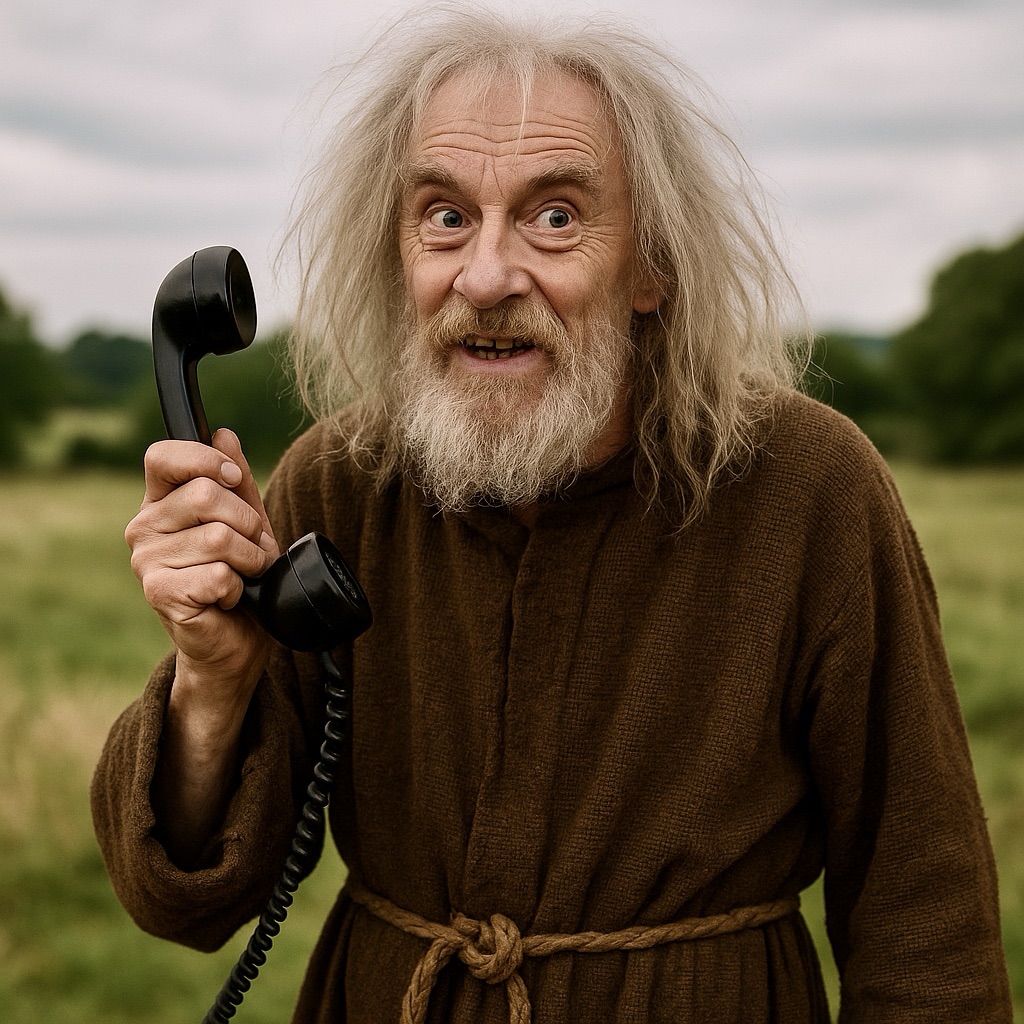
To him, the telephone became the Tellingbone – an oracle that whispered voices from the void. Electricity was Electrickery – the devil’s bottled lightning. A motor-car, all hissing pistons and petrol breath, was the Iron Horse, galloping without flesh. These were not misnamings, but baptisms: each a reminder that the world’s still strange if we only have the courage to look askance.
Catweazle’s genius was his folly. He was what Chesterton once said of the madman: not that he’d lost his reason, but that he’d lost everything except his reason. Yet in that loss, in that laughter-soaked bewilderment, he rediscovered wonder. He revealed what Eliot called ‘the still point of the turning world,’ that ancient pause where time itself looks over its shoulder and remembers the poetry it once spoke.
And now, let the old wizard himself shuffle forward – beard tangled, eyes glinting like two stolen candles – to tell his own tale. Don’t mock his babblings, for behind them lies more sense than in all the polished technocracies of our age. As Ecclesiastes sighed, ‘The eye is not satisfied with seeing, nor the ear filled with hearing.’ But Catweazle, in calling the thing by a stranger name, satisfied both.
Come then, and hear him. For he has much to tell – though his words be crooked, his truth is straight.
The Farewell of Catweazle
I am Catweazle, son of another age, marooned upon thine iron shore. I was born in the shadow of the Norman’s lash, when kings smote with sword and saints smote with psalm, and yet – by mishap and mis-enchantment – I awoke in a land where dragons had been yoked into carriages and the sun itself stuffed into bottles. The folk call it the twentieth century, but to me it’s a dream made of thunder.
How was I to name such sorceries? The telephone was no mere thing of brass and wire; to mine ears it was a Tellingbone, a rib plucked from the skeleton of some titan, humming with voices of the far-flung dead. The candle that burned without wick I dubbed Electrickery, for surely trickery it was – Lucifer’s flame strung through walls. The horseless cart I christened the Iron Horse, though it had no hide, no hoof, and yet galloped faster than Odin’s steed Sleipnir. The box that showed living shadows I called the Magic Eye, and I feared it as one fears a sorcerer’s mirror, for it betrayed all secrets yet told no truth.
I laughed, aye, but trembled also. For what is the twentieth century but an unwitting conjuration? Men of thine age scoff at spells, and yet they live in them. Dost thou not see? The very air is haunted with invisible voices, coursing through the ether like Ariel himself. Lights spring from switches as if Puck had flicked them with mischievous thumb. Time is devoured by the Time Dragon that roareth along its rails. Truly, Prospero himself would have burnt his books in shame, seeing what enchantments ye commoners now wield.
Yet I, poor Catweazle, with my frogs and my charms, my chants of ‘Salmy-dorum, Dorem-salmy,’ was mocked, and rightly, for I grasped not the grammar of your new sorcery. My Latin could not tame the telephone. My runes bent no radio waves. Even my trusty familiar, Touchwood the toad, blinked in befuddlement when faced with the bright glass of your television screen.
And still – still I loved it. For what is a wizard if not a poet who stumbles? Did not Dante descend into the inferno with Virgil for guide, naming horrors that others could not? Did not Shakespeare’s fools utter truths clothed in nonsense? And did not Ecclesiastes warn, ‘Of making many books there is no end; and much study is a weariness of the flesh’? Even so, I weary of your gadgets, yet rejoice in renaming them. For in every mis-naming lies revelation. The world grows strange again, and to see it thus is to be a child, or a prophet.
I was a fool of time, yet in mine own folly I glimpsed eternity. A light-switch is a wand. A telephone is necromancy. A car is a dragon tamed. And when men scorn such names, it is only because they have forgotten their wonder.
So remember me kindly, thou children of thine own electrick age: the ragged man who called the future by its true names. For though my beard be grey with cobwebs and my robe patched with nettle-stings, yet in every mis-spoken word there burned a little magic. And who knoweth? Mayhap in centuries yet to come, when thine own iron wonders have rusted into dust, some other poor wizard shall stumble into another world and say, in awe and in terror: ‘What manner of Tellingbone is this?’
Colophon
This Book of Catweazle was set forth in no known type, but scratched with a rusty nail upon parchment filched from a monk’s cellar.
Printed by goblins under a waning moon.
Bound by toads, stitched with cobweb, and blessed (or possibly cursed) with frog-spittle.
The ink was brewed from nettles, crow-feathers, and the sorrow of owls.
Finished in the year of Our Lord knows when,
in the season of falling leaves,
at the hour when the Tellingbone did shriek most fearsomely.
Here endeth the Book.
Salmy-dorum, Dorem-salmy.

 Wording