f you ever wake up in the morning and think, ‘Life would be so much better if everyone behaved exactly the same,’ then I recommend you either take a cold shower, or read Yevgeny Zamyatin’s We. For here’s a book that takes the notion of a perfectly ordered society and runs it to its logical conclusion – namely, that it would be perfectly ridiculous.
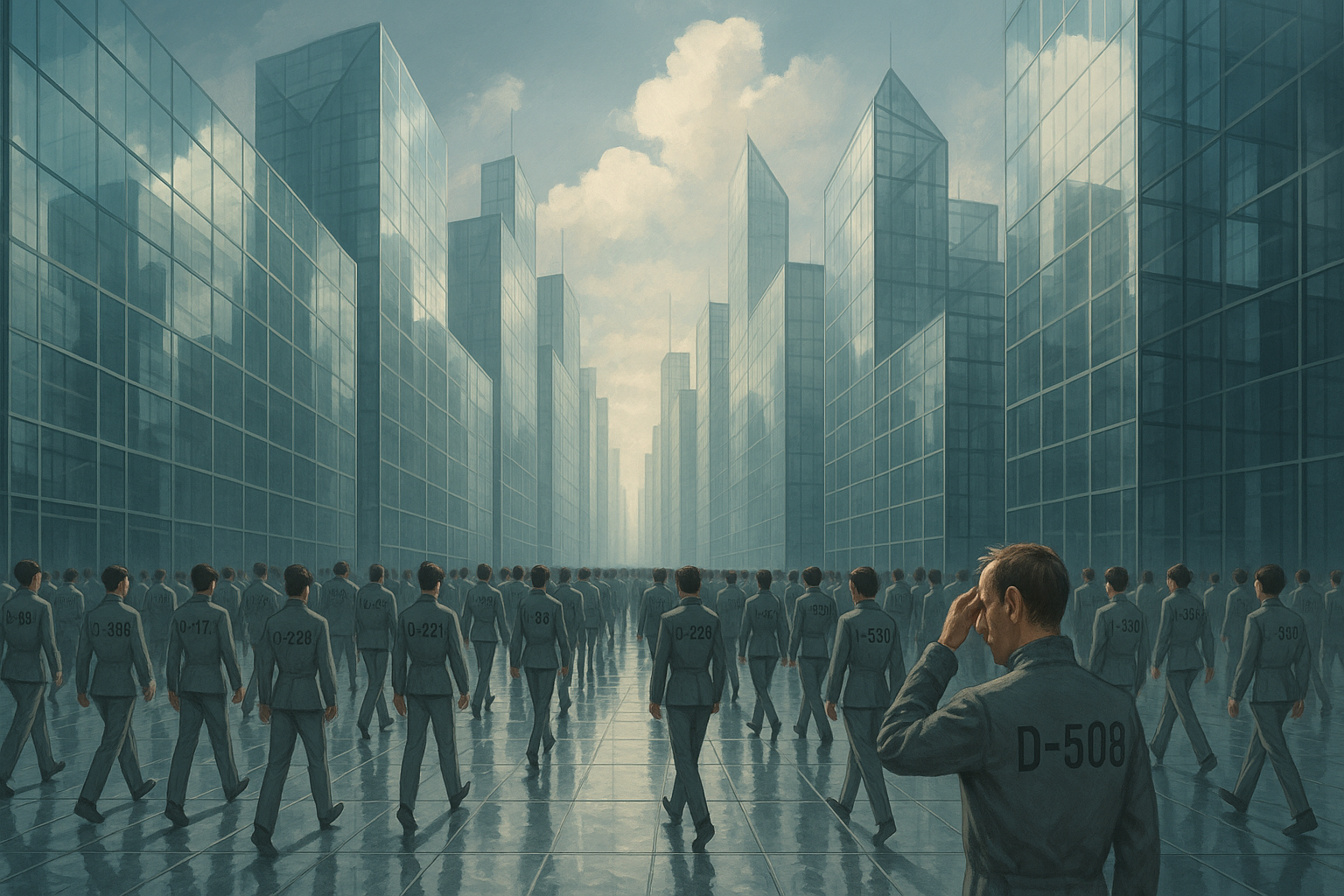
Zamyatin gives us a world of glass. Not metaphorical glass, mind you, but the literal stuff: walls, houses, streets, all transparent. Privacy is outlawed. Every thought, every motion, is supposed to be visible. A noble ideal, if you’re an architect; a nightmare, if you’re a human being. Try sneaking a midnight biscuit raid in such a house – everyone from your neighbour to the local government inspector would see you chewing. Transparency, we’re told, is next to godliness. But in practice, it’s just another word for surveillance with a shine on it.
And that’s the great comic irony: a system designed to banish chaos ends up producing absurdities that make chaos look rather charming. It’s the same principle you find in bureaucracies everywhere. Invent a rule to stop one mischief, and you soon need ten rules to stop the mischief created by the first rule. The road to Hell is paved not with good intentions, but with triplicate forms.
The people in this world are known by numbers. Very tidy. No more John Smiths cluttering the census. But numbers aren’t very romantic. Imagine Shakespeare rewriting Romeo and Juliet: ‘Call me I-330, and I’ll call you D-503.’ Doesn’t quite sing, does it? Nothing ruins a love sonnet like sounding as though you’re ordering spare parts for a combine harvester.
What Zamyatin shows, with wicked humour, is how dehumanisation often arrives dressed in the clothes of efficiency. Strip away names, individuality, and imagination – all in the name of progress – and what you get isn’t paradise but parody. As the old saying goes, ‘The road to utopia always runs past the asylum.’
From a psychological standpoint, the One State (as Zamyatin calls it) is a Freudian laboratory. Desire is repressed, spontaneity is strangled, and fantasy is treated like a contagious disease. Yet as Freud warned us, what you repress tends to pop back up like a cork in a bath. Ban daydreams, and they return at night as fever-dreams. Ban passion, and it sneaks back disguised as neurosis. Human beings, alas, aren’t programmable machines – though God knows Silicon Valley keeps trying.
And spiritually? This is a society that’s written God out of the equation, only to replace Him with the Benefactor – a pale parody of divinity, offering order without mercy, light without warmth, eternity without grace. It’s the Tower of Babel rebuilt in reinforced glass: tall, gleaming, rational, and utterly doomed. The Psalmist once wrote, ‘Except the Lord build the house, they labour in vain that build it.‘ Zamyatin gives us a house of glass – built in vain, and trembling under its own perfection.
Every page of We whispers the same truth: that human beings are gloriously unfit for perfection. We’re crooked timber, to borrow Kant’s phrase, and the attempt to plane us straight only makes us splinter. There’s an old English idiom, ‘Don’t put all your eggs in one basket.’ The One State does precisely that: it puts all its eggs in the basket of mathematics, and then drops the basket.
And yet, there’s comedy here. One can’t read of this perfectly synchronised society without smirking. Imagine the Ministry of Marching – entire departments dedicated to ensuring that everyone puts their left foot forward at precisely the same microsecond. Or the Ministry of Smiling – inspectors with rulers to measure the curvature of lips. Utopia, it turns out, is just slapstick in uniform.
Why should we, in our messy, Wi-Fi-soaked age, care about a Russian novel written a century ago? Because we’re closer to it than we care to admit. Swap glass houses for smartphones, and you have a society equally obsessed with visibility. Everyone’s their own Big Brother now, filming their breakfast and broadcasting their heartbreak. We’ve achieved surveillance by consent – which is both more efficient and more absurd than Zamyatin ever imagined.
And yet, just as in the novel, something in us squirms. We resist being numbers. We resent being watched. We crave the irrational: love, faith, imagination, even mischief. Man doesn’t live by algorithms alone. Give us all the glass walls you like, but we’ll still scribble rude jokes on the panes.
In the end, We is less a tragedy than a cosmic joke: the story of humanity trying to make itself perfect and discovering – surprise! – that the human heart refuses to fit into a spreadsheet. As the Book of Ecclesiastes puts it, ‘God hath made man upright; but they have sought out many inventions.‘ Zamyatin would add: and the inventions, like most of our gadgets, are faintly ridiculous.

 Wording