Life, says Céline, isn’t a banquet but a butcher’s stall, and each of us is the meat on the hook, dripping away one grey day at a time. Death on the Installment Plan isn’t a novel so much as a splatter of bile, a confession delivered in hysterics, punctuated with ellipses… ellipses… until the very form of grammar looks as weary as the author himself.
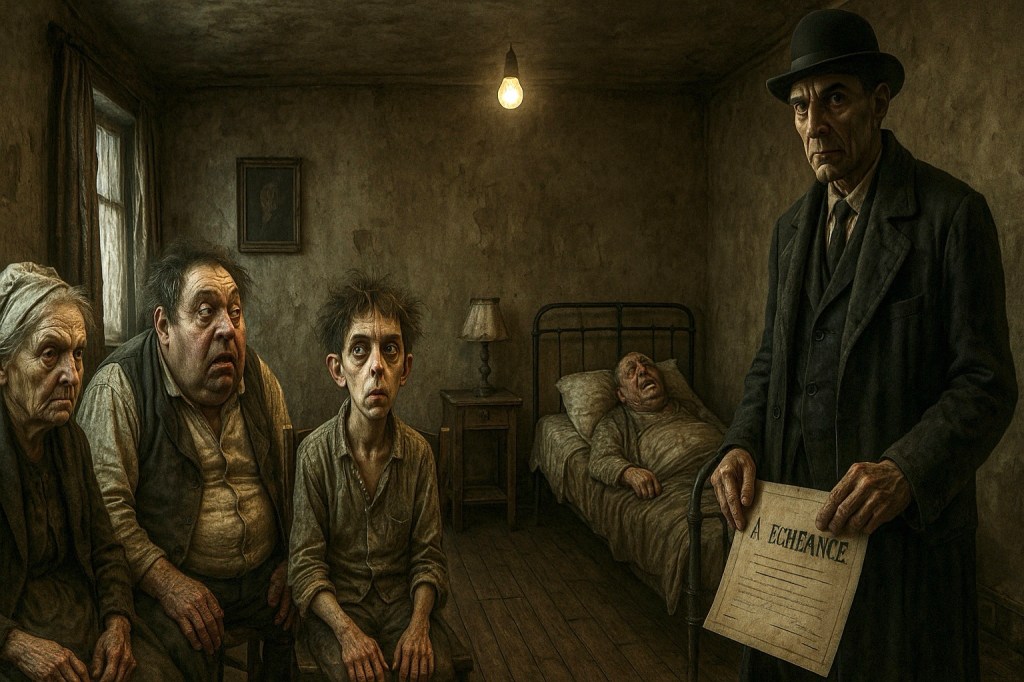
Where Dickens gave us the miseries of childhood with lantern-light sentiment, Céline drags us down a back alley behind the lamp-post and shows us the rats gnawing at the foundations. Ferdinand (the thinly veiled Céline) grows up among neurotic parents, shoddy furniture, damp lodging houses, failed inventions, and the humiliations of poverty. Every scene is grotesque, every figure a caricature warped by despair, like a Punch and Judy show staged by Hieronymus Bosch.
Céline’s peculiar genius is that he makes us laugh even as he suffocates us. His Paris is stuffed with grotesques: petty swindlers, obsessive mothers, bungling fathers, teachers wielding canes like inquisitors. It’s grotesque in the way Dickens is grotesque, but without Dickens’ wink. Dickens would offer redemption; Céline offers only more absurdity. He’s the court jester who, instead of mocking the king, mocks life itself – and makes the gallows a punchline.
It’s slapstick played on a scaffold. I think of Dostoevsky’s underground man if he had joined the circus, or Kafka if Kafka had traded in metaphysical anxiety for diarrhoea jokes.
The title itself is a cruel metaphor: death doesn’t come in a blaze of grandeur, but in instalments, like payments on a cheap coffin. Misery is paid bit by bit: humiliation at school, failures in work, thwarted lusts, arguments with parents, illnesses that never kill you but never quite let you live. We’re all in debt, Céline says, and the creditor is Death, collecting slowly, month by month, until there’s nothing left but a negative balance.
It’s the inversion of Nietzsche’s ‘eternal recurrence.’ Instead of reliving the ecstasy of existence, Céline insists we’re condemned to relive every trivial insult, every small humiliation, every clammy handshake with despair – on repeat, until the credit runs out.
One of the most radical elements of the novel is how it portrays childhood. For the Romantics, childhood was a lost Eden; for Wordsworth, the child was ‘trailing clouds of glory.’ For Céline, the child is a trapped rat in a damp basement. Adults appear as clowns, tyrants, or idiots, and the young Ferdinand’s sensitivity is only a liability in a world that punishes tenderness. Education isn’t enlightenment but battery farming; religion is superstition with a hangover; sexuality is grotesque, not sublime.
It is as if Céline had taken Rousseau’s Émile and hurled it into the gutter.
And then, there’s the style: the famous ellipses, the sputtering rhythm, as if the text itself is coughing on its own phlegm. It’s street-talk in literature’s Sunday suit, dragging the academy down to the pavement. Critics called it incoherent, obscene; but it’s more accurate to say that Céline reinvented the sentence to mimic thought – not the polished thought of a philosopher, but the ragged, panicked thinking of a man falling downstairs while swearing.
I could compare him to Joyce’s Ulysses, but where Joyce exults in linguistic play, Céline spits on the page. It’s consciousness not as stream but as gutter-water.
Psychologically, Death on the Installment Plan is an anatomy of resentment. Ferdinand is a child who sees through the hypocrisies of the adult world and responds not with revolt (as Camus’s rebel might) but with disgust. He can’t change the world; he can only mock it, describe it, exaggerate its filth until it becomes unbearable. It’s Schopenhauer rewritten by a clown doctor: the will to live isn’t just tragic, it’s ridiculous.
Spiritually, there’s no God here, except as an exhausted gag. Céline’s theology is that of Job rewritten by a drunk who never hears God’s answer from the whirlwind. Life is suffering, and then you suffer more, and the priests are in on the scam.
And yet, perversely, in all this misery there’s vitality. Like a black rose, the novel flourishes in its own poison. To read it is to feel the pulse of existence in its ugliest form – and to recognise, with a kind of grim laughter, that yes, this too is life.
Of course, Céline himself remains radioactive. His later pamphlets, dripping with anti-Semitism, turned him from enfant terrible into pariah. Yet, separating the man from the book (if we dare), Death on the Installment Plan endures as a monument of grotesque modernism. It influenced Henry Miller, Bukowski, even Beat writers – all who discovered that literature could be squalid, furious, convulsive, and still searingly alive.
To read Céline is to swallow poison with a chaser of laughter. You don’t ‘enjoy’ him, any more than one enjoys being electrocuted. But you come away buzzing, furious, disgusted – and strangely grateful that someone had the audacity to tell the truth in the language of the gutter.
We’re all on the same installment plan, Céline reminds us, and the debt collector always wins. The only rebellion is to sneer, spit, and scribble ellipses until the page itself chokes.

 Wording