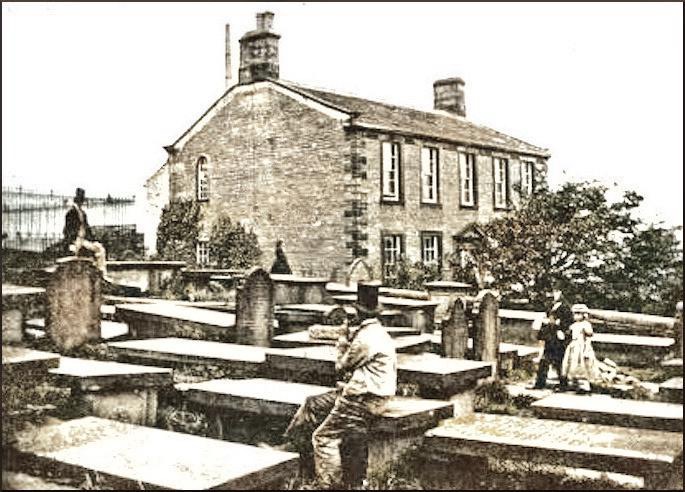
Haworth Churchyard photograph, John Stewart, c.1856–57. © Brontë Society. Sourced via annebronte.org.
There’s a photograph – albumen print, sepia-toned, crisp with the shadows of headstones – that has set imaginations aflame for more than a century. It shows Haworth churchyard, with its lichen-bitten tombs and overhanging sky, a place where the dead vastly outnumber the living. And somewhere in the middle distance, blurred yet distinct enough to haunt, stands a small female figure in bonnet and cloak. ‘Charlotte?’ people whisper, as if the question mark itself were an invocation.
Of course, Charlotte Brontë had been in her grave two years before the photograph was even taken. The negative dates from John Stewart’s commission of 1856–57, when he was dispatched by Smith, Elder & Co. to capture views for Elizabeth Gaskell’s Life of Charlotte Brontë. Charlotte died in March 1855. The arithmetic alone should close the case. Yet still, we persist. For in the age of ghosts, arithmetic is a timid jailer.
The Brontës are among the most beloved of literary saints, and saints always accumulate relics. A lock of hair, a scrap of handwriting, the scrawled miniature notebook stitched from sugar-paper: these are our equivalents of bone and nail, tokens of presence in absence. A photograph would be the most electrifying relic of all. For we’re moderns, and unlike medieval pilgrims we don’t quite believe in splinters of the True Cross; but we do believe in Kodak and collodion.
Yet there are no confirmed photographs of Charlotte, Emily, or Anne. There are Branwell’s smudged ‘Pillar Portrait’ and a scattering of amateur sketches; that’s all. The absence gnaws. And so, when we see a tiny figure in the churchyard – blurred, ambiguous, doll-sized – we allow desire to bend the evidence. We see Charlotte where there may only be some nameless Haworth seamstress or a child on an errand.
Freud would recognise this as the uncanny: the almost-familiar encountered in the wrong place. The indistinct bonneted shape wavers between person and phantom, history and imagination. Like Hamlet staring at the apparition of his father, we half-know it can’t be real, and yet it speaks to something lodged in the heart.
There’s also projection at work. In Jungian terms, the photograph becomes an archetypal canvas: the ‘maiden among graves,’ symbol of transience, genius cut short. The human mind’s a desperate pattern-making engine; even a smudge on a plate glass window becomes the face of the Virgin Mary if the viewer is hungry enough.
From a theological point of view, the speculation reveals less about Charlotte’s likeness and more about our own yearning. ‘Now we see through a glass, darkly; but then face to face,’ Paul writes in Corinthians. How apt that phrase ‘through a glass’ feels here, when what we glimpse is a darkened photographic plate and a blurred silhouette. The hunger for certainty – to see Charlotte’s face ‘clearly’ – isn’t so different from the hunger for God. In both cases, we grasp at shadows, convinced that behind them lies a presence we’re not yet ready to behold.
Haworth churchyard is a Brontë novel in stone. It’s the stage-set of Jane Eyre’s Gothic gravitas, the moorland of Wuthering Heights translated into masonry. To place a female figure there, diminutive and spectral, is almost to create a lost daguerreotype of Lucy Snowe from Villette: watchful, self-contained, both present and absent. The photograph unwittingly illustrates what literature always knew – that Charlotte was destined to haunt her own setting.
There’s also the irony of time’s revenge. Emily Brontë never set foot in a photographic studio, yet her novel will outlast a thousand portraits. Meanwhile we pore over a blurred stranger in a graveyard as if salvation depended upon the right pair of cheekbones. It’s almost Wildean: ‘In matters of grave importance, style, not sincerity, is the vital thing.’ The photograph has style – a blurred figure framed by tombs – and so we endow it with sincerity.
One imagines the anonymous woman herself, returning from the grocer’s, immortalised by accident. Had she known she was about to be mistaken for Charlotte Brontë, she might have straightened her bonnet or at least arranged her cloak to greater effect. Posterity can be cruel: who among us would wish to be misidentified forever as somebody else’s ghost?
There’s a bleak hilarity here too: Charlotte’s own publisher commissions photographs for her biography, but manages to include – not Charlotte herself, but a stranger who’ll be taken for her by generations of enthusiasts. As if Fate, with a morbid grin, were saying: ‘You wanted Charlotte? I’ll give you only shadows.’
The Haworth churchyard photograph isn’t Charlotte Brontë. But it’s something just as revealing: a mirror of our own longing to know her, to bridge the gap between ink and flesh. It testifies not to what was, but to what we wish had been. Like all ghosts, it says more about the living than the dead.
And perhaps that’s enough. For in that blurred bonneted figure, we glimpse – not Charlotte’s features – but the outline of our eternal hunger for connection, for relics, for proof that genius once walked among the tombs and left her shadow behind.

 Wording