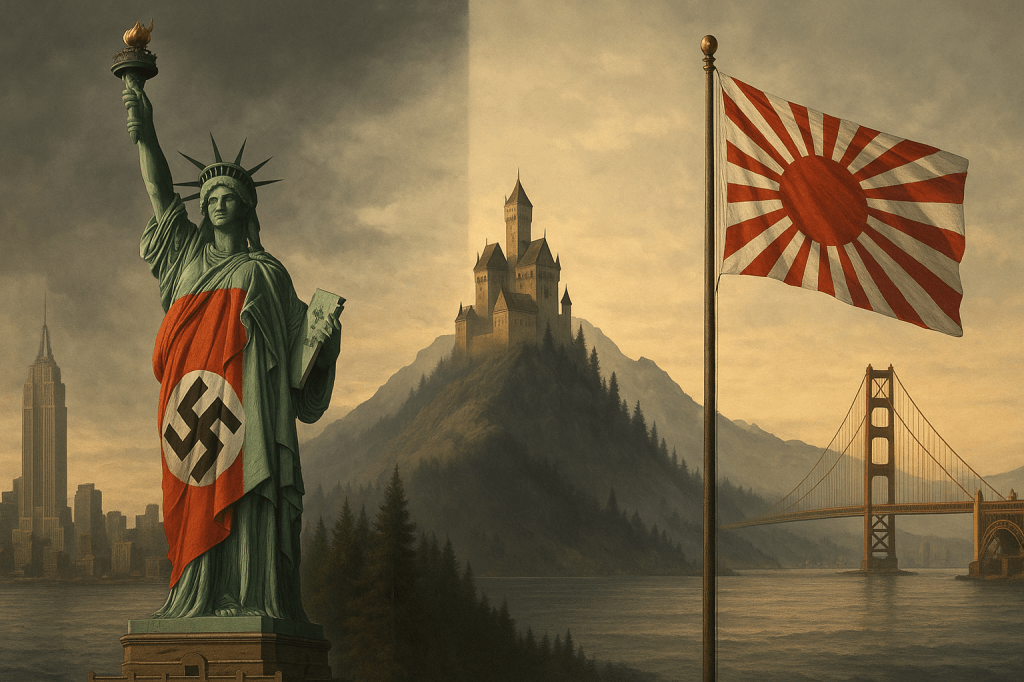
Some novels ask ‘What if?’ and there are novels that ask ‘What is?’ Philip K. Dick’s The Man in the High Castle manages the perverse trick of doing both at once. Set in a United States divided between Nazi Germany and Imperial Japan after an Axis victory in the Second World War, it ought to be nothing more than a parlour game of alternate history. Yet in Dick’s hands, the parlour becomes a confessional, and the wallpaper starts to peel away. We’re left not with strategy maps but with something much darker: the suspicion that history itself is an illusion, a mask that slips.
Everyone in the novel is lying. Dealers in ‘authentic’ Americana hawk forgeries to Japanese collectors. Businessmen wear new names to fit their circumstances. Even The Grasshopper Lies Heavy, the novel-within-the-novel in which the Allies triumphed, is a forgery of history. I can’t help but think of Christ’s words in Matthew 23: ‘Woe unto you, scribes and Pharisees, hypocrites!’ – the world Dick sketches is one of whited sepulchres, outwardly adorned but inwardly hollow.
This obsession with the counterfeit is deeply Freudian: we project our anxieties into trinkets, our longings into relics, and in the process deceive ourselves. Existentially, it’s Camus’ absurd in action – men and women clinging to scraps of ‘authentic’ meaning in a universe that constantly undermines their certainties.
What’s most unsettling in this universe is not the grandeur of Nazi banners fluttering from skyscrapers but the sheer ordinariness of life. People still haggle over antiques, worry about social etiquette, and squabble in boardrooms. Hannah Arendt called it the banality of evil, and Dick anticipates her thesis: totalitarianism doesn’t only appear in concentration camps, it creeps into the bureaucrat’s ledger, the businessman’s contract, the neighbour’s quiet compliance. Evil whispers through the quotidian, not always through the jackboot.
There’s something hauntingly biblical here too. Nehemiah built a wall to protect Jerusalem, but Dick shows us a society without walls against moral collapse. The Reich’s technological ambition – draining the Mediterranean, colonising Mars – resembles nothing so much as Babel rebuilt, humanity once again stacking bricks toward heaven until God scatters them.
Here’s the novel’s philosophical coup: in a world where Germany and Japan have won, there exists a book imagining the Allies victorious. The characters themselves begin to suspect that this book is more real than their own lived reality. And the oracle guiding them – the ancient I Ching – seems to agree.
Is Dick merely playing games? I think not. He’s proposing something terrifyingly Kierkegaardian: that truth isn’t objective but relational, existing only in the leap of faith. History becomes a Möbius strip, and we’re forced to ask whether the world we inhabit is itself just one turn of the strip, while another reality – truer, higher – lies on the reverse.
This is pure Jung: the collective unconscious bubbling up archetypes that fracture the surface of consensus reality. From a spiritual one, it’s Ecclesiastes: ‘All is vanity and vexation of spirit.’ Our histories, like our lives, may be smoke, vapour, mere chasing after wind.
Even in victory, the Reich is restless. There are rumours of genocide carried to planetary scale, schemes of colonisation that reek of hubris. Power never rests; it metastasises. And so we glimpse Dick’s final irony: evil doesn’t stop at conquest, because conquest is never enough. Nietzsche warned us of the will to power, but Dick shows it not as heroic striving but as lunatic overreach – rocket-fuelled nihilism.
The Japanese, by contrast, represent order, restraint, etiquette. Yet they too are compromised: polite maskers at the banquet of history, nibbling counterfeit Americana while remaining blind to the larger abyss. They’re not villains, but nor are they saviours. They’re simply human beings attempting to survive amid the machinery of empire.
In the end, the question lingers: what’s real? The Nazis’ triumph? The Allies’ secret victory in The Grasshopper Lies Heavy? Or some other history altogether?
Dick, I think, would say that reality isn’t fixed; it’s negotiated. We lean on dice, on oracles, on books, on stories, to tell us what’s true. The tragedy – and the comedy – is that the dice may be loaded, the oracles cryptic, the stories self-deceiving.
This is where the novel leaves us in existential dread and faint laughter, like Job listening to God answer out of the whirlwind: ‘Where wast thou when I laid the foundations of the earth?’ Perhaps we’re forever condemned to read footnotes in the Book of Time, while the Author writes elsewhere.
When I close The Man in the High Castle, I’m not left thinking ‘What if Germany had won?’ but ‘What if none of us truly know who’s won at all?’ History may be no firmer than the sand beneath our feet; what matters is how we live in the shadow of uncertainty. Perhaps that’s why Dick gave us forgeries and fakes – so that, like Jacob wrestling with the angel, we’d limp away with the blessing of doubt.

 Wording
Dick, and others, ignore the idea of God. If you call yourself a Christian, well, there is someone watching over it all and whose “take” will be perfect. You just won’t get that until you get to Heaven.
Yes, Dick leaves God out, and perhaps that’s why his universes spin so wildly into paranoia. If man’s the measure of all things, then history becomes a hall of mirrors. As you say, the Christian faith rests in the assurance that there is a divine Author whose ‘take’ won’t be provisional, but final. Dick’s silence on that point’s telling.