This piece has been a long time in gestation. Ever since Justin Welby announced his departure, I’ve found myself jotting notes, revisiting history, and anticipating the inevitable turn the Church of England would take. Today’s announcement is therefore no surprise – only the confirmation of what many of us had already suspected. It seemed fitting, then, that I should finally give shape to those musings and let the words out. What follows isn’t a hurried outburst but a considered vent, the distillation of months of reflection, a mixture of history, lament, and satire. If it burns a little, it’s only because the embers have been glowing for some time.
History, they tell us, is a long conversation with the dead. But in Canterbury, that conversation isn’t just long, it’s deafening. The stones of the cathedral murmur with Augustine’s Latin chants, echo with Becket’s final scream beneath Norman swords, and sigh with Cranmer’s Protestant fire. For nearly a millennium and a half, the Archbishopric of Canterbury has been the steeple-crowned heart of English Christendom, the Pope’s thorn, the King’s conscience, and, at times, the nation’s guilty jester. And now? In 2025, like a conjuror pulling a rabbit from a hat – or perhaps a mitre from a handbag – the Church of England has chosen Dame Sarah Mullally as the first female Archbishop of Canterbury. One imagines Augustine blinking in disbelief, Becket tearing at his martyr’s robe, and Cranmer, ever the reformer, trying to suppress a grim smile as he strikes yet another match.
The tale begins in 597, when Pope Gregory the Great, spying fair-haired Anglo-Saxon boys in a Roman slave market, quipped they were not Angles but angels. He dispatched Augustine to Kent to plant Rome’s flag in barbarian soil. Augustine was a nervous monk, trembling like a schoolboy before his headmaster, yet King Æthelberht received him courteously. Canterbury became his seat, and Augustine his first archbishop. Here was no small office. The man was shepherd of a nation unborn, a gardener planting vines where there’d only been thistles. To borrow Eliot’s phrase, Canterbury became ‘the still point of the turning world.’
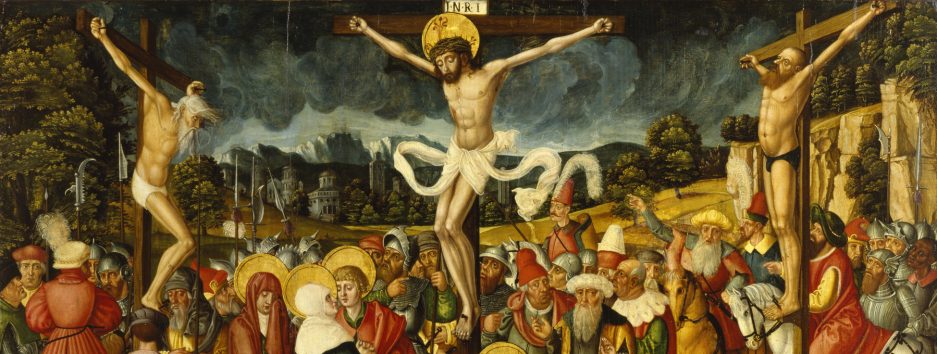
Fast-forward to the twelfth century, and we find Thomas Becket, the archbishop who dared to shout “Thus far and no further!” at King Henry II. For that insolence he was cut down in his own cathedral, his skull cracked by knights who mistook royal bluster for command. Blood on the stones, a saint in the making, and Canterbury was flooded with pilgrims until Henry VIII smashed the shrine to rubble. Becket’s murder showed the essence of the office: the archbishop was no courtier with a crozier, but a conscience with a sword at his back.
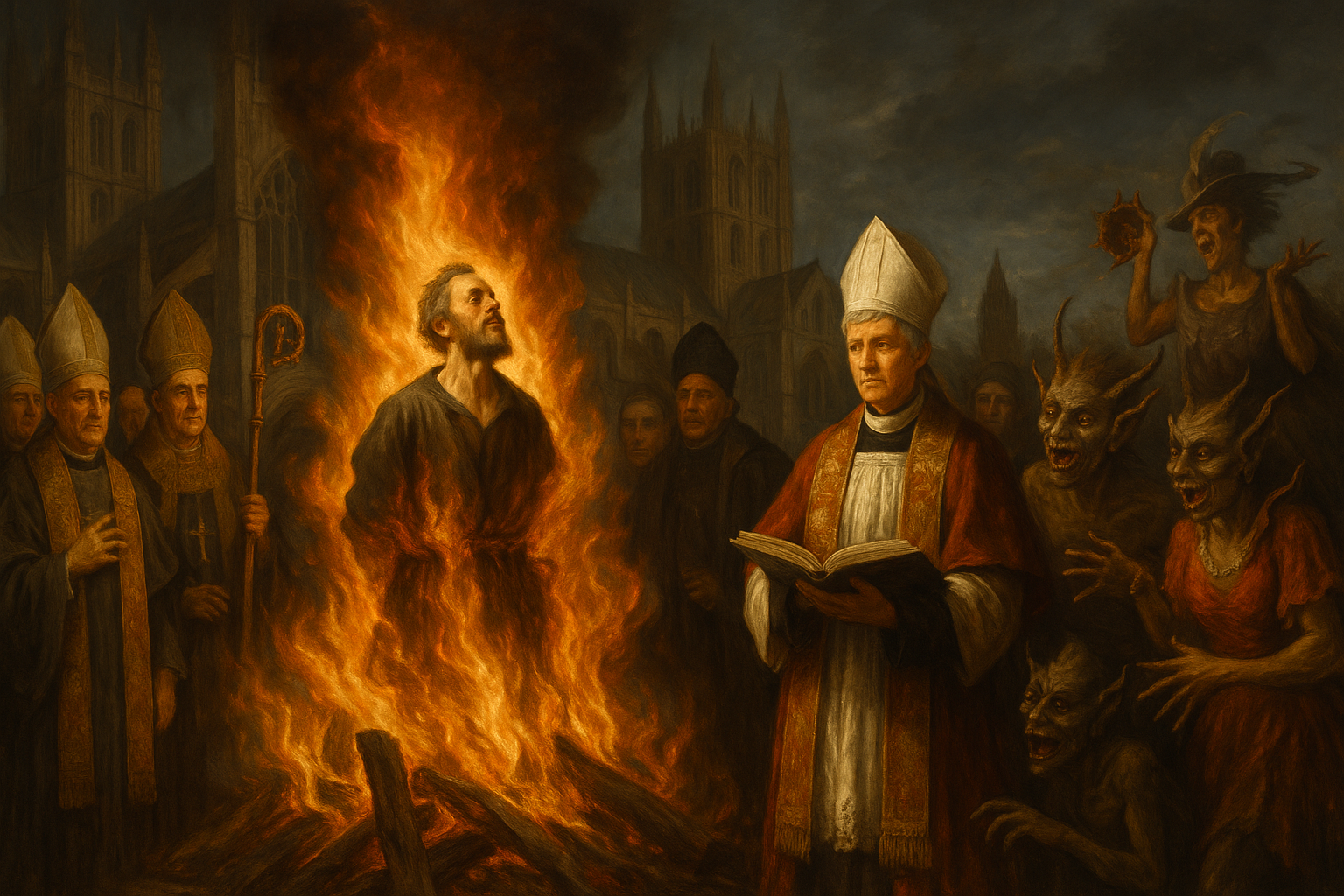
Then came Thomas Cranmer, the quiet scholar with steel in his soul. Under Henry VIII he annulled marriages and under Edward VI he crafted the Book of Common Prayer, whose cadences still haunt English ears like organ notes drifting through mist. Under Mary Tudor he burned, thrusting his ‘unworthy hand’ into the fire that had signed false recantations. Cranmer’s smoke lingers yet, reminding us that the archbishopric wasn’t a velvet seat but a pyre. Through centuries, archbishops played shuttlecock between monarchs and mobs. William Laud lost his head to Puritans, while William Sancroft lost his mitre for refusing to swear to William and Mary. They were forever torn between prophet and puppet, between God’s altar and the King’s table. As Roger Scruton might have said, their office embodied ‘the tension between loyalty and truth, belonging and belief.’
By the Victorian age, the Archbishop of Canterbury had become a kind of ecclesiastical Lord Chamberlain: crowning monarchs, hosting garden parties, issuing gentle sermons about progress and morality. The Lambeth Conference was born, a talking shop of bishops wringing hands over empire, divorce, and later sexuality. The archbishop was no longer a prophet in sackcloth but a civil servant in silk. In the twentieth century, men like William Temple preached Christian socialism, while Rowan Williams muttered in poetic Welsh about unity as the Communion cracked apart. Justin Welby, banker turned bishop, tried to reconcile everything with management speak.
And then – the hammer blow of 1994: women ordained priests. In 2015: women consecrated bishops. Now, in 2025, the final act: a woman enthroned at Canterbury. Enter Dame Sarah Mullally. Nurse turned bishop, politician’s darling, and now ‘Mother of us all.’ The headlines crow: ‘After 1,428 years, Canterbury has a woman.‘ Progressives toast it as triumph; conservatives gnash their teeth. But let’s pause. Scripture isn’t silent. St. Paul, for all his supposed cultural baggage, writes plainly: ‘I do not permit a woman to teach or to exercise authority over a man‘ (1 Timothy 2:12). For nearly fifteen centuries, the Church obeyed this teaching. Augustine, Anselm, Becket, Cranmer – all men, not because they were men, but because they stood in an apostolic line traced back to Christ and his male apostles. Now, that line’s bent like a reed in the wind. We’re told it’s justice. But is it not rather a capitulation? As Chesterton warned, when you marry the spirit of the age, you’re soon a widow.
So what’s Canterbury now? A cathedral of memories, a crypt of saints, a tourist trap for coach parties. Augustine’s ghost lingers by the high altar, Becket’s blood cries from beneath the stones, Cranmer’s ashes whisper from the cloister. And now, amidst the incense and the organ, comes the rustle of a new kind of cassock – one that signals rupture, not continuity. The Archbishopric of Canterbury, once the steel-backed conscience of kings, now looks like a committee chairmanship dressed in lace. As Nietzsche might smirk, ‘God is dead – and the archbishopric has killed Him, with bureaucracy, sentiment, and a dab of feminism.’
And yet, history’s a joker. Who’s to say what Dame Sarah’s tenure will bring? Perhaps she’ll surprise the cynics and shame the scoffers. Perhaps Canterbury will rise again as a true beacon. But I suspect otherwise: that this appointment is the final page in a long descent from Augustine’s cloak of humility, through Becket’s bloodied mitre, through Cranmer’s flames, down to a gender-politicised office that looks more like a diversity hire than a divine vocation. The Archbishopric of Canterbury began with saints and martyrs; it now risks ending with managers and mediocrities. The mitre, once a crown of thorns, may end as nothing more than a hat in the ring of modern politics. And if I seem uncharitable, it’s not without cause. I’ve known such figures not only from a distance but in the intimacies of life – even, once upon a time, in marriage. My experience has been that the experiment of female vicars too often produces a chill at the altar and a gush of sentiment in the pulpit: cold where warmth is needed, cloying where restraint is called for. It’s a strange brew, neither nourishing nor sustaining, and I fear Canterbury has now decided to pour it into the nation’s cup.

 Wording