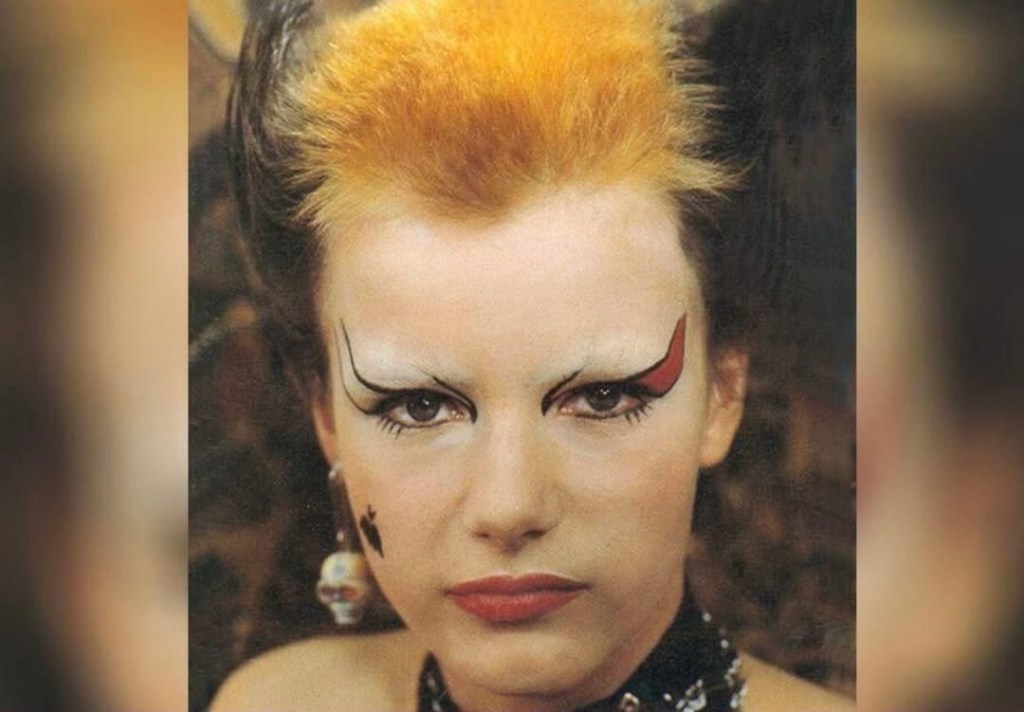
Sue Catwoman (Sue Lucas), c.1977.
Photographed by Ray Stevenson.
Publicly circulated press image from the early London punk scene.
Every generation breeds a handful of figures who seem to slip through the net of time – too wild for the archives, too vivid for mere memory. Sue Catwoman was one of those rare creatures: a woman who turned her own image into a roar, then vanished into the smoke and feedback of the seventies.
When punk first clawed its way out of the fetid basements of London, the newspapers searched for villains, for saints, for something to explain the noise. But what they found, again and again, was Sue. Before the safety pin was myth, before Vivienne Westwood turned rebellion into couture, there she stood – eyes lined like daggers, hair like a flame held against the wind, her expression somewhere between contempt and invitation. She wasn’t a singer, nor a musician; she didn’t have to be. She was the look that made the music believable.
Her orbit crossed that of the Sex Pistols, those apostles of anarchy whose sneer became Britain’s accidental national anthem. Sue moved among them like a familiar spirit – appearing in Ray Stevenson’s photographs, haunting the backrooms of the Roxy and the 100 Club, and at times, simply standing beside Johnny Rotten as if to prove that punk’s fury could also wear lipstick. She was close to the Pistols’ camp, part of that raw constellation of artists, misfits and voyeurs who gathered around Malcolm McLaren and Vivienne Westwood’s SEX boutique on the King’s Road.
It was there that the legend of Sue Catwoman took shape. Her makeup – white brows erased and red-black lines flicked upward like claws – wasn’t fashion but theatre, a kind of visual heresy. In an age of beige conformity, she became a walking apostasy. The pose wasn’t adopted; it was inhabited. There was something feline about the way she stared down a camera lens – beautiful, yes, but dangerous to approach.
Yet, behind the myth, there was Sue Lucas – a girl from the Midlands who carried her own bruises into the city and transmuted them into art. She wasn’t chasing fame; she was exorcising the dull ache of ordinary life. Punk gave her a vocabulary for that defiance, a way to say ‘no’ without words.
Those who knew her speak of her warmth, her dry humour, the way she could puncture the pomposity of a room with a single glance. But there was melancholy too – that strange undertow that runs through all who burn brightly for a time. In later years she receded from the spotlight, living quietly while the photographs she once posed for became cultural relics. And yet, she never disowned that past. “It was fun,” she said once, “but it was also necessary.” That remark, simple and unsentimental, might be the truest epitaph punk ever received.
Now, at seventy, she’s left the stage. There’ll be no obituaries in the tabloids, no endless retrospectives. Punk never cared for ceremony. But for those who remember the smell of vinyl and eyeliner in small clubs, for those who once felt the electricity of that unholy newness, her passing matters deeply. She was part of the spell – the dark glamour that made a movement feel eternal.
In the end, Sue Catwoman stood for something almost unfashionable: authenticity. She didn’t imitate rebellion; she embodied it. Her face – half-painted mask, half-mirror – still asks a question that each generation must answer for itself: what will you dare to be?
So here’s to Sue Lucas, the cat who hissed at the world and refused to purr. The girl who made a snarl into an art form. The woman who taught us that sometimes the truest form of beauty is the refusal to behave.
Rest well, Sue – may your eyeliner never fade, and may heaven tremble at your stare.

 Wording