In memory of the children of Aberfan, 21st October 1966
Before the Bell Rang
There are mornings that never end, only echo. Aberfan was one of them. The rain had fallen through the night — the kind of Welsh rain that softens the hills but sharpens the nerves. By half past nine, the children of Pantglas Junior School were gathered for assembly. Their voices rose like the weather — light, ordinary, innocent — until the mountain itself began to move.
The sound came first: a dull, growing roar, like the throat of the earth clearing itself. Then darkness, weight, silence. Five minutes later, the school was gone, and the village that had built Britain’s empire of coal found itself buried beneath it.
We’re told that history teaches; but in truth, history only warns. And when the warning is ignored, it returns — not as memory, but as mud. The question, whispered through decades of rain, remains the same: how does a nation forget its own children?
And so before we begin, pause — just a moment — and listen.
The hill is quiet now. The bell has rung. The lesson has not yet been learned.
The Slag Heap of Forgetfulness
“And as the smart ship grew
In stature, grace, and hue,
In shadowy silent distance grew
the Iceberg too.”
— Thomas Hardy, The Convergence of the Twain (1912)
I’ve often thought that Britain specialises not in tragedy, but in the tidy mismanagement of it. We don’t so much suffer disaster as administer it. We hold a meeting, draft a memo, pour a cup of tea, and assume that everything will sort itself out by Thursday. But on one October morning in 1966, in a small Welsh village called Aberfan, the British habit of muddling through met the mountain it had made — and the mountain won.
The coal tip that collapsed above Pantglas Junior School was not an act of nature; it was an act of nurture — the child of complacency. For years, the villagers had warned the National Coal Board that the slag heap was unsafe. They spoke of the springs that ran beneath it, of the way the ground shivered after rain. But warnings are easily ignored when they come from the poor. The language of power prefers ink to mud. And so the mountain swelled, black and glistening, until at last it could no longer contain its own contempt.
At 9.15 a.m., it broke. One hundred and sixteen children and twenty-eight adults were buried alive in a wave of coal slurry that rolled down the hill like liquid night. It took less than five minutes to annihilate a generation. The bell had just rung for school assembly. The children were singing. There was no warning but a rumble — and then silence.
Hardy, in his poem The Convergence of the Twain, wrote that while men were rivetting plates on the Titanic, the iceberg was forming in secret, ‘growing taller and colder, by degrees.’ That line chills me more than any description of the shipwreck itself. It’s not the collision but the parallel preparation that wounds the conscience — the slow, silent growth of catastrophe beside the vanity of man.
Aberfan was our landlocked Titanic. The mountain was the iceberg we built ourselves. Each cartload of waste trundled up that slope was another stanza in a hymn to productivity, another token of faith in the god of coal. The village lay below, trusting that those who made their living from the earth knew how to handle it. But faith misplaced in men who worship progress is as fatal as faith lost in God.
When the Queen visited days later, her face was ashen — not with royal restraint, but with recognition. This wasn’t the spectacle of empire, but its aftermath. The camera captured her grief, and the nation saw itself reflected in that composed sorrow: strong tea for strong emotions, as if decorum could disinfect the soul. The miners dug for their own children; the mothers washed the black from the faces of the dead. It was said that no birds sang in Aberfan for weeks. Perhaps they couldn’t hear their own voices over the silence.
The inquiry that followed was as British as the disaster itself: thorough, moral, and perfectly useless. The National Coal Board was found culpable but not criminal. The tip was removed, the documents filed, and the case closed. A memorial fund was raised — and, in a final insult, part of that fund was used to pay for the removal of the very tip that caused the disaster. One might laugh, if laughter didn’t stick like soot in the throat.
Aberfan was a mirror held up to our industrial vanity — a tragedy not of fire and brimstone but of paperwork and inertia. Hardy’s poem imagined the ‘Immanent Will’ that shapes destruction to design. But what if the Will is ours? What if the convergence isn’t between ship and iceberg, but between greed and governance, negligence and normality?
The coal industry was the beating heart of post-war Britain, and every beat sent more waste up that hill. To question it was to question the national pulse. Yet I can’t help thinking of those children’s exercise books — the unfinished sums, the half-written essays, the small handwriting stilled mid-word. There, among the debris, the human scale of tragedy made a mockery of every ton of coal ever burned.
I often wonder whether we’ve learned anything since. We build glass towers now instead of slag heaps, but they too can fall. We talk of progress, sustainability, innovation — as though changing the vocabulary absolves the sin. Our disasters are cleaner now, quieter, bureaucratised to the point of invisibility. The moral dust settles quicker, the memorials are digital.
But the lesson of Aberfan, like Hardy’s iceberg, remains: what we create in pride, we often destroy in silence.
The mountain waits; the paperwork piles; and somewhere, a bell rings for morning assembly.
Coda: The Blackened Angel
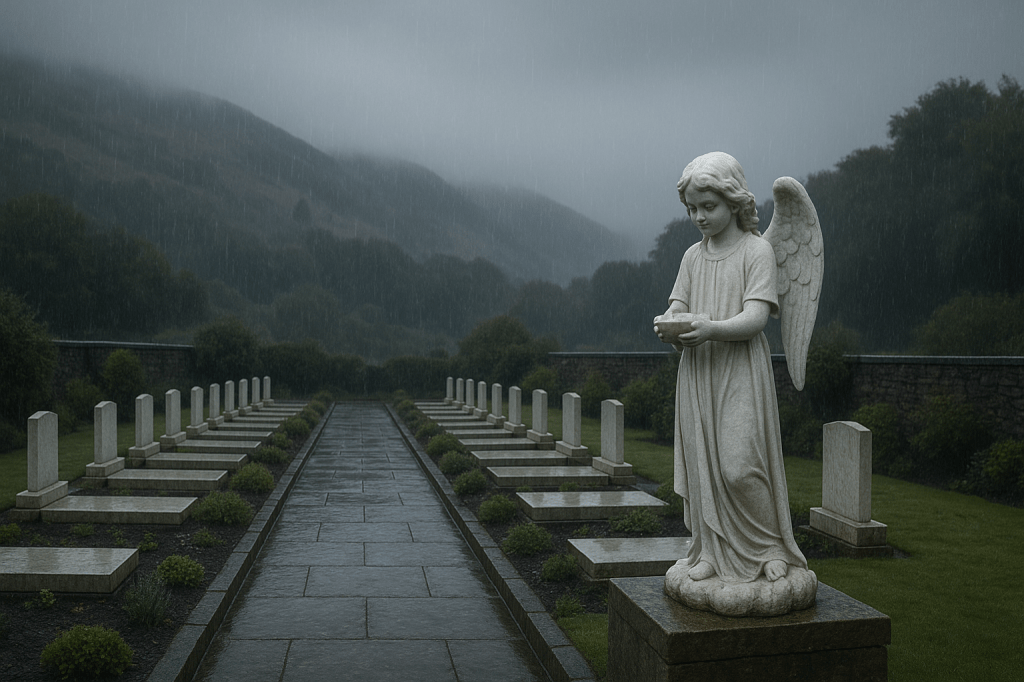
There’s a small white angel in the Aberfan Memorial Garden, her face lifted toward the valley sky. She stands not in triumph but in remembrance — one of those innocent figures who, by standing still, moves the heart more deeply than any sermon could.
When I last saw her, many years ago, rain had gathered in her stone palms. It was an ordinary Welsh rain, grey and steady, falling as it always does — the sort that seeps into the soul rather than soaks it. And yet there was something in that simple image: an angel holding the rain, as though catching what heaven had wept and the earth had forgotten.
The children of Aberfan were born into the twilight of an empire and the dawn of an industrial dusk. Their fathers mined the coal that powered the nation, their mothers washed it from their clothes at night. They weren’t citizens of modernity, but subjects of necessity. In another century, they might have been farm boys and girls chasing sheep over the hills; instead, they grew up in the shadow of the pithead, where ambition was measured in shifts and safety in silence.
Every civilisation buries its children somewhere. Some under pyramids, some under ideals. Ours chose profit. The blackened angel stands as the witness we deserve — unblinking, mute, forever twelve years old. I cannot see her without hearing Hardy’s ghostly music, that sense of inevitability that hums beneath progress like a warning bell.
‘Alien they seemed to be:
No mortal eye could see
The intimate welding of their later history.’
Hardy meant the ship and the iceberg, but he could as well have meant man and his machinery, government and its guilt. The welding is eternal; the collision inevitable. The only mercy is memory — the fragile thread that binds the living to the lesson.
But memory fades when the living grow comfortable. Time has a cruel politeness: it tidies up the evidence, turns horror into heritage. The name Aberfan is now spoken softly, almost reverently, as if whispering could undo the noise of the collapse. We call it ‘a tragedy,’ which is true — but it was also a crime of indifference. And every time we forget that, the angel’s wings grow a little darker.
The poet R. S. Thomas once wrote that ‘God is in the bits and pieces of everyday — a dust mote in sunlight.’ If so, then perhaps He’s also in the bits and pieces of coal and clay that entombed those children. Perhaps even there — especially there — divinity dared to dwell among the waste. The blackened angel doesn’t accuse; she endures. Her silence is heavier than any sermon, her stillness more eloquent than a thousand apologies.
And what of us, fifty-nine years later? We scroll past fresh calamities with the same detached sympathy we once reserved for strangers in black-and-white photographs. We have become spectators at our own undoing, connoisseurs of catastrophe. The slag heaps are now metaphysical — piles of data, deceit, and distraction. We’ve traded shovels for screens, coal dust for clickbait, yet the blindness is the same.
So I ask again, quietly, perhaps to myself: Have we all forgotten Aberfan?
If we have, then the ground beneath our own civilisation is already shifting.
The rain falls still. The angel holds it faithfully.
And somewhere, deep in the blackened earth, the children dream of daylight.
The Rain Still Falls
The earth at Aberfan has long been cleared, the blackened hillsides green again, the rain the same as ever. Yet somewhere beneath that quiet grass, the morning of 21st October 1966 hasn’t passed. Time, it seems, can’t drain what the heart refuses to forget.
We speak of ‘moving on,’ as if memory were a burden instead of a duty. But remembrance is the price of conscience — and to pay it willingly is the only grace left to us. Those children never grew old enough to forget; the least we can do is remember for them.
So let the names be spoken, softly. Let the rain fall where it must. And let the angel stand, cupping her small hands to catch what heaven still weeps.
In memory of the children of Pantglas Junior School and the people of Aberfan.
October 21st, 1966.

 Wording