“Many waters cannot quench love, neither can the floods drown it.” — Song of Solomon 8:7
History is littered with martyrs, but some rise from the ashes not as mournful relics, but as burning questions. Anne Askew — born in 1521 in Lincolnshire, unwilling wife, unyielding believer, and finally unwilling guest at Smithfield’s stake — was one such ember of resistance. She wasn’t merely a victim of Henry VIII’s England but a voice that refused to be extinguished, her words recorded even as her bones broke on the rack.
Anne was a woman out of joint with her time. Married off to Thomas Kyme, intended originally for her late sister, she proved a most inconvenient bride: too Protestant, too outspoken, and too committed to reading the Bible in English rather than hearing it filtered through Latin pomp. In a society that wished women to sew, to simmer, to silently nod, Anne read, reasoned, and rebutted. Imagine if Cassandra had refused to be merely tragic and had taken to sermonising in the agora. That was Anne: part prophet, part irritant, wholly unbiddable.
Her heresy wasn’t theatrical. She didn’t mount pulpits like Savonarola, nor thunder like Luther. She simply refused to affirm the doctrine of transubstantiation — the idea that bread and wine became flesh and blood in the Mass. It may sound a quibble, the sort of scholastic hair-splitting Thomas Aquinas might have turned into Latin riddles, but in Tudor England it was treason against the soul of Christendom. Anne wouldn’t bend. In this, she resembles Antigone, standing against Creon’s decrees, insisting that conscience is higher than law.
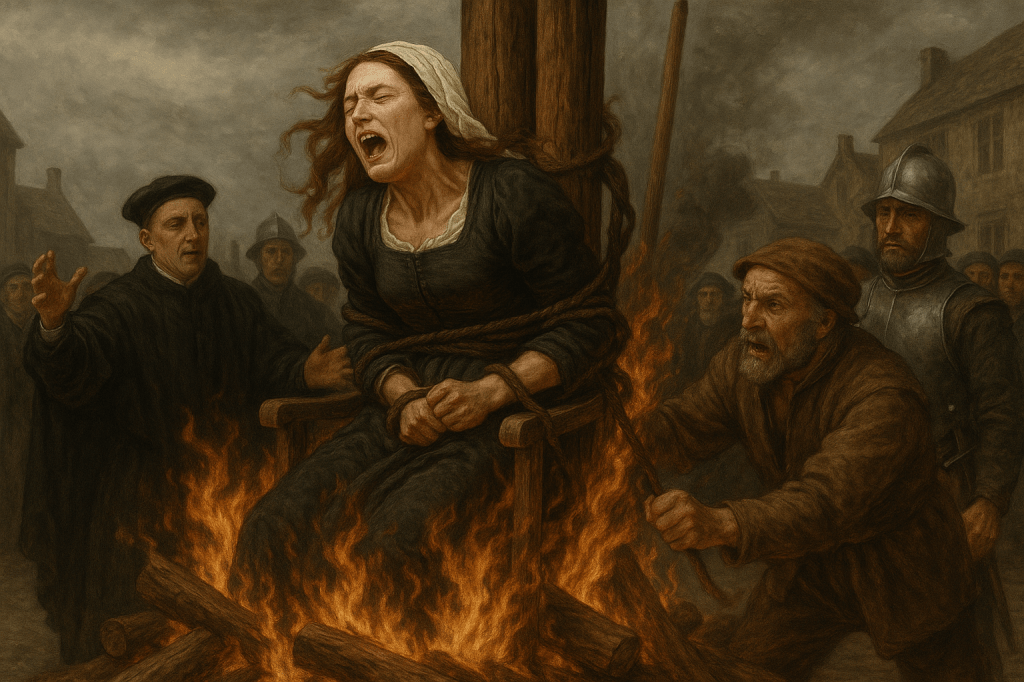
The price was agony. Hauled before Bishop Bonner and interrogated in the Tower of London, Anne Askew was racked — pulled until her joints snapped and her body became a ruin. Even her executioners faltered, yet the Lord Chancellor, Wriothesley, insisted she be stretched further. The cruelty is almost Greek in its excess, the gods mocking Prometheus for daring to steal their fire. Anne was left unable to stand, so when they brought her to Smithfield on 16 July 1546, they carried her in a chair, broken yet unbowed, and tied her upright to the stake. Fire would finish what the rack began.
What fascinates isn’t her death but her serenity. She’d smuggled out her written ‘Examinations,’ accounts of her interrogations, prayers, and steadfast convictions. These manuscripts became spiritual contraband, the Dead Sea Scrolls of the Reformation. In them, her voice is clear, ironic, defiant: ‘I am not come hither to deny my Lord and Master.’ There’s almost a Dostoevskian quality here — the underground voice refusing the tyrant’s demand for submission, clinging to truth even in torment.
Psychologically, her story is a paradox. The human instinct when tortured is survival — give the answer, nod the assent, whisper the lie that lets the body live. Anne didn’t. Some will call it fanaticism, others faith; perhaps it’s the same thing viewed from opposite ends of eternity. Kierkegaard wrote of the ‘leap of faith’ — for Anne, the leap wasn’t into comforting abstraction but into the fire itself.
And so her ashes mingled with those of John Lascelles, Nicholas Belenian, and John Adams, all burned that same day. Yet Anne’s words endured, finding sanctuary in John Foxe’s Book of Martyrs, that Protestant hagiography of suffering. There she became not merely a woman of flesh, but an icon — a Tudor Joan of Arc, except with parchment rather than sword.
But here lies the haunting: Anne’s death was not only about doctrine. It was about gender, power, and the refusal of silence. In a world that wished her to obey, she didn’t. In a Church that demanded assent, she withheld it. In a state that sought her submission, she endured rather than comply. The rack mangled her body, but it couldn’t rearrange her mind.
Smithfield has long since cooled, its flames reduced to historical footnotes and coffee shops. Yet when we walk its pavements, we might still hear the echo of her prayer — faith not as comfort, but as confrontation. Anne Askew reminds us that the fire of conscience burns hotter than any pyre, and that to live in fear of men is death, while to die in fidelity to truth is life eternal.

 Wording