Following on from yesterday’s reflection on Corpse Bride, I found myself still wandering through Tim Burton’s haunted imagination — that candlelit corridor where love, death, and longing share the same heartbeat. If Corpse Bride was his requiem for romance, A Nightmare Before Christmas is his hymn to the restless artist — the skeleton who, having mastered the macabre, dares to borrow joy and nearly burns in its light.
Both tales, in their own way, prove that even in Burton’s world of bones and shadows, the dead are often more alive than the living.
There are some films that belong to no season, only to the imagination — Tim Burton’s A Nightmare Before Christmas is one of them. A ghostly hymn stitched together from tinsel and tombstones, it dances between Halloween and Christmas like a skeleton trying to waltz with an angel. Burton gave us a world where bats hang beside baubles, and pumpkins glow not just with candlelight, but with existential longing.
Jack Skellington, the lanky maestro of Halloween Town, suffers from that most poetic of ailments: spiritual exhaustion. He’s the Romantic artist as tragic clown, the Gothic Byron of the graveyard. Having mastered terror, he’s bored by it — the nightmare has become routine. What he suffers, in truth, is the curse of all creators: success without surprise. He’s like a poet who’s won too many prizes or a priest who’s stopped believing in his own liturgy. When he wanders into Christmas Town, his reaction isn’t worship but envy. Snow! Joy! Bells that ring for love, not doom! In a fit of aesthetic confusion, he kidnaps Santa Claus and tries to become him. The results, predictably, are disastrous.
Yet Jack’s failure is a moral victory. A Nightmare Before Christmas isn’t a clash between holidays — it’s a meditation on identity and imitation. It tells us, with a grin and a shudder, that you can’t borrow another man’s purpose and call it passion. To steal joy when you’re made for mischief is to profane both. In trying to perform Christmas, Jack desecrates it, just as modern man desecrates belief by performing virtue without faith. Burton’s allegory, like all great fairy tales, hums beneath the surface: authenticity is sacred; appropriation, absurd.
But what makes the film transcend its own holiday gimmick is the melancholy heart beating beneath the bones. Jack’s lament, ‘What’s this?’, isn’t really about snow or stockings. It’s about meaning. The poor skeleton is tired of being adored for all the wrong reasons. He wants to be more than his role — the way we all do, when we grow weary of our costumes and crave some soul to inhabit them.
And then there’s Sally — stitched, poisoned, quietly profound. She’s the soul of the story, and like all of Burton’s heroines, she sees what genius blinded by ego can’t. Her love is the kind that waits, not the kind that demands. She doesn’t try to fix Jack; she merely hopes he remembers himself. She’s the ghostly echo of faith — quiet, enduring, and unshowy.
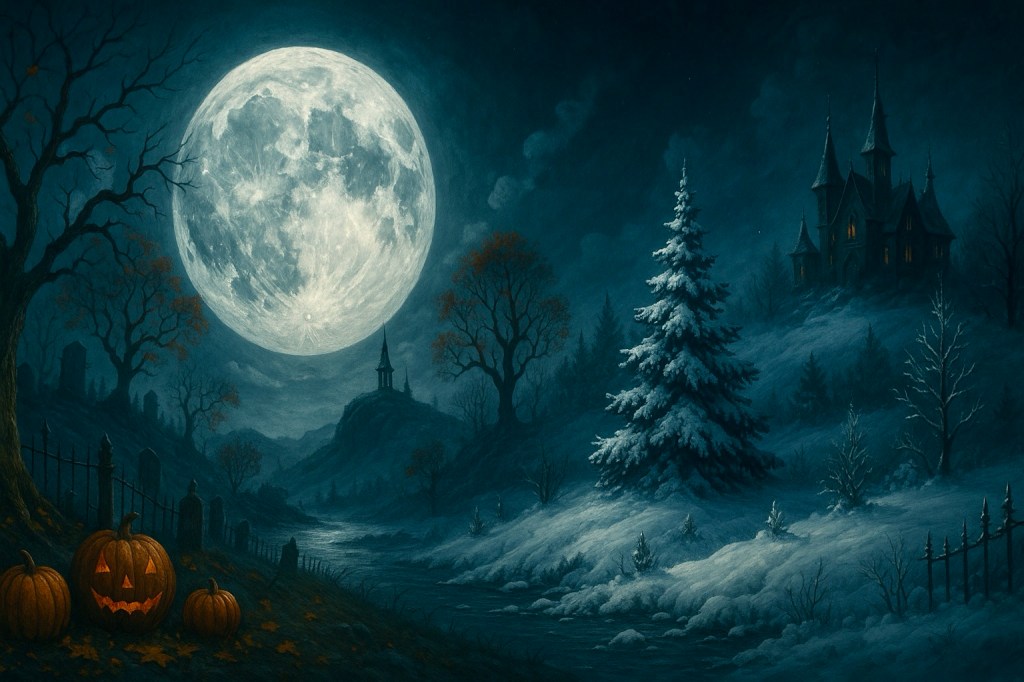
Visually, A Nightmare Before Christmas is a delirious masterpiece. Every crooked street and spiralling hill seems drawn by a hand that trembles between nightmare and nursery rhyme. Henry Selick’s stop-motion direction lends weight to the fantasy — as if this world really were built from clay and sorrow. The moon, perpetually huge and hollow, hovers like the eye of a lonely god. Even the shadows have personality; they stretch and cower as if afraid of their own darkness.
Danny Elfman’s score deserves its own cathedral. He doesn’t simply compose music — he translates Jack’s soul into melody. The songs slip from gleeful horror to aching sincerity without missing a beat. When Jack sings ‘What Have I Done?’ after his failed attempt to hijack Christmas, it’s almost biblical. The fallen artist confesses to the heavens — and the heavens answer not with thunder, but with silence and snow.
Burton, of course, has always been the high priest of misfits. From Edward Scissorhands to Beetlejuice, his saints are the misunderstood and his devils are the ordinary. A Nightmare Before Christmas perfects that theology. Halloween Town, for all its grotesques, is the only honest society in Burton’s canon. Its monsters are sincere. Its mayor, literally two-faced, is the only politician in history to admit it. Even Oogie Boogie — a villain made of bugs and burlap — is more honest than any smiling salesman of modern virtue. He at least admits he’s wicked.
There’s a moral here for the modern world: we are all Jack Skellington now — dissatisfied, distracted, decorating our emptiness with borrowed traditions. We want the feeling of Christmas without the faith that gave it birth, the thrill of Halloween without the humility of death. Burton’s film prophesied our age of seasonal identity crisis — a world where we change beliefs as easily as we change outfits.
But beneath the satire lies mercy. Jack’s redemption isn’t found in success but in failure — in the quiet recognition that he is who he is, and that’s enough. He doesn’t find salvation through Christmas, but through returning to his own nature, renewed. It’s not a lesson about giving up; it’s a revelation about belonging. Even a pumpkin king, it seems, must learn to love his patch.
So what is A Nightmare Before Christmas? It is, in essence, a carol for the creatively damned. A hymn for those who’ve lost their way in pursuit of wonder. It reminds us that the imagination, like faith, can’t be forced — and that even the dead deserve their holidays.
After all, as Jack himself discovers,
there’s no place like home — especially when it’s haunted.

 Wording