I heard a small sad sound,
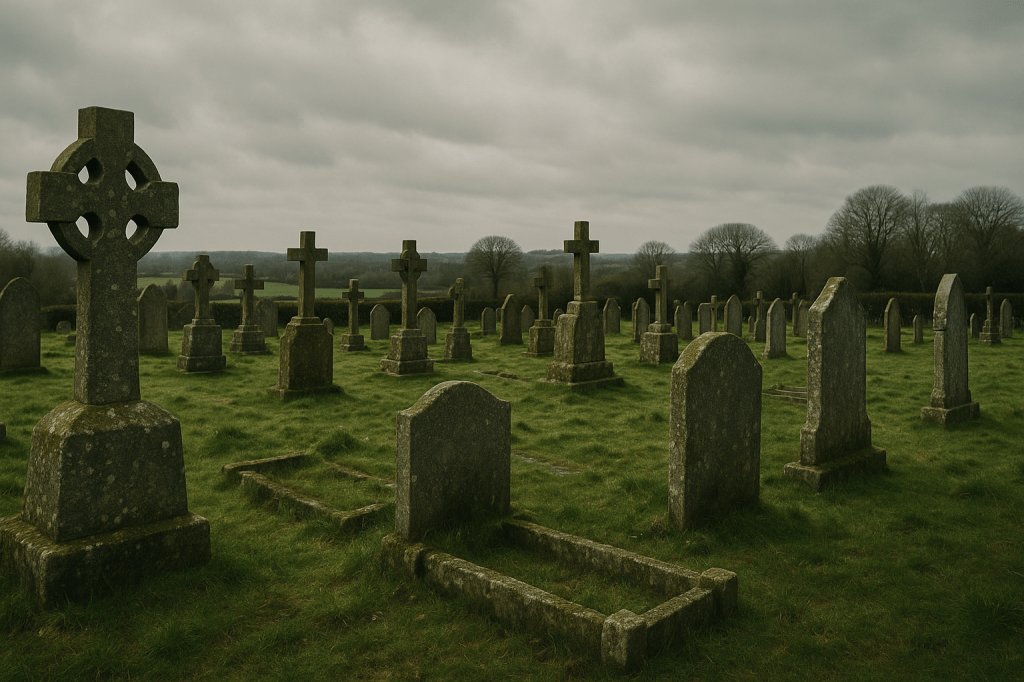
And stood awhile among the tombs around:
“Wherefore, old friends,” said I, “are you distrest,
Now, screened from life’s unrest?”
But that our future second death is near;
When, with the living, memory of us numbs,
And blank oblivion comes!
“These, our sped ancestry,
Lie here embraced by deeper death than we:
Nor shape nor thought of theirs can you descry
With keenest backward eye.
“They count as quite forgot;
They are as men who have existed not;
Theirs is a loss past loss of fitful breath:
It is the second death.
“We here, as yet, each day
Are blest with dear recall; as yet, can say
We hold in some soul loved continuance
Of shape and voice and glance.
“But what has been will be —
First memory, then oblivion’s swallowing sea;
Like men foregone, shall we merge into those
Whose story no one knows.”
“Well: sooner let it be;
Who, being about to die, desires disease?
There’s taste in toothsome death—but none in this.
Bland blunting of the Miss.”
Reflection and Commentary – ‘The Second Death’
Few poets have stared into the mouth of time as unflinchingly as Thomas Hardy. To read The To-Be-Forgotten is to feel the centuries breathing faintly through the grass, each blade whispering of one more erased existence. Hardy isn’t so much writing a poem about death as he’s conducting an audit of remembrance — a quiet accounting of who, among the buried multitudes, still flickers in the mind of the living.
The poem’s conceit — the ‘second death’ — is devastating in its simplicity. The first death is biological, inevitable, shared. But the second, the obliteration of memory, is social, accidental, and cruelly uneven. Hardy’s dead lament not their burial but the prospect of being doubly erased: first by decay, then by neglect. It’s a haunting idea — that we don’t truly die until the last person who speaks our name dies too.
There’s something almost psychological in Hardy’s layering of deaths. Freud’s notion of the ‘death drive’ — the pull toward dissolution and forgetfulness — might find its poetic twin here. Hardy’s ghosts aren’t the raging spectres of Gothic fiction but resigned analysts of their own extinction. They stand like patients describing their symptoms to an invisible doctor — symptoms of memory fading, of their names dissolving from the ledger of the world.
The ‘second death’ also carries a biblical echo. In Revelation 20:14, the ‘second death’ is the lake of fire — eternal separation from God. Hardy, ever the agnostic mystic, replaces hellfire with silence. Oblivion, not punishment, is his apocalypse. To be unremembered is to be cast out from creation itself. There is in this a peculiar English stoicism: no drama, no wailing — merely the quiet horror of vanishing altogether.
The setting of the poem, that ‘tombed’ Dorset hillside, becomes a moral landscape — half pastoral, half purgatorial. Hardy’s England is no longer the green and pleasant land of Blake; it’s an archive slowly mouldering, each gravestone a page that time is patiently erasing. The dead, once ‘blest with dear recall,’ are aware that their reprieve is brief. Memory, that last candle, sputters and goes out.
And yet — and yet — Hardy’s irony saves him from despair. That final stanza, which some critics have dismissed as flippant, is his most profound gesture. ‘Who, being about to die, desires disease?’ he asks, rejecting the sentimental hunger for remembrance. To linger half-alive in the thoughts of others is, to Hardy, a sort of putrefaction of the soul. ‘There’s taste in toothsome death—but none in this bland blunting of the Miss.’ The line has the bite of a man who knows that fame is just another form of rot — and that obscurity, properly accepted, is the only clean death.
We’re reminded, perhaps, of Camus’ later remark that ‘to be deprived of one’s illusions is to see the world as it is.’ Hardy saw the world as it was — unvarnished, unsupervised by any divine archivist. And in that nakedness, he found a grim nobility. Life may be fleeting, memory fickle, but there’s dignity in the brief spark before extinction.
It’s tempting, reading this, to rebel against Hardy — to insist that art, poetry, and love preserve what time erases. But even the poet knows his rebellion will fail. His lines, too, will one day sink into the ‘swallowing sea.’ The very poem we’re reading warns of its own fate. And that self-awareness is what makes Hardy modern. He writes in full knowledge that poetry can’t conquer oblivion; it can only serenade it beautifully.
Perhaps that’s the final mercy Hardy offers: that while eternity may not remember us, we can at least remember ourselves — for a moment, here, now — and find a strange sweetness in our smallness. The ‘second death’ can’t touch the instant of being alive to it. In the end, Hardy’s vision isn’t despair but acceptance: a stoic peace carved into stone, weathered, and still faintly legible under the rain.

 Wording