What book are you reading right now?
There are some novels that pretend to be about the devil but are, in truth, about the far more distressing creatures that live under our own ribs. Rosemary’s Baby is one of them. On the surface it’s a story about covens, conspiracies, ancient rituals, and a baby with unfortunate parentage. But peel away the sulphur, scrape off the candles and chanting, and you’ll find something far more recognisable, far more neighbourly, and therefore far more terrifying: the quiet worship of self-interest.
Whenever I reread Ira Levin’s tale, I’m struck by how little sorcery is required to ruin someone’s life. Rosemary doesn’t fall prey to demons — she falls prey to politeness, that strange moral opiate which prevents us from interrupting evil when it knocks, coughing politely, on our door. The horror of the book is not that the Devil walks in Manhattan; it’s that ordinary people hold the door open for him because they don’t want to seem rude.
Guy, of course, is the most banal kind of traitor: the ambitious artist whose talent isn’t quite enough, and whose moral fibre melts faster than a cheap candle. Goethe warned us that the devil’s favourite meal is the mediocre man who wants just a little more applause. Guy doesn’t sell his soul so much as he leases it on a monthly plan with guaranteed upgrades. It’s not that he’s evil — no, far worse — he’s weak.
And weakness, when decorated with charm and a rehearsed smile, is indistinguishable from wickedness.
The Castavets, those nosy neighbours who smell faintly of talcum powder and ancient heresy, hardly need to be witches at all. They could have been a badminton club conspiring over rosemary tea, and the result would be the same: an older generation feeding on the hope of the young, leeching their futures with the gentle insistence of ‘we know what’s best for you, dear.’ Every society has its Castavets, and most of them live upstairs.
The real story, though, is Rosemary herself — the woman who slowly awakens inside her own nightmare. Her journey isn’t supernatural; it’s existential. She begins as a creature shaped by the domestic sermons of the 1960s: be agreeable, be pretty, be patient, be trusting. And then she confronts the ultimate test — the moment she realises that everyone around her is lying.
There’s a particular loneliness in that revelation. Kierkegaard would have called it the anguish of truth; Jung would call it the collapse of the persona. I call it Tuesday.
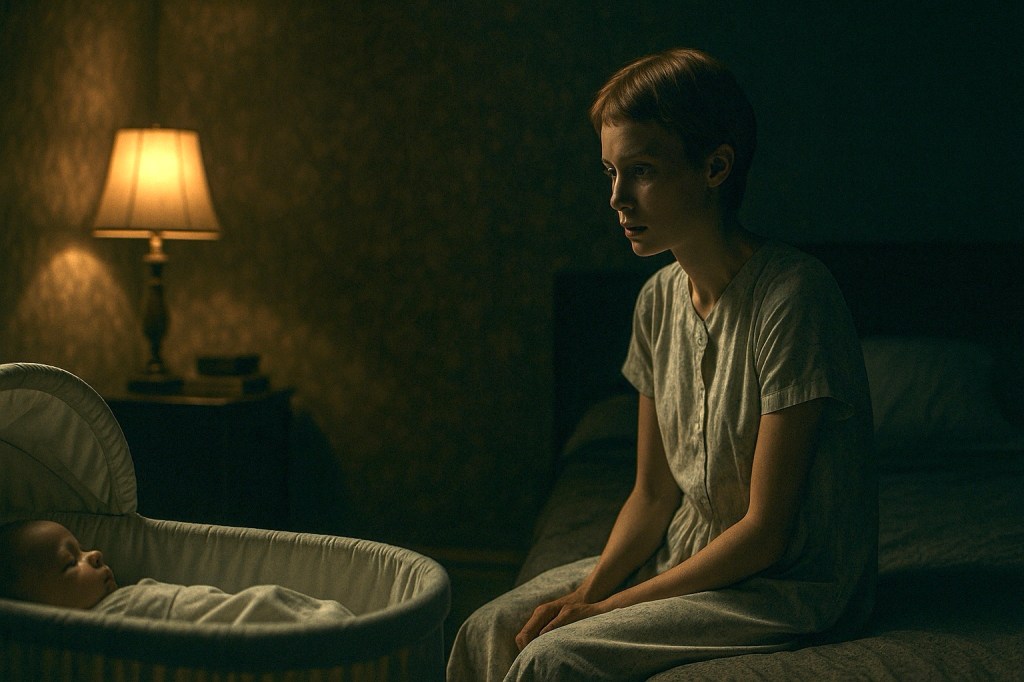
Rosemary’s terror doesn’t come from Satan but from the collapse of certainty. From the knowledge that the bed in which she sleeps — the most intimate, vulnerable landscape of the soul — is no longer a sanctuary but a stage on which other people’s agendas are rehearsed. It’s the horror of the woman who realises her own life is being written by someone else’s pen.
And yet — the ending. The cradle. The child. That strange, unsettling moment when love reveals itself as the most irrational, un-governable force in the universe. You can dress evil in velvet, call it a ritual, give it a genealogy — but place a newborn before its mother and watch the doctrine of the human heart erupt in defiance of every theological diagram.
‘His eyes… they’re his father’s.’
And still she rocks the cradle.
It’s the most blasphemous line in the novel, because it suggests what theologians fear most: that love can bloom even in the soil of hell. Not sentimental love, not romantic love, but that ancient, unchosen, biological devotion that makes mockery of our moral categories.
The greatest heresy of Rosemary’s Baby isn’t that Satan has a son — but that even Satan’s son might be loved.
And that, perhaps, is what unsettles me most. Not the covens, not the candles, not the satanic lullabies floating through a New York apartment. What lingers, like incense on old wallpaper, is the realisation that the line between innocence and complicity runs through every one of us. That we, too, might endure the unbearable simply because it’s ours.
In the end, Rosemary doesn’t defeat evil; she tucks it in. And I, closing the book with a shiver, am forced to ask myself a question far more terrifying than anything Ira Levin intended:
If evil came to me swaddled in a blanket, would I really know what to do?

 Wording