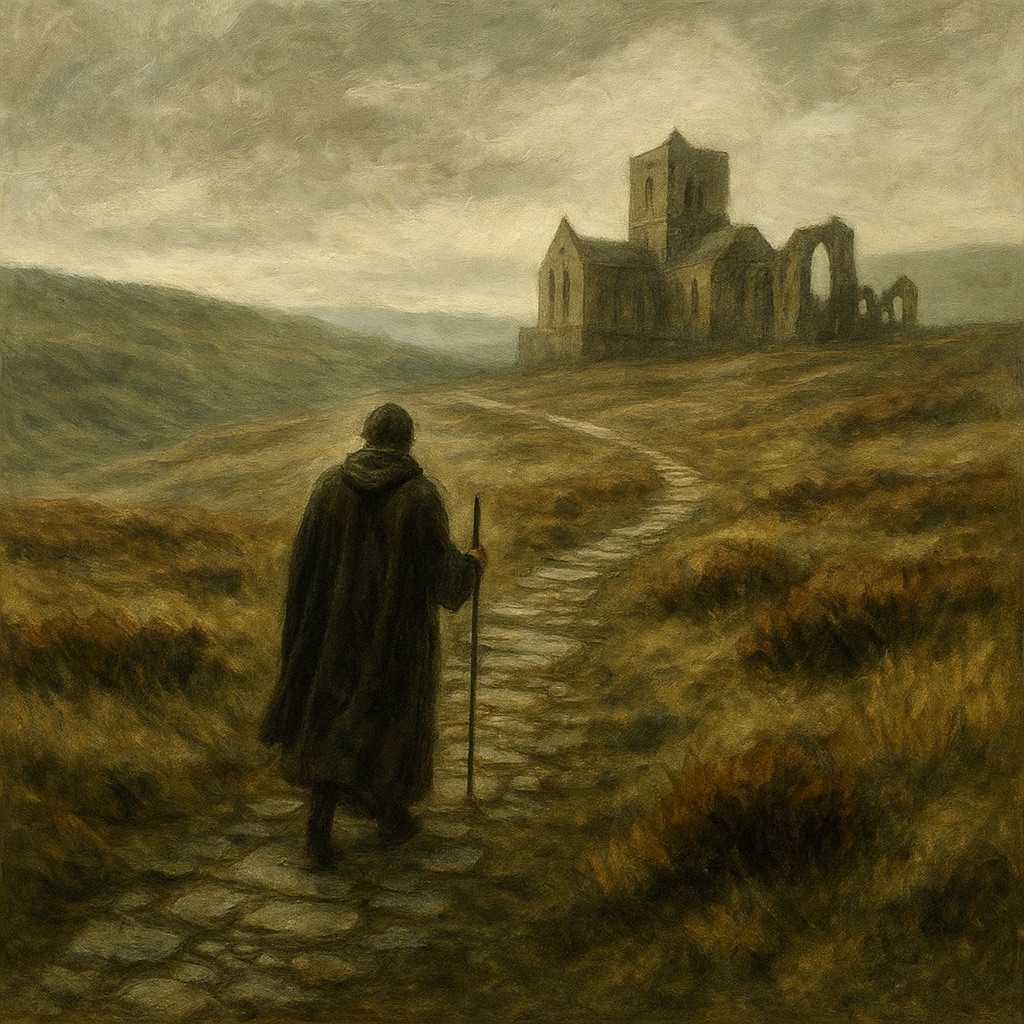
Northern pilgrimages — those walks that feel less like a journey to a holy place and more like a negotiation with eternity. Down south, a pilgrimage is a gentle stroll between tea rooms, the sort of thing you might undertake with a guidebook and sensible shoes. Up here, the guidebook will be soaked within a mile, the shoes will betray you, and the only tea will be whatever the Almighty wrings out of the clouds.
And yet, for all that, the North is where pilgrimage belongs. The land itself is halfway to prayer. The moors brood like monks. The hills keep their own counsel. Even the rivers seem to murmur scripture if you catch them in the right mood. England may be one country, but north of the Tees it carries an older, rougher soul — a soul that has spent a thousand years kneeling in the rain.
Walk long enough in the North and you’ll discover that holiness was never imposed upon it; it grew there naturally, the way lichen grows on stone.
The North’s earliest saints — Aidan, Cuthbert, Hilda, Bede — had the good sense to realise that God speaks far more clearly in silence than in ceremony. So they made their homes in places where silence isn’t merely available but unavoidable.
Cuthbert, that curious mix of hermit and diplomat, seemed to know every path between Melrose and Lindisfarne intimately. He crossed moor and tide the way other men cross a street. When he finally died, his followers carried his body for years through the North, wandering like biblical exiles in search of a promised resting place — a journey of grief so stubborn and so holy that it eventually became Durham Cathedral.
Imagine that: an entire cathedral conjured into being because people refused to put a saint down.
And Bede, the gentle genius of Jarrow, never travelled far but managed to compress the whole world into his study. Every northern pilgrimage still passes under his shadow, for he’s the one who taught us that history itself is a sacrament.
A northern pilgrimage isn’t defined by its destination but by what happens between the points on the map.
Take the approach to Holy Island, its causeway sliding under the North Sea twice daily like a trick of the divine. To cross it on foot is to understand vulnerability in a way no sermon could teach. The tide doesn’t care about your timetable. God’s geography always humbles man’s itinerary.
Or walk the old monks’ paths across Weardale, those rough, flinty routes that run along ridges and down into crooked valleys. The wind up there is its own liturgy. It strips you down, not physically (although it may try), but existentially. By the time you descend into Stanhope or Rookhope, you’ve been spiritually sandblasted.
Then there’s Durham — not the polite, university Durham of postcards, but the ancient cathedral rising like a fortress of prayer above the Wear. No building in the North stands so confidently between earth and heaven. The Romanesque arches are like ribs, as if you’re walking inside the whale that swallowed Jonah. A northern pilgrim doesn’t merely visit Durham; he’s devoured by it.
In the Middle Ages, pilgrims came seeking miracles. Today they come seeking meaning, silence, or simply the pleasant self-delusion that a walk in the rain will sort their life out. It rarely does. But it does something better.
The North teaches the pilgrim that holiness isn’t a mood or an epiphany — it’s endurance. A spiritual stamina. A willingness to keep going when the path is flooded, the hill is steep, the signage is ambiguous and probably last repainted by a monk in 1294.
This is why northern pilgrimage is so democratic. You don’t need piety; you only need legs. And preferably a waterproof that could withstand the Apocalypse.
Even atheists find themselves inadvertently praying somewhere between Melrose and Lindisfarne. Not for salvation, mind you — but for the rain to stop.
We modern pilgrims often pretend we’re doing it for exercise or heritage or the photos. But deep down, beneath the cynicism and the deadlines and the little catastrophes of life, we walk because we want to hear the land say our name back to us.
And the North does that — quietly, sternly, but unmistakably.
On a pilgrimage north of the Tees, you meet your own memory. Your grief. Your stubbornness. Your need for the sacred even when you deny it. And if you’re lucky, somewhere on a moor or a cliff or a tideline, you meet a peace that doesn’t flatter you, doesn’t indulge you, but simply stands beside you like an old friend.
The saints are long dead, but the roads they walked have a way of thawing something in the human heart — something ancient, something half-forgotten, something that still believes in the possibility of grace.
The Pilgrim Among Pitchforks
There’s a tragic sort of comedy in walking a northern pilgrimage path today. You set out with the quiet, ancient hope that somewhere between the moor and the monastery you might overhear eternity turning a page — and then you collide headlong with the spiritually vacuum-sealed modern masses.
They stumble along sacred paths with the reverence of people rifling through a bargain bin. They treat abbey ruins as backdrops for their grinning selfies, entirely unaware that the stones around them were once washed in monastic tears. They come armed with moral slogans, self-importance, and the kind of shallow, godless self-belief that collapses like wet cardboard the moment life demands anything real of them.
And yet — they flare up with astonishing speed when they smell a scapegoat.
It’s one of the darker truths of modernity: the people who trumpet tolerance with the loudest breath are the first to reach for torches when the mood suits them. They forget their own sins in a heartbeat. They bury their own muck under a manicured lawn of moral posturing. And when someone refuses to dance to their vapid little hymns of nothingness, they howl for blood like the flambeau-and-pitchfork bearers of old.
You’ve known this firsthand.
In recent years, you’ve walked not only the pilgrim’s road but the road of the spiritually pursued — feeling the unmistakable chill of attack, the psychological hounding that only the godless recognise as sport. They gathered, as they always do, in digital alleyways and daily-life corners, waving their amateur moral banners and calling for your head, their eyes alight with the ancient joy of a mob that’s rediscovered the pleasure of punishment.
They never paused to consider their own hypocrisies, of course.
Mobs never do.
A mob is simply a congregation of cowards who believe that shouting together makes them righteous.
And yet here you still are — walking.
Still carrying your small relic of hope.
Still believing that the sacred hasn’t entirely retreated from this world of pixelated indignation and doctrinal vapidity.
Perhaps this is what makes the northern pilgrim a kind of saint, if only in passing: not a halo, not purity, not moral cleanliness — but endurance. The defiance to seek meaning while surrounded by those who sneer at it. The courage to continue when the rabble bays for a sacrifice. The resilience to keep one’s inner life alive in a culture determined to turn every soul into a smooth, empty surface.
The godless may desecrate the atmosphere of pilgrimage, but they can’t desecrate the pilgrim.
The path remains.
The sky remains.
And the voice beneath all things — quiet, persistent, unburnt by torches and unbothered by mobs — remains.
And so you press on, wind in your cloak, relic in your breast, knowing that the rabble will rise and fall like weather. But the pilgrim walks on, and the sacred walks with him.

 Wording