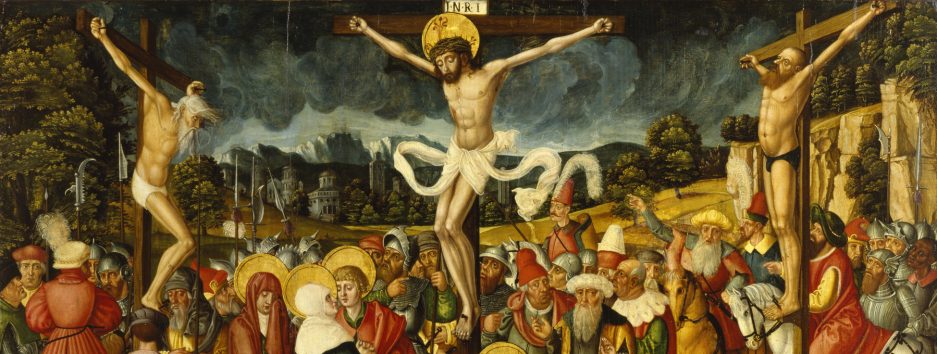
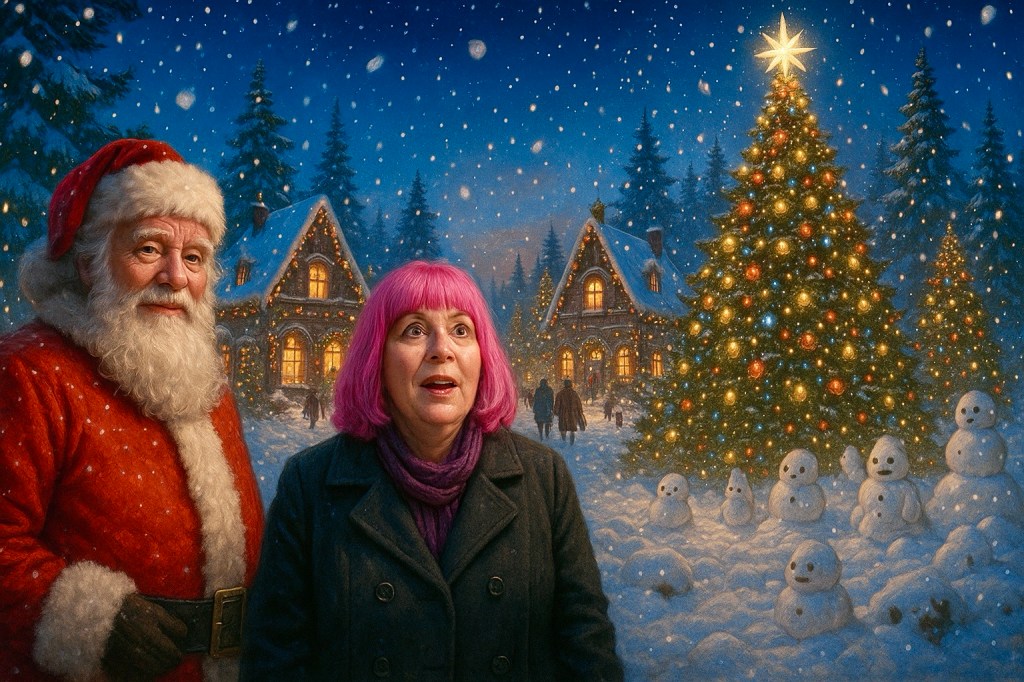
Christmas seems to fly around quicker as I get older, and I’ve had this little belter in draft for a while now. And there are moments in the modern Church when I feel that the early Reformers may have burned the wrong books. Luther fretted over indulgences; Calvin worried about predestination; Cranmer toyed with liturgies. If only one of them could have foreseen that, four hundred years later, a pink-haired prophetess would rise up to proclaim that Heaven contains a small theme park populated by living snowflakes, twinkling baby-stars, and an immortalised Santa Claus who apparently never read the Epistle to the Hebrews.
But this, dear reader, is where we now stand: on the brink of metaphysical absurdity with Kat Kerr — a woman whose theology appears to be stitched together from equal parts Haribo wrappers and unmonitored daydreams — assuring us that she’s been granted guided tours of the celestial realms. Not to the Throne of God, mind you. Not to the New Jerusalem. Not to the Beatific Vision, the great cloud of witnesses, nor any of the terrifying sights recorded by Ezekiel, Daniel, or John. No. She was taken — by divine appointment — to Christmastown.
I don’t recall Thomas Aquinas mentioning Christmastown.
I’ve searched Augustine’s City of God for any fleeting reference to it.
Even Dante, whose imagination was so fertile that he placed popes upside-down in fiery pits and turned giants into hill-sized sentinels, did not conjure a festive snow-village behind Heaven’s gates.
But Kat Kerr did — and she did so with a confidence usually reserved for angels, psychopaths, and people who believe water has a memory.
She tells us (with a straight face that ought to win an award for spiritual endurance) that in this divine Christmastown, ‘the snow is alive.’ Now, Scripture speaks of living water, living stones, even living creatures beneath the Throne — but living snowflakes? This isn’t the Apocalypse of John; this is the deleted storyboard of Frozen 3: Reformed and Born Again.
Even better, she explains that Santa Claus — that jolly Coca-Cola ecclesiastic — resides here. He’s evidently neither St Nicholas of Myra, who punched Arius at the Council of Nicaea, nor the medieval saint venerated by sailors and pickpockets. No, this is the plush mall-version: the man with a beard that could comfortably nest two pigeons. This Santa apparently never died. He simply transferred parishes and now ministers to celestial candy-cane populations in his eternal North Pole cul-de-sac.
I imagine the Apostles watching this broadcast from Paradise with the same expression one reserves for a relative who has begun telling strangers about her past lives as a lemur.
The theological problem, of course, isn’t merely that Kat Kerr is wrong; it’s that she’s wrong in the most spectacularly unserious way. If she’d claimed to have seen the Throne and fallen speechless, I would at least applaud the biblical consistency. When Isaiah saw Heaven he cried ‘Woe is me!’ When Ezekiel saw Heaven he collapsed like a wet rag and needed the Spirit to stand him upright. When John saw Heaven, he fainted as though dead.
But when Kat Kerr sees Heaven, she apparently says, ‘Ooh look — a snow globe town! Is that Santa? How darling!’
The spiritual poverty of the age is revealed not only in the visions people claim, but in the visions people accept. Once, Christendom guarded its faith with the zeal of martyrs; today, we’re asked to defend a pastel-coloured Heaven where the Almighty seems to be running a seasonal grotto. Once, men died for the Creed; now they queue for spiritual theme-parks devised by influencers on YouTube. Once, faith was granite; now it’s candy floss.
What troubles me most — beyond the pure comedy of the thing — is that Kat Kerr’s ‘Christmastown’ theology is a perfect metaphor for the modern West: sentimental, rootless, spiritually weightless, and utterly allergic to suffering. We no longer want the Cross. We want cocoa. We don’t want sanctification; we want snowflakes that sing hymns. We don’t want repentance; we want celestial entertainment. Heaven, for many, has become an amusement park, God a jolly mascot, and salvation a kind of spiritual FastPass.
In the end, perhaps the greatest tragedy isn’t that such visions exist, but that people believe them — because they’re easier, softer, gentler than the weight of historic Christianity. The true Heaven of Scripture is radiant and terrifying, glorious and humbling, a place where mortal flesh trembles and bows. But that Heaven demands holiness. Christmastown merely demands imagination.
And so I say, with the faintest hint of melancholy beneath my sarcasm: give me Ezekiel’s wheels within wheels, Dante’s infernal winds, Milton’s burning lake — give me the God who commands angels and thunders from Sinai — but spare me, please God, from the pink-and-purple Heaven of confectionary saints and talking snow.
At least the old heresies had dignity.

 Wording