Been a while since I looked at a play. So..
There are moments in literature when I realise the human race isn’t merely flawed but gloriously, catastrophically absurd. Gogol understood this long before Beckett ever let Vladimir and Estragon wander out onto a dusty road to wait for a man who’d never come. If Waiting for Godot is the poetry of cosmic futility, then The Government Inspector is the operatic buffoonery of civic collapse, the moment when an entire town stares into the bureaucratic abyss and sees, not judgement, but its own trembling reflection.
The premise is simple: a corrupt mayor hears an incognito government inspector is on his way. Panic erupts. The town’s officials scuttle about like beetles in a tin pan — bribing, flattering, cleaning, hiding evidence, and generally sweating through their uniforms like men who know that justice, if it ever arrives, won’t be kind. Into this pandemonium strolls Khlestakov: a penniless, vain little man whose greatest achievement prior to this moment wasn’t starving to death in a Petersburg boarding house.
But hysteria has its own logic, and the townspeople see what they want to see. They baptise this idiot in the holy water of their paranoia and immediately elevate him to godlike status. And here lies the genius of Gogol: Khlestakov, a man with no qualities, becomes a monster of influence simply because everyone else has agreed to hallucinate him into one.
He doesn’t deceive the town.
The town deceives itself.
In this sense, the play stands as a spiritual forefather to Beckett. Where Beckett gives us characters waiting for a saviour who’ll never arrive, Gogol gives us characters choking with dread over a judge who’s not only absent but entirely imaginary. Both worlds orbit the same dark truth: the human mind is perfectly capable of manufacturing its own torment.
Corruption in the town runs like rot beneath wallpaper — laughed at, ignored, half-justified. Officials are lazy, cruel, bribable, boastful; they exist in a perpetual dance of mutual delusion. When crisis comes, they don’t repent; they don’t correct; they don’t learn. Instead, they fall over one another in a manic frenzy of self-preservation, like sinners rushing to light candles at an altar they sneer at the rest of the year.
And Khlestakov, bewildered but eager, goes along with it. He lies because he’s encouraged to lie; he boasts because people clap when he does; he becomes a tyrant simply because no one dares to call him what he is: an empty vessel filled with other people’s fear.
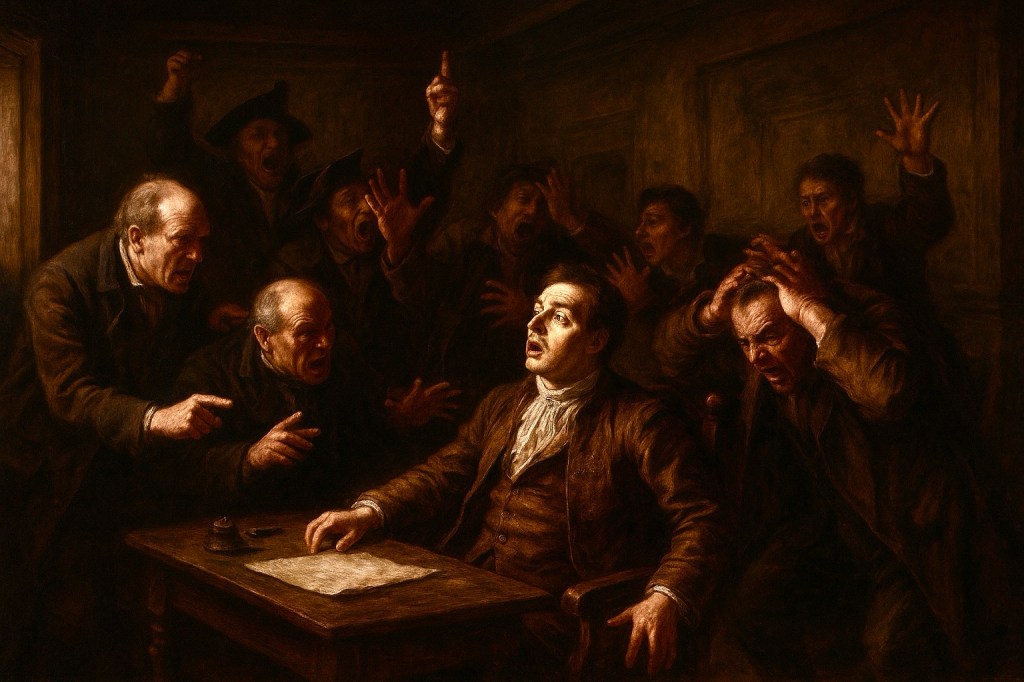
The ending — one of the greatest in dramatic history — is a frozen, wordless tableau. The real inspector has arrived. The truth stands at the door like an executioner. And the whole cast, in a single breathless instant, is carved into silence. It’s as though time itself holds up a mirror and says: Look at you. All of you. What have you become?
Beckett’s world is bleak because it strips humanity down to existential bone; Gogol’s world is bleak because he leaves the flesh on — and shows it rotting.
But both, in their own way, reveal the same bitterly comic wisdom:
Left to our own devices, we’ll invent our own Godots, our own Inspectors, our own doom.
And we’ll greet them with the trembling reverence normally reserved for salvation.

 Wording