I suppose I should confess at the outset that my interest in Queen Mary I’s embalming didn’t spring from some lofty academic impulse, but from years spent in the trade myself — years of sewing mouths shut, persuading stubborn limbs into positions they hadn’t attempted since the Thatcher era, and discovering that even the most respectable families will argue like dockyard brawlers over who gets the ashes. Once you’ve embalmed enough people to populate a small village, you naturally begin to wonder how the royals fared under the knife. And because I also happen to love narrative history — particularly the blood-spattered soap opera that was the Tudor age — the question eventually became irresistible: how did they keep a queen presentable before deodorant was invented?
It turns out the answer is delightfully grim. The Tudors, bless them, combined piety with butchery in a way only the English ever could. And so, with the enthusiasm of a man who has spent too long around formaldehyde and never quite recovered, I found myself digging (figuratively, not literally — I’ve learned from experience to avoid exhumation unless invited) into the strange afterlife of Mary I. What I discovered was that royal embalming was less a rite of dignity and more the medieval equivalent of taxidermy for important people.
If anything, my years in the mortuary only sharpened the curiosity. Once you’ve drained old Mr Thompson and packed him with enough cotton wool to stuff a sofa, you begin to look back at history’s grand funerals with a certain professional empathy — and occasionally a professional wince. Because behind every majestic Tudor procession was some poor sod elbow-deep in a monarch, muttering prayers, spices, and quiet curses in equal measure. And that, needless to say, is where Queen Mary’s story becomes very interesting indeed.
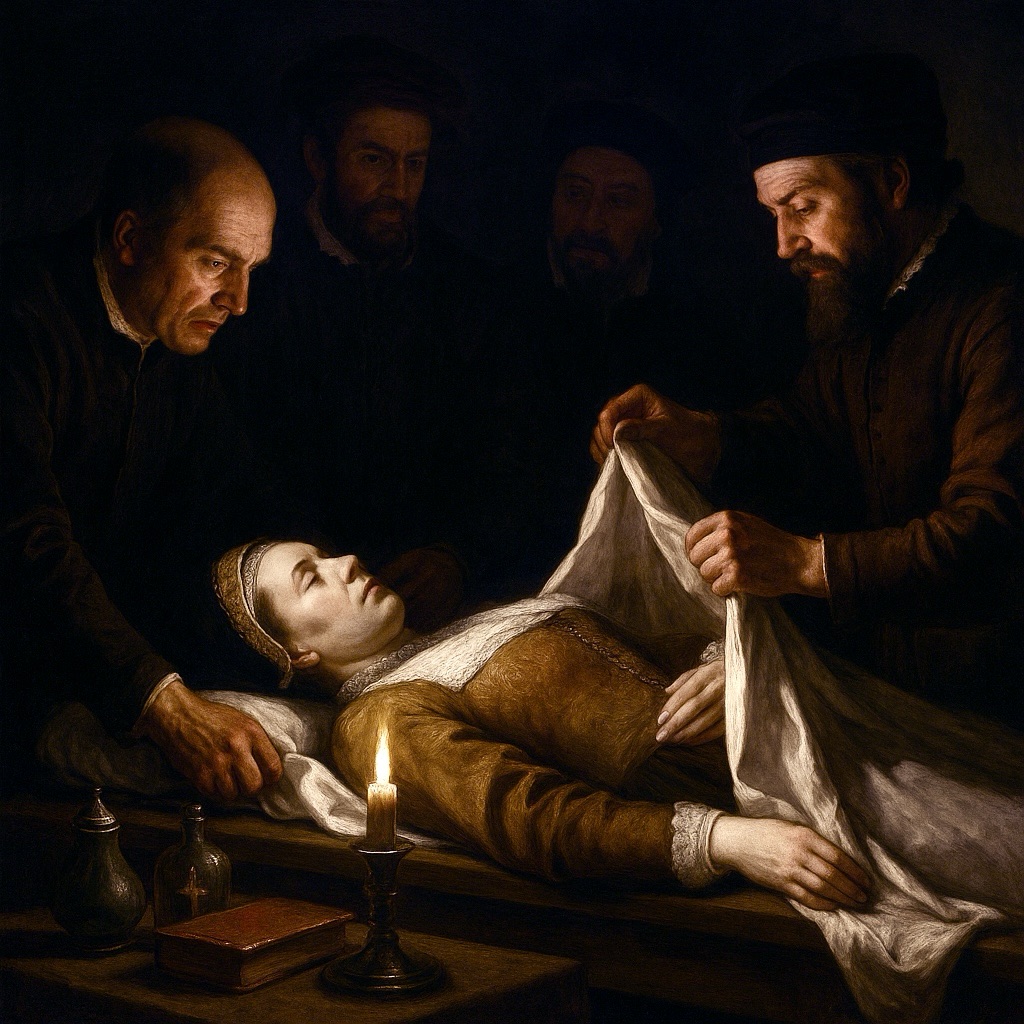
In history, sometimes the distance between splendour and butchery becomes so thin you could slice it with a Tudor surgeon’s knife. One such moment arrived on a cold morning in 1558, when Queen Mary I — that much–maligned daughter of Catherine of Aragon, ‘Bloody Mary’ to the Protestant fabulists who made a career out of exaggeration — slipped finally from this world and into the hands of the royal embalmers. Death, for monarchs, was never private. It was a public performance with a backstage area more chaotic than any theatre. And the backstage, in Mary’s case, was a wooden table, a set of sharp instruments, a basin of wine, and a group of men who knew far more about the inside of a queen than any historian ever would.
The surgeons descended upon her with the brisk, unsentimental professionalism that accompanies both the butcher and the priest. Out came the viscera — stomach, liver, lungs, bowels — the very machinery that had sustained the sovereign body through years of sickness, sorrow, religious fury, and political disappointment. These were washed reverently in warm wine, salted like a Lenten fish, and anointed with the sort of spices that would make even a modern aromatherapist blush: cinnamon, storax, benzoin, clove, and whatever exotic resin the apothecary hadn’t sold to a lovesick courtier that week. Wrapped and placed in a small airtight lead canister, Mary’s inner life — quite literally — was buried beneath the altar of the Chapel Royal at St James’s Palace. Meanwhile her outer life — the embalmed, purified, and carefully restored image — processed in grand splendour to Westminster Abbey, where she lies still beneath the glittering Cosmati pavement.
To later generations — especially the excitable Victorians with their séance tables and embroidered hysteria — this separation of organs invited melodramatic interpretation. Rumours spread, as they always do, that the Tudors buried viscera separately to prevent spirits rising, or demons returning through the entrails (one wonders whether Dickens himself would have found the tale too fanciful). But the truth, as ever, is more mundane — and therefore far more revealing. The Tudors didn’t fear spirits half as much as they feared smell. ‘Corruptio prima,’ the theologians called it: the first corruption of the flesh, which begins, quite scandalously, in the soft organs. If you wish to present a monarch in state, with candles burning and choirs chanting and foreign ambassadors pretending not to be bored, you must first prevent her from announcing herself to the congregation in the manner of an overripe cheese. Remove the organs, treat them, bury them near the place of death, and the corpse — purified, stitched, stuffed with herbs, and wrapped in linen — becomes safe to display. Royalty, after all, has never been compatible with honesty.
Mary I wasn’t singled out. Henry V had his heart buried in Rouen, his bowels in a separate reliquary. Edward IV and Henry VIII were likewise divided. Even minor nobles found themselves disembowelled for the greater glory of God and the convenience of their surviving relatives. It was ritual, practical and sacred in equal measure, not superstition. Medieval theology held that the soul, not the flesh, awaited the resurrection; the organs, being the first to decay, were best given to holy ground as soon as possible. In this there’s something faintly beautiful, like Chaucer’s pilgrims leaving offerings at shrines: the softest parts of us returning first to God, the bones following later at a statelier pace.
Yet there’s also something darkly comic about the whole affair. Imagine the royal surgeons — men with names that sounded like Latin verbs or German pastries — leaning over the Queen with the solemnity of high priests and the efficiency of abattoir workers. One rinses the intestines in wine (‘Her Majesty’s bowels have finally found a use for Bordeaux’). Another salts them with the liberal generosity of a medieval cook. A third seals the canister, muttering a prayer that the lid holds tight. Meanwhile, the corpse on the table lies as still as a saint in a fresco, awaiting its transformation into the Tudor Deluxe Model: dignified, deodorised, and unlikely to embarrass the realm.
The irony is that Mary I, a woman grotesquely caricatured by Protestant propaganda as a blood-soaked zealot, received in death the most meticulous Catholic care imaginable. Her enemies reduced her to a grisly nickname; her surgeons reduced her to two funerals. Yet in that strange partitioning lies the truest reflection of monarchy: it’s all image. The sovereign body is as much theatre as theology; as much stitching as sanctity. Shakespeare knew this when he put into the mouth of Richard II that razor-sharp line about kings being ‘subject to the breath of every fool.’ Even a queen’s corpse must be managed, curated, presented — embalming is the final act of statecraft.
When I worked in the trade, I learned quickly that death grants no exemptions. I embalmed bankers, bricklayers, mothers, misfits, saints, and sinners, and they all required the same practical interventions. Injection, drainage, sutures, cotton wool, cosmetics, a prayer of hope and a sigh of resignation. The monarch simply receives more linen and better spices. Mary I, for all her royal blood and tempestuous reign, ended her journey in precisely the same truth as every pauper buried on consecrated ground: the soft parts rot, the hard parts wait, and dignity is always an illusion maintained by human hands.
And so Queen Mary lies in two places — the queen above, the woman below. The public body marching with plumes and processions toward Westminster; the private body resting quietly beneath an altar within the palace walls. Between them is the whole mystery of funerary art: part devotion, part deception, part defiance against the slow, inevitable work of time. If resurrection comes, God will find her easily enough; He’s not so easily confused by lead containers. But I suspect that if Mary could speak across the centuries, she’d tell us that being divided in death is a small indignity compared to being misunderstood in life. The surgeons took her organs; history took her character. Only the embalmer tried, in his way, to make her whole again.
In the end, perhaps the most honest view of Mary I isn’t as a tyrant or martyr but as a woman rendered into two burials — one for the appearance, one for the truth. And if that’s not the perfect metaphor for power, for politics, for monarchy itself, then nothing is. As Dante reminds us, ‘the body is but the pilgrim’s cloak; the soul is the traveller.’ Mary’s cloak was carefully mended, perfumed, and paraded; the traveller slipped silently into God’s hands. And between those two realities — between altar and abbey, between organ and crown — lies the tragic, comical, human heart of embalming.

 Wording