It’s one of history’s great absurdities that the Middle Ages believed human beings could fly — and one of modernity’s great dullnesses that we no longer permit them to.
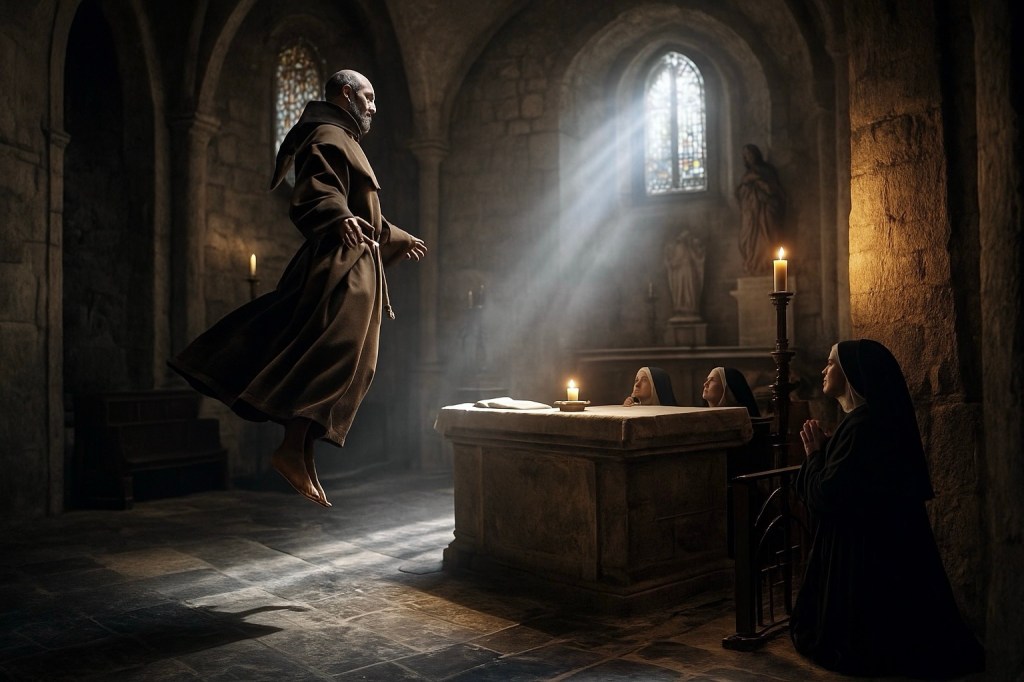
Carlos Eire, in his magnificent and quietly mischievous They Flew: A History of the Impossible, takes us by the hand and leads us into a world our ancestors inhabited with utter seriousness: a world where friars drifted skyward in fits of ecstasy, where nuns clutched the altar rail lest they drift off like holy helium balloons, and where the line between divine grace and demonic mischief ran as thin as a hair shirt. It’s a world of miracles, suspicion, wonder, terror, and — most importantly —meaning.
And it’s a world we’ve lost.
Eire is a historian, not an evangelist; yet there’s something almost pastoral in the way he writes about these airborne saints and spiritual oddities. He doesn’t tell us that they flew, but rather why people believed they flew — and what this belief reveals about the human creature, clumsy biped that he is.
For in those centuries before the Enlightenment clipped every wing it could find, it was widely accepted that holiness sometimes took to the air. Saint Joseph of Cupertino couldn’t trust his own feet: the slightest mention of Christ and up he went, levitating in church, in the refectory, in front of sceptical ambassadors, and once (delightfully) into a tree. This wasn’t a parlour trick; witnesses abounded. Teresa of Ávila begged God not to let her fly. A levitating nun was a PR disaster for a convent; it brought pilgrims, doubters, and ecclesiastical busybodies in equal measure.
To fly was to be touched by God — or touched by something far darker. Witches, too, were said to fly, though usually with far less grace and far more suspicion. The Inquisition, ever the loyal spoil-sport, examined such claims with the grim zeal of a council health inspector. Flight could sanctify or condemn. Either way, it mattered.
What Eire reveals isn’t the physics of levitation but the metaphysics of longing. Human beings want to rise. The body’s a cage; the soul’s a bird. Even now, in our supposedly rational age, we fly — only now we do it in aircraft, antidepressant doses, and YouTube meditation channels. Modernity denies miracles but manufactures substitutes on an industrial scale.
The saints flew because their world was enchanted. Ours is disenchanted and disillusioned, the spiritual equivalent of a retail park in the rain. The medieval mind assumed heaven was close enough to touch, and on rare occasions, heaven reached back. The modern mind assumes heaven is either an old wives’ tale or a postcode in Surrey.
Yet the need remains.
I remember, in the funeral home, watching a widow bend over her husband’s forehead and whisper, ‘Fly home, love.’ She said it with the same utter conviction Teresa of Ávila had when wrestling the divine wind that threatened to lift her off the chapel floor. Neither woman meant aerodynamics. They meant the upward ache — the ancient human instinct that the soul has wings tucked beneath its ribs.
This is where Eire’s book becomes more than an historical oddity. It becomes a quiet indictment of our age. The Enlightenment killed miracles because miracles made life unpredictable. Bureaucrats prefer gravity. Priests once argued whether levitation proved sanctity or seduction by Satan; today’s equivalent would ask whether it breaches health and safety regulations.
But if modernity has rejected the possibility that anyone might fly, it has also ground the human imagination flat. We no longer look at the sky and wonder what holy thing might emerge from it; we merely check the weather app.
And here lies the sting: what if the saints didn’t fly physically at all, but spiritually — and we, earthbound pragmatists, are the ones missing the point? What if levitation was a metaphor that became reality only because the medieval heart understood something we’ve forgotten?
The heart’s lighter than the mind. Faith’s lighter than the empirical. Love’s lighter than the grave. And sometimes, in the collision of those forces, a person rises.
Eire restores that possibility — not to prove it, but to honour it. His work is an invitation to imagine again, to remember that for most of human history, the idea of a soul floating heavenward wasn’t superstition but common sense.
We moderns are, I fear, the true irrationalists: we believe in nothing and wonder why everything feels heavy.
The saints, whatever else they may have been, knew that the world was stranger, holier, and far more alive than our spreadsheets allow. They lived in a universe where God might tug at their feet during prayer.
And so — quietly, reverently — they flew.

 Wording