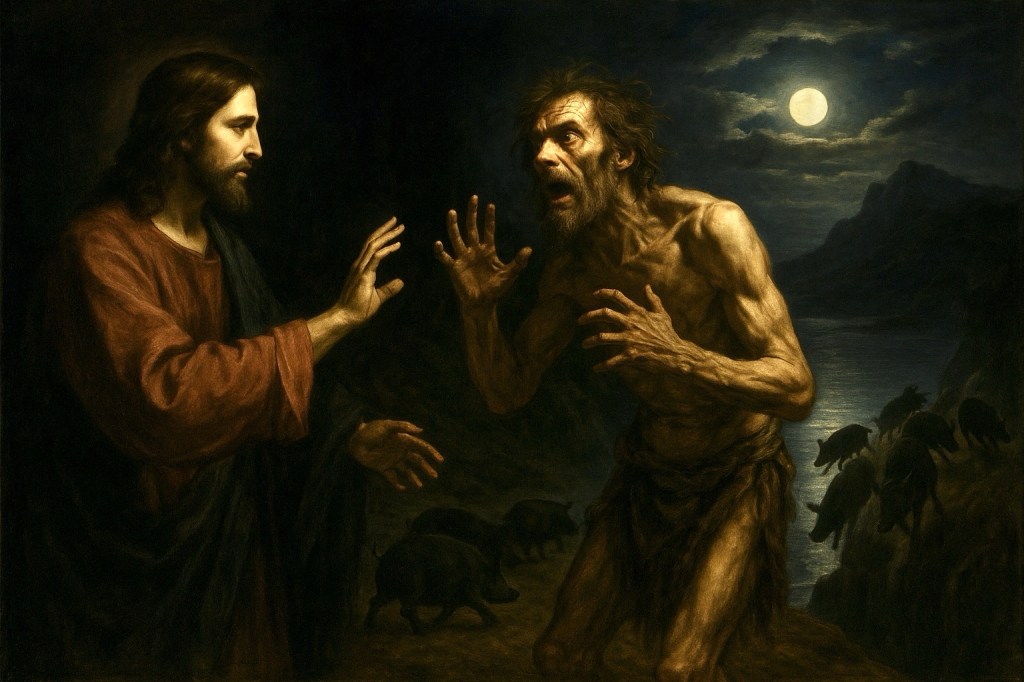
Some passages in Scripture read like thunder: sharp crack, sudden light, then a silence in which something ancient vibrates in the bones. The story of the Gadarene demoniac is one of them. A naked man shrieking among the tombs; chains snapped like wet wool; a village too afraid to bury its dead without one eye fixed toward the cliffs. It’s horror and holiness in the same breath — as though God walked into a nightmare simply to turn on the light.
And when Jesus arrives, the nightmare knows His name.
‘What have You to do with me, Jesus, Son of the Most High God?’
There’s panic in the voice — the quiver of a thief caught with both hands in the till. Then comes the plea, a strange one: send us into the pigs. Not into the Abyss. Not into the void. Into flesh. Anything with breath and heartbeat will do.
For demons, it seems, resent the cold of homelessness.
In Matthew 12:43 we’re told that unclean spirits wander ‘through dry places seeking rest, and finding none.’ Hell, for them, is homelessness. The soul, once glorious, rebelled; now it clings to any ribcage, any nervous system, just to feel warm again. A body — even that of a pig — is a coat against the cosmic winter. Evil has always needed vessels. Cain needed hands. Judas needed lips.
Sin is parasitic — it never builds a body, only borrows one.
There’s an old belief, whispered through Jewish tradition and echoed in early Christian thought, that demons are the disembodied spirits of the Nephilim — the hybrid offspring of the ‘sons of God’ and human women in Genesis 6. Being born of flesh yet fathered by fallen angels, they had no rightful home in either realm. When their giant bodies perished in the Flood, their spirits — neither human nor angel — became restless wanderers, craving once more the physical warmth they’d lost. If so, their plea for the pigs wasn’t merely malice but memory — a hunger for embodiment, however base. Better swine than the abyss; better flesh than the desert wind.
Jesus grants the request, but only to expose it. The pigs — all two thousand of them — sprint like suicidal thunder, tumble over the cliff, and vanish beneath the waves. A grotesque ballet, and over in minutes. It’s evil’s biography compressed:
possession → frenzy → ruin → silence.
There’s your theology in a single stampede.
We sometimes romanticise demons in modern culture — elegant, witty, leather-bound. Yet when given bodies, they drive them into the sea. This is the truth no screenplay dares show: the end of evil isn’t drama but drowning; not conquest but collapse.
Why did Jesus allow it? Because invisible miracles are easy to doubt. A man, once mad, now calm — sceptics could call it coincidence. But two thousand pigs racing like lunatics into watery death? Try writing that off as placebo.
The swine were a sermon the countryside couldn’t ignore. Some lost their livestock and grumbled at the cost, but they missed the irony: they preferred pigs possessed to a man restored. Humans are funny things — we’ll tolerate evil so long as it’s profitable.
The horror of the passage is this: spirits need bodies. And if spirits long for embodiment, then we who have bodies must ask what spirit lives within us. The demoniac was filled with Legion — two thousand voices shouting through one throat. Today, our demons are subtler:
Ambition. Self-worship. Resentment kept warm like a pet. Despair disguised as sophistication. Possession doesn’t always break chains; sometimes it wears a good suit and speaks with cultured vowels.
The pigs show us the end of such things — the tranquil sea, rippling where destruction slipped under. That’s where every hatred, every godless desire leads: into the deep.
But the healed man stayed clothed, seated, and in his right mind — the miracle of a soul no longer sublet to darkness.
I often think of that nameless man — once naked among tombs, later clothed and commissioned. A living parable that no one is beyond the reach of Christ, not even a man haunted by a thousand voices. We shudder at demons, but the Gospel shouts louder: grace is not intimidated.
The demons begged for bodies. Christ gave a man back his own. Perhaps that’s salvation in its simplest form: God returning us to ourselves.
And somewhere beneath Galilee, in the cold dark, two thousand swine dreams still swirl like bubbles — a reminder that evil is dramatic only on the way down.

 Wording