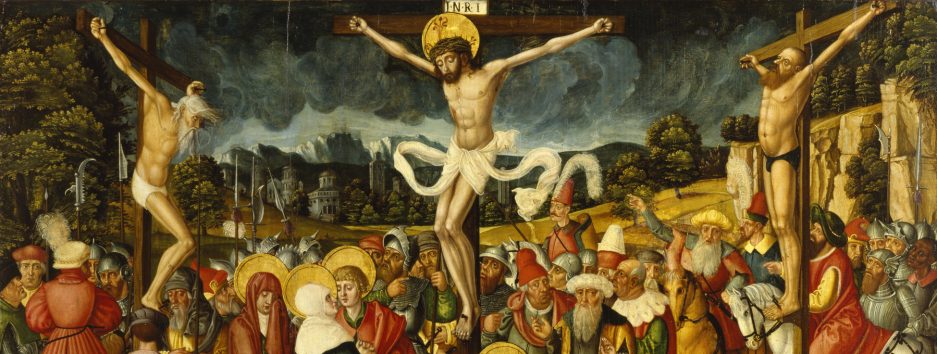
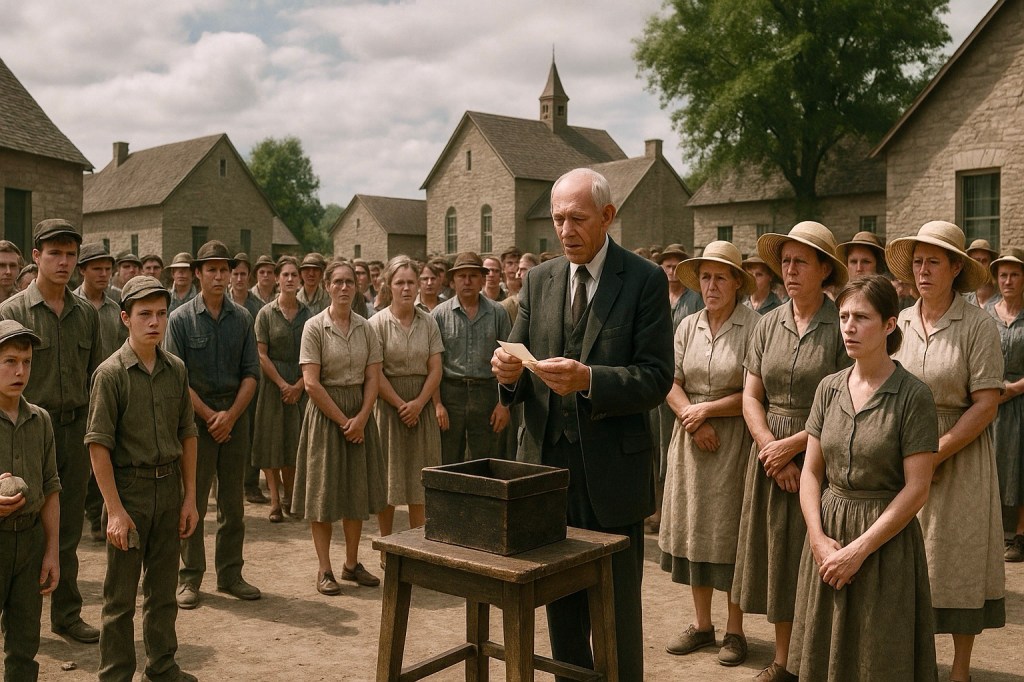
This isn’t a story that creeps like fog, but a story that strikes like a thrown stone. Though Shirley Jackson’s The Lottery manages both. It begins with a sky of perfect summer blue, as though God Himself had painted it fresh for a village fête, and ends with Tessie Hutchinson screaming under a rain of stones thrown by her neighbours – even her children – as casually as one might toss breadcrumbs to ducks. It’s the kind of tale you sit back to read with tea, expecting strawberries and maypoles, and instead you find Golgotha in the village square.
Jackson wrote it in 1948, though it might as well have been yesterday or tomorrow. A small American town gathers for the annual lottery. Children collect stones the way children once gathered conkers. Men talk weather. Women gossip about dishes and babies. There’s a black box – rickety, splintered, patched like an old sin – from which slips of paper are drawn. No one remembers why the ritual began, only that it must continue. ‘Lottery in June, corn be heavy soon,’ someone mutters, as though that explains anything at all. Tradition, when left too long in the sun, ferments into madness.
This is the genius of Jackson: she refuses us the comfort of explanation. There are no robed cultists chanting under the moon, no ancient scrolls or glowing sigils. The ritual is mundane – bureaucratic, even. Like renewing a licence or paying council tax. The villagers aren’t villains; they’re us. Decent folk, fond of gossip and barbecue. They pet their children, sweep their doorsteps, and once a year stone a neighbour to death because that’s simply what one does. Evil rarely arrives with fanfare. More often it arrives with a clipboard.
Tessie Hutchinson, late to the gathering and laughing, becomes the chosen one. She protests, of course – ‘It isn’t fair’ – the way we all would if judgment fell on us rather than someone else. Our sympathy stirs; we dislike her fussing, yet feel the cold pinch of recognition. She’s not heroic. She’s ordinary, surprised that the knife has found her ribs this time. The ritual tightens like a noose, and suddenly the children who gathered stones so playfully now hold them with purpose. A stone in a child’s hand is a theological statement: innocence is no safeguard against inherited cruelty.
I’ve seen something like this in real life. Not stones, but whispers. Smiles turned sharp. A group turning on one as though compelled by invisible tide. Humans are pack animals with better shoes. We follow the crowd to avoid becoming the next sacrifice. Jackson knew this, and she makes no sermon of it; she simply shows us the blade. Her restraint is the cruelty. She doesn’t shout. She purrs. And the horror grows like ivy beneath the prose.
The black box fascinates me most. Splintered wood. Faded paint. A reliquary of fear. Nobody wants to replace it – as though to renew the box would be to admit the ritual is alive and not a relic. This is how societies operate: we cling to old misery because its familiarity comforts us. Churches, governments, institutions – all built on black boxes. We kiss them, fear them, pass them down. And sometimes, like relics of forgotten gods, they demand blood.
Is The Lottery about fascism? About McCarthyism? Witch trials? Cancel culture? All yes, and none completely. It’s about the dark delight of scapegoating, that ancient game where a community purifies itself through one convenient victim. Leviticus knew it. The Greeks perfected it. Twitter (now X) reinvented it in neon. Christianity substituted lamb for sinner, yet even the Church has occasionally thrown stones with both hands. Jackson merely moves the stage to a sunlit square.
What unsettles us most is the ordinary nature of the killers. They’re not demons. They’re neighbours. The people who lend sugar and comment on the weather. Mrs Delacroix – name meaning of the cross, irony sharp as flint – selects a stone ‘so large she had to pick it up with both hands.’ What a beautiful cruelty. The cross becomes the instrument of murder, not salvation. We like to think ourselves saints; Jackson hints we’re only saints when the lottery favours us.
I reread The Lottery and think of every moment humanity has drawn lots and chosen a target. The heretic. The Jew. The witch. The ‘other.’ We’ve traded the stone for the tweet, which bruises slower but lingers longer. The children still gather rocks – only now the rocks are words.
When Tessie cries, ‘It isn’t fair,’ the village doesn’t pause. Fairness is irrelevant; ritual is sovereign. The final image isn’t the violence itself, but its normality. No thunder cracks. No conscience intervenes. Housewives adjust shawls. A stone strikes bone. Life goes on. The horror isn’t that Tessie dies – it’s that everyone else sleeps soundly afterward.
Jackson ends with the clarity of a church bell at midnight. She shows us who we are beneath manners and floral dresses: half saint, half wolf. Civilisation is a veneer, thin and cracking. Beneath it lies the altar. Beneath the altar, blood.
As I place the book down, I wonder quietly: If I stood in that crowd, would I refuse the stone? Or would I, like Mrs Delacroix, reach for one that required both hands? The question doesn’t comfort.
And that – that’s why The Lottery endures.

 Wording