It began, as most life-altering things do, without warning.
Mary wasn’t praying for revelation. She wasn’t prepared. She was simply living — and that, it seems, was enough. The angel didn’t descend with thunder or spectacle, but with words. A greeting, strangely formal, and yet weighted with eternity. She was told she was favoured, though nothing in her life suggested advantage. She was told she would conceive, though she knew enough of the world to understand impossibility. The Holy Spirit would overshadow her. The child would be called Son of the Most High.
Mary didn’t argue theology. She asked only how — and when the answer came, it didn’t explain, it invited. The world would tilt; she’d carry the consequence. And in the quiet space between fear and obedience, she spoke the most dangerous sentence in history: Let it be done unto me. With that consent, heaven entered flesh.
The miracle didn’t announce itself. Her body changed before her understanding did. God grew silently beneath her heart, learning humanity in secret. The infinite became hidden. The eternal waited.
Needing confirmation more than comfort, Mary travelled to the hill country to see Elizabeth — her kinswoman, old enough to know despair, and now miraculously alive with hope. When Mary crossed the threshold, the child in Elizabeth’s womb leapt, as though recognising a presence older than language. Elizabeth, filled with the Spirit, spoke blessing before explanation, joy before proof.
Two women stood together — one young, one old — both bearing impossible life, both knowing the cost would be theirs to carry. Mary sang then, not a lullaby but a revolution. The proud would fall. The lowly would rise. God wasn’t arriving to maintain the order of things.
Time moved. Rome counted its subjects. Caesar required obedience, and obedience is rarely convenient. Joseph and Mary travelled to Bethlehem — a name meaning House of Bread — carrying within her the Bread of Life. There was no room. There never is. So God was born where warmth was borrowed and dignity improvised.
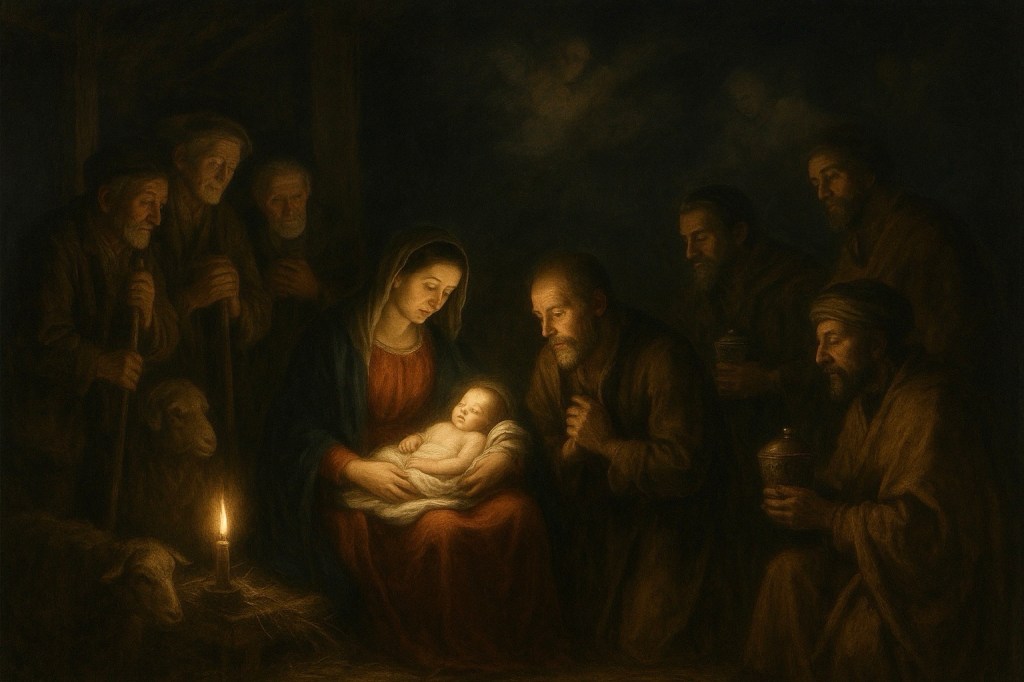
The child arrived without ceremony. Mary laboured. Joseph steadied. The world continued unaware. The Son of God entered it crying, as all humans do, because incarnation hurts. Wrapped in cloth, laid in a feeding trough, He rested where animals ate — creation, it seemed, recognising its Creator before humanity did.
Shepherds came first. They always do. Men without status, without invitation, without reputation. Heaven spoke to them because heaven isn’t impressed. They knelt without instruction. They understood enough.
Later came the Magi — learned, foreign, unsettled. They read the sky and followed it, not knowing they were approaching the end of one kingdom and the beginning of another. They bowed not out of courtesy, but recognition. Their gifts foretold glory, worship, and burial — all at once. And far away, in a palace thick with paranoia, Herod listened.
Power doesn’t fear goodness; it fears replacement. A child had been born who threatened no army, yet unsettled a throne. Orders were given. Soldiers obeyed. Cries filled the night. Bethlehem’s children were silenced because a king was afraid. Rachel wept. History recorded it briefly. Heaven didn’t forget. But God had already fled.
Warned in dreams, carried by obedience, the child escaped into Egypt — the old place of bondage now becoming refuge. The Redeemer learned exile before He learned speech. Salvation crossed borders with nothing but trust and memory. And so Christmas was never gentle. It was hope born into danger. Light kindled under threat. God didn’t enter the world to admire it. He entered to survive it — and then to save it.
The child would grow. The shadow would lengthen. But on that first night, amid straw and silence, heaven learned to breathe — and the world, though it didn’t know it, had already changed.
The Kind of God Who Comes Like This
It’s tempting, at Christmas, to tidy the story.
We smooth the straw, soften the blood, hush the crying. We place the child safely back in the crib and keep Him there — harmless, decorative, reassuring. A God we can admire without having to follow.
But the real scandal of the nativity isn’t that God became small. It’s that He became near.
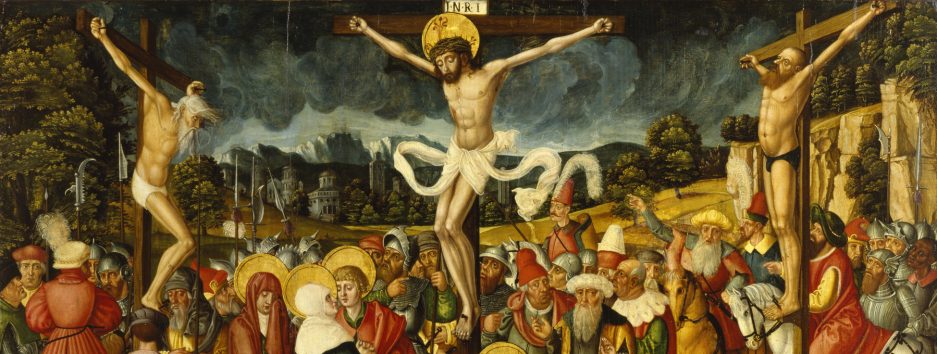
He entered history without credentials, arrived uninvited, and trusted Himself to a young woman who couldn’t explain Him, a carpenter who couldn’t protect Him, and a world that would one day kill Him. This wasn’t sentiment. It was strategy. God didn’t come to avoid suffering. He came to inhabit it.
From the first moment, His life was marked by displacement, danger, and loss. Christmas already contains the cross — folded small, like myrrh among gifts, like exile hidden in a dream. Hope, it turns out, isn’t naïve. It’s defiant. And yet, He came anyway.
Which means that when the world’s crowded, frightened, and ruled by anxious men, God isn’t absent — He’s already there, often where we least expect Him. In borrowed spaces. In overlooked lives. In the quiet obedience of those who say yes without applause.
Christmas doesn’t ask us to feel festive. It asks us to pay attention. Because if God can enter the world like this — unprotected, uncelebrated, and unwanted — then He can still enter our lives the same way: not as an ornament, but as an interruption. And perhaps that’s the gift.
Not that God came once, long ago, but that He still comes — whispering rather than shouting, waiting rather than demanding, asking only for room. Even now.
Merry Christmas.

 Wording