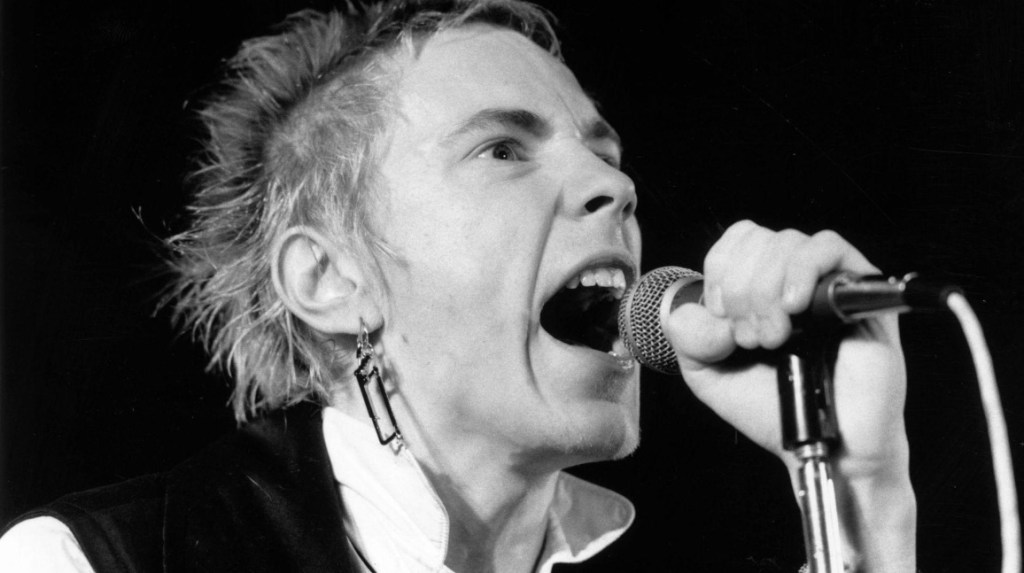
Johnny Rotten (John Lydon) performing with the Sex Pistols, c. 1977. Photographer unknown.
I was reminded today – over lunch with a charming, warm, and dangerously attractive lady – of a line from the song EMI by the ever-charming hooligans of The Sex Pistols:
‘And blind acceptance is a sign of stupid fools who stand in line.’
It’s one of those lines that arrives with the elegance of a brick through a cathedral window. Crude, yes. But I can’t deny the accuracy of the trajectory.
We spoke of its meaning, and while the lyric was originally directed at the record industry – that great sausage factory of manufactured rebellion – it seems to me that the line has aged like a good claret. Or perhaps more accurately, like a warning carved on a pub table by a philosopher who’d been thrown out of several universities. For the truth is that the queue of stupid fools has only grown longer since the 1970s.
Human beings have always loved queues. The British especially treat them with something approaching liturgical reverence. A queue isn’t merely a line – it’s an institution. A quiet social contract. A mild-mannered sacrament. Yet the queue that the Pistols were describing wasn’t a queue for tea or the post office. It was the queue for approval. The queue for permission. The queue for fashionable opinions. And once you begin noticing this queue, you see it everywhere. The Romans queued for bread and circuses. The Victorians queued for imperial glory. And the modern world queues for whatever algorithmically approved nonsense the cultural priesthood happens to be dispensing that week.
As George Orwell observed, orthodoxy is unconsciousness. One doesn’t even realise one is conforming — one simply repeats the approved phrases and congratulates oneself on one’s independence. Too many ‘ones’, I know. The most obedient people in society are often the ones shouting loudest about rebellion.
Punk, whatever else I may say about it, had the virtue of insolence. The late 1970s in Britain weren’t merely an aesthetic crisis but a social one: strikes, stagnation, political exhaustion, and a cultural establishment that had grown so pompous it practically required deflating with a safety pin. Enter Johnny Rotten, looking like a scarecrow who’d escaped from a psychiatric hospital and wandered accidentally into a microphone. And yet – in the snarling chaos of that music – there was a curious honesty.
Punk mocked the music industry because the industry had begun packaging rebellion like soap powder. You could buy outrage in a shiny sleeve for £3.99. Even revolution had a marketing department.
Fast-forward to the present day and the situation hasn’t improved. If anything, it’s metastasised. Where once the industry sold rebellion, it now sells conformity disguised as rebellion.
Modern pop is assembled like kitchen furniture. Modern rap – or at least the mass-produced sludge that dominates the charts – often sounds like a man mumbling into a microwave while counting borrowed jewellery. There are, of course, talented artists in every genre. There always are. But the cultural centre of gravity has shifted toward something oddly lifeless – a kind of algorithmic mediocrity designed not to offend, not to inspire, and above all not to think. The result is music that feels less like art and more like wallpaper. You might say that the machine now produces both the music and the audience.
And here the old Pistols lyric becomes prophetic. Blind acceptance isn’t merely a musical phenomenon. It’s political. It’s social. It’s psychological. Modern society prides itself on progress, yet one of the most striking features of our age is the fear of disagreement. Opinions arrive pre-packaged like airline meals, and you’re expected to consume them with polite gratitude. If you question them – well, you’re accused of being all sorts of dreadful things. This isn’t new. Søren Kierkegaard once warned about ‘the crowd,’ that peculiar creature which dissolves responsibility and replaces thought with consensus. The crowd is rarely wise. It’s merely loud.
There is, after all, nothing easier than fashionable thinking. It requires no courage. You simply observe which way the intellectual wind is blowing and position yourself accordingly. It’s rather like sailing – except that the boat is made of cardboard and the captain is terrified of storms. The danger is that once a culture becomes accustomed to blind acceptance, it begins to lose its capacity for genuine dissent. And dissent, inconvenient though it may be, is the engine of intellectual life. Without it, society becomes a polite echo chamber.
The lyric calls such people ‘stupid fools who stand in line.’ Now, this is perhaps a little unkind. Most people standing in that queue aren’t stupid. They’re merely comfortable. It’s easier to repeat approved opinions than to form one’s own. Easier to nod along than to ask awkward questions. Easier to belong than to risk being thought eccentric. But civilisation has always depended on eccentrics. The man who refuses to stand in line is usually the one who notices the building is on fire.
And so that snarling little punk lyric from 1977 continues to echo across the decades like a rude but necessary sermon. The record companies it mocked have changed. The politicians have changed. The technology has changed. But the queue remains. There’ll always be people eager to stand in it – nodding dutifully, applauding obediently, congratulating themselves on their enlightenment while someone else does the thinking for them.
As for me, I’ve always preferred wandering about the room with a cup of tea in my hand, mildly suspicious of everyone. Which is why that old Pistols line still feels so deliciously accurate. Because if there’s one thing history teaches us, it is this: The crowd is almost always wrong. And the queue of fools is rarely short.
So whenever I hear that lyric again, I smile. Not because it’s polite. But because it’s true.

 Wording