I’ve long held a rather unfashionable view about dear Glinda the Good Witch, and it’s high time I set it down in ink – or pixels, as the modern fashion demands. To me, she isn’t merely a fluttering pink confection of benevolence; she’s the most insidious sort of villain, the one who smiles whilst sharpening the knife. Allow me to confess my grievances in full, with all the venom and vinegar they deserve.
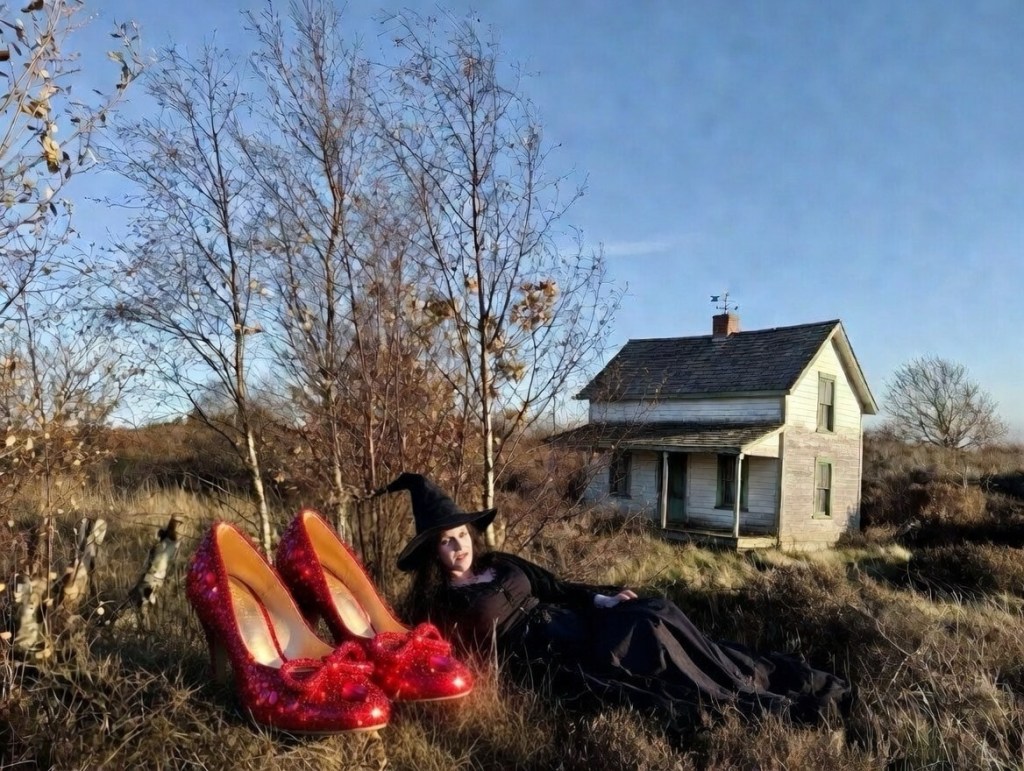
Picture it: a child, ripped from her grey Kansas existence and deposited, house and all, upon an unsuspecting witch in Munchkinland. The ruby slippers – those glittering instruments of accidental homicide – land squarely on Dorothy’s feet. And who appears in a bubble of saccharine light to greet the bewildered girl? Not some hapless bystander, but Glinda herself, the self-proclaimed Good Witch of the North (or South, depending on which dusty tome one consults; the film muddles the geography quite delightfully). She knows the slippers’ power from the outset. She could have clicked those heels together faster than you can say ‘there’s no place like home’ and whisked the poor mite back to Aunt Em’s kitchen. Instead, what does she do? She plants the seed of terror by announcing the slippers have made Dorothy an instant target for the Wicked Witch of the West, then bundles her off down the yellow brick road like a sacrificial lamb dressed for Sunday school.
It’s the oldest trick in the book, really – the one where the shepherd sends the lamb to slaughter under the guise of a merry jaunt. Glinda doesn’t merely withhold the truth; she engineers a pilgrimage of peril, complete with poppies that would make any opium den blush, flying monkeys straight out of a fever dream, and a charlatan wizard who promises the earth but delivers only hot air. Why? Because in the grand theatre of Oz, Glinda is playing three-dimensional chess whilst everyone else is still learning draughts. By the final curtain, the Wicked Witch of the East is flatter than a pancake under Dorothy’s house, the Wicked Witch of the West has melted into a puddle of regret, and the Wizard has been exposed as the great and powerful fraud he always was. Glinda? She floats away unscathed, the sole remaining witch of consequence, her bubble pristine and her reputation polished to a mirror shine.
One might call it Machiavellian cunning wrapped in tulle – power consolidated not through brute force but through the gentle art of misdirection. She’s the architect of chaos who never gets her hands dirty, the spider who spins the web and then feigns innocence when the fly struggles. In theological terms, she embodies that most troubling archetype: the deity who permits suffering for some inscrutable ‘greater good,’ demanding faith in her benevolence whilst the faithful endure trials that could have been avoided with a single merciful gesture. She robs Dorothy of agency under the pretence of granting it – ‘you’ve had the power all along,’ she trills at the end, as though the preceding nightmare were merely character-building. It’s the cruelest sort of gaslighting: endure the absurd, the terrifying, the absurdly terrifying, and then be told it was all a lesson in self-reliance. As though trauma were merely tuition fees for wisdom.
She’s the quintessential narcissist in benevolent disguise – the one who orchestrates dependency so she may swoop in as saviour. She kisses Dorothy’s forehead (a protective charm, we’re told), yet that kiss only heightens the stakes, marking the girl as even more desirable prey. It’s affection as armour-piercing round. She recalls the problem of evil refracted through rose-tinted spectacles: if omnipotence and omnibenevolence coexist, why permit such gratuitous torment? Glinda’s answer appears to be that the ends justify the means – provided the ends are her unchallenged dominion over Oz.
And the aphorisms one could hurl at her feet like so much yellow brick! She’s the sort who’d butter you up only to slip you a knife in the ribs. She puts the ‘con’ in ‘concern.’ Her kindness is the velvet glove over an iron fist of self-interest. She’s all fur coat and no knickers when it comes to genuine compassion. In short, she’s the smiling assassin of fairy tales, the one who proves that the road to hell isn’t paved with good intentions – it’s lined with pink bubbles and jaunty tunes.
So yes, I maintain my heresy: Glinda wasn’t the solution. She was the bloody problem from the very first sparkle. The Wicked Witch at least wore her malice on her green sleeve; Glinda cloaked hers in chiffon and called it virtue. And that, dear reader, is wickedness of the most perfidious stripe – because it convinces the world it’s goodness itself.
There’s no place like home, indeed. Especially when someone’s ensured you’ll crawl over broken glass to get there.

 Wording