There are mornings in this country when the light itself seems to remember something we’ve long since tried to forget. Easter Sunday is one of them. It arrives not with the brashness of Christmas – no gaudy excess, no sentimental avalanche – but with a quiet insistence, like a truth that’s been waiting patiently at the back of the room while we prattle on about everything else. It is, if you like, the still small voice after the storm. And yet, like most things that matter, it’s precisely this quietness that modern man finds intolerable.
I’ve always thought that Easter exposes us. Christmas flatters us; Easter confronts us. Christmas allows a man to pretend he’s generous. Easter asks him whether he believes anything at all. And here, I’m afraid, we run into trouble.
We live in an age where conviction is treated like an embarrassing rash – best covered up, preferably with irony. The modern atheist, that curious creature, struts about like a man who has discovered fire, when in truth he’s merely misplaced the matchbox. He’ll tell you, with all the confidence of a schoolboy who has just read half a Wikipedia article, that religion is a relic, that resurrection is nonsense, and that meaning is something we must cobble together ourselves like a poorly assembled flat-pack wardrobe. It’s all very bold, very brave, and utterly hollow.
For what is atheism, at its most fashionable, if not a kind of existential shrug? A philosophy that begins with ‘nothing matters’ and ends, rather predictably, in precisely that condition. It is, to borrow an old idiom, a dog chasing its own tail – energetic, noisy, and going absolutely nowhere.
I suspect that this is less about reason and more about discomfort. The Resurrection isn’t merely a claim; it’s an affront. It offends our tidy categories. It disrupts our carefully curated sense of control. To say that a man rose from the dead isn’t simply to assert a miracle – it’s to suggest that death itself isn’t the final word. And that, for a culture that’s made a sort of secular peace with despair, is deeply inconvenient.
The consequences are plain enough. A society that no longer believes in resurrection soon loses its nerve. It becomes obsessed with safety, with comfort, with the management of decline. It clings to life not because it understands it, but because it fears losing it. We have, in short, become a civilisation that fears death precisely because it no longer knows what to do with it. And then, into this muddle, we drag our institutions.
I might have hoped that the monarchy – our so-called ‘Defender of the Faith’ – would offer a note of clarity. Instead, we’re treated to a sort of theological soup, a warm bath of vague spirituality in which all distinctions are gently dissolved. Our current king, bless him, seems less a defender of the faith than a curator of sentiments, collecting religious ideas as one might collect teacups – admired, arranged, and entirely unused. It’s all terribly modern, terribly inclusive, and, if I may be blunt, terribly confused.
As for the heir apparent and his much-advertised ‘warm’ faith – what a phrase that is. Warm faith! I imagine something lukewarm, tepid, neither hot nor cold, the very condition that the Book of Revelation treats with such memorable disdain. Faith, if it’s anything, isn’t warm. It’s fire. It burns, it refines, it consumes. A faith that merely warms is about as useful as a fireplace painted on the wall.
But perhaps I’m being unfair. After all, we’ve decided, as a culture, that conviction is impolite. Better to hedge, to soften, to speak in gentle generalities. Better to offend no one and believe nothing.
And then there’s the annual ritual of the clever clogs who pop up every Easter to inform us – usually with a tone of weary superiority – that ‘Easter is actually pagan.’ I can almost hear the smugness dripping from the statement, like condensation from a badly poured pint.
Now, it’s true that the English word ‘Easter’ has a complex history, often linked to the Old English Ēastre, possibly a spring festival. But to leap from this linguistic curiosity to the conclusion that the Christian feast itself is pagan is rather like claiming that because we use the word ‘Thursday,’ we’re secretly worshipping Thor every week. It’s a confusion of language with substance, of etymology with theology – a category error so basic it would be amusing if it weren’t so persistent.
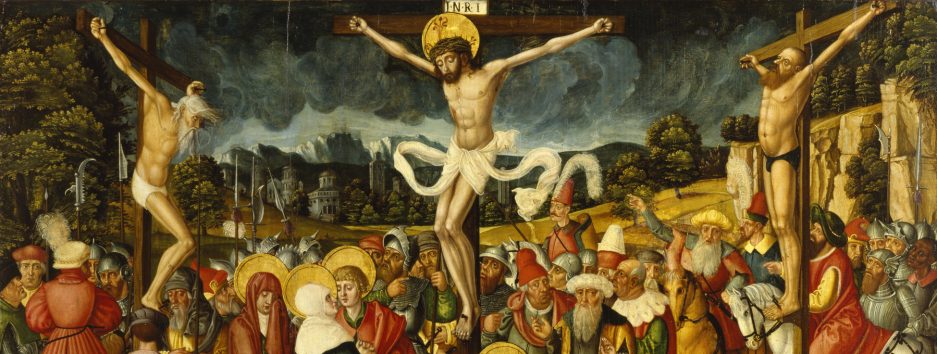
The actual substance of Easter – the Paschal feast – is rooted not in pagan myth but in the Jewish Passover, in the Exodus, in the long and intricate narrative of covenant and redemption. Christianity didn’t borrow Easter from paganism; it proclaimed something that reinterpreted time itself. The Resurrection isn’t a seasonal metaphor. It’s a historical claim with cosmic implications. It doesn’t say, ‘Spring has come again.’ It says, ‘Death has been defeated.’ And that, I suspect, is the real sticking point.
For if Easter is true, then everything changes. Not in the sentimental sense – no soft-focus montage of improved habits – but in the deepest, most unsettling way. It means that the universe isn’t indifferent. It means that suffering isn’t meaningless. It means that the grave isn’t the end of the story.
Existentially, it is dynamite.
And so we do what we always do when faced with something too large to comfortably ignore: we trivialise it. We turn Easter into chocolate eggs and bank holidays, into a pleasant long weekend with a vague hint of springtime cheer. We reduce the most staggering claim ever made – that a man walked out of his own tomb – to a sort of cultural background noise.
It is, if I may say so, a bit like standing at the edge of the Grand Canyon and remarking on the quality of the car park.
Yet despite all this – despite the confusion, the mockery, the indifference – Easter persists. It stubbornly refuses to go away. Like truth itself, it has a habit of resurfacing at inconvenient moments. The church bells still ring. The old words are still spoken. ‘He is risen.’ Not metaphorically, not symbolically, but – if I dare to say it – actually. And here I am, on Easter morning, caught somewhere between exasperation and awe.
For all our cleverness, all our scepticism, all our modern posturing, we haven’t managed to extinguish this strange and ancient hope. It flickers still, like a candle in a draughty room – battered, perhaps, but not blown out.
And I find myself thinking that perhaps this is the real scandal of Easter. Not that it’s unbelievable, but that it refuses to be forgotten.
Happy Easter.

 Wording