Just the name of this protagonist activates my chuckle muscle – imagine introducing yourself with this moniker to a purveyor of sea-foods!
Washington Irving’s Rip Van Winkle is a tale that has intrigued readers for over two centuries, not just because of its fantastical plot, but because it taps into the universal desire to avoid responsibility and, perhaps, take a really good nap. Let’s dig into this story with a humorous, analytical, and slightly irreverent approach.
Rip Van Winkle, our titular hero, is the original procrastinator. Long before millennials were blamed for procrastination, Rip was perfecting it in the Catskill Mountains. Rip’s reluctance to work and his tendency to escape into the wilderness can be viewed as a masterclass in avoiding doing the dishes. His village life is mundane, dominated by the incessant nagging of Dame Van Winkle, his wife. The modern equivalent might be ignoring your boss’ emails while pretending to be on a Zoom call. Rip’s escape to the mountains represents every individual’s desire to avoid the monotony of daily responsibilities.
Rip’s 20-year snooze is the ultimate and original power nap, surpassing even the longest of student all-nighters followed by marathon sleep sessions. Let’s break it down: He sleeps through the American Revolution! Imagine hitting the snooze button and missing the entire series of historical events that formed the backbone of modern America. One can only envy Rip’s ability to sleep so soundly. This nap could be seen as a metaphor for the ultimate escape from reality – a place where time ceases to matter, and one’s biggest concern is not missing breakfast.
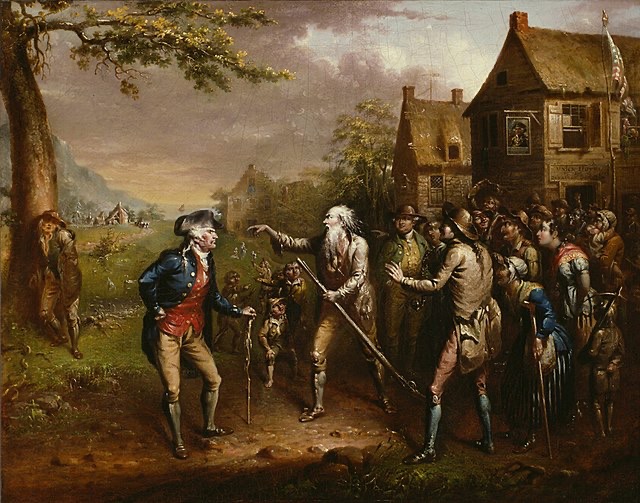
Rip Van Winkle wakes up to find himself in a world he doesn’t recognise – there are times when I wake like that often. His beard has grown a foot long, his gun is rusted, and his dog is nowhere to be found. Rip’s confusion upon awakening is akin to your grandparents’ bewilderment when trying to understand TikTok. This time-travel element in Irving’s story adds a layer of humour as Rip grapples with the radical changes around him. The village, now buzzing with post-revolutionary fervour, views Rip as a curiosity, a relic of a bygone era – much like an old Windows 95 computer trying to run Windows 10.
Washington Irving deftly uses Rip’s story to comment on political changes. Rip’s indifference to the American Revolution (because, let’s be honest, he was napping) can be interpreted as a satirical take on the average citizen’s disengagement from politics. When Rip returns, he finds King George’s portrait replaced by George Washington’s, and the villagers are now talking about rights and elections. Rip’s disinterest might reflect the sentiment of those who feel disconnected from political upheavals – preferring to nap through them instead.
While one might argue that Rip’s story serves as a cautionary tale about the dangers of idleness, it’s hard to ignore the fact that Rip ends up just fine. Sure, he’s a bit confused, but he’s warmly welcomed back into the village and spends his days telling his story to anyone who will listen. This outcome suggests that maybe, just maybe, avoiding your problems isn’t so bad after all. Rip becomes a beloved village character, the guy with the craziest story at the local tavern – a role many would envy.
This is not just a story about a man who took an extraordinarily long nap. It’s a humorous exploration of escapism, the passage of time, and the rapid changes that can occur while one is blissfully unaware. Rip’s tale is timeless (pun intended), resonating with anyone who has ever wished to escape their responsibilities, even for a moment. I myself, spent many years, ploughing through my work, with very little focus on anything of the outside world, paying no attention to news media, changing trends or even watching television. However, when my career came to end – I retired early – I was stunned by so much change and what I’d missed! It was a whole new world, and all of a sudden. It was scary. I’ve more or less caught up now; not that I wanted to.
So, the next time you find yourself overwhelmed with life’s demands, remember Rip Van Winkle. Embrace your inner procrastinator, find a cozy spot, and take a nap. Who knows? You might wake up in a whole new world, and if not, at least you’ll be well-rested.
From a philosophical angle…
Washington Irving’s story explores themes such as the nature of time, change, and personal identity, all of which have significant philosophical implications.
At its core, Rip Van Winkle is a meditation on the passage of time and the inevitability of change. Rip falls asleep in a world ruled by British colonial authority and wakes up in a new nation, shaped by the American Revolution. This dramatic shift highlights the transient nature of political and social structures. Philosophically, this can be related to the concept of impermanence, a key idea in many philosophical traditions, including Buddhism, which teaches that all things are in constant flux.
For the layperson: This means recognising that change is a constant in life. Just as Rip’s world changed drastically while he slept, our lives and societies are always evolving, often in ways we cannot predict – I’ve already touched on my own experience, and these ever-evolving lives don’t always work out perfectly.
Rip’s identity is another focal point. After his long sleep, he finds himself unchanged, but his surroundings, relationships, and society have all transformed. His sense of self is challenged as he navigates this new world. This touches on the philosophical question of personal identity – what makes someone the same person over time despite changes in their environment and experiences? Can we be the same person? I think not. When I finished my career, my identity was retired with it. I was no longer the identity I had been for thirty years. Stood at the crossroads, hands raised in a questioning pose, “which way now?”
For the layperson: This aspect of the story encourages us to think about what truly defines us. Is it our memories, our relationships, or our sense of self? Rip remains fundamentally the same person despite the changes around him, suggesting that our core identity can persist through life’s transformations. Lucky Rip. Here I am writing this and in my head, I’m arguing my own point! Life events and experiences change our character – we are never the same person from one decade to the next.
Rip’s desire to escape from his responsibilities by heading into the mountains and eventually sleeping for 20 years can be seen as a critique of escapism. Philosophically, this raises questions about the role of responsibility and engagement in a fulfilling life. Rip’s story suggests that while temporary escape might provide relief, it does not solve underlying issues and can lead to a disconnection from the world.
This theme reminds us of the importance of facing our responsibilities and engaging with our communities. Avoiding problems might provide short-term comfort, but addressing them is crucial for personal growth and societal contribution.
Rip’s experience blurs the line between reality and fantasy. His encounter with the mysterious men and the prolonged sleep seems fantastical, yet it has real consequences. This touches on philosophical questions about the nature of reality and our perception of it.
This invites us to consider how our perceptions shape our reality. Rip’s bewilderment upon waking up is akin to how we might feel when encountering unexpected changes in our own lives. It’s a reminder that our understanding of reality is often limited and shaped by our personal experiences and biases. I think I’m repeating myself a little.
Rip’s indifference to the revolutionary changes around him can be seen as a commentary on individual disengagement from societal and political events. It raises philosophical questions about the role of the individual in history and the collective consciousness.
This aspect of the story encourages reflection on our own engagement with social and political changes. It suggests that being aware and involved is part of our responsibility as members of a society, even if, like Rip, we sometimes feel detached or overwhelmed.
The tale offers a rich tapestry of philosophical themes that resonate with everyday experiences. It encourages us readers to reflect on the nature of time and change, the essence of personal identity, the pitfalls of escapism, the nature of reality, and our role in the broader social and historical context. By examining these themes, we gain insights into our own lives and the world around us, making Irving’s story not just a whimsical tale, but a profound philosophical exploration accessible to all. Time for a cuppa.

 Wording