
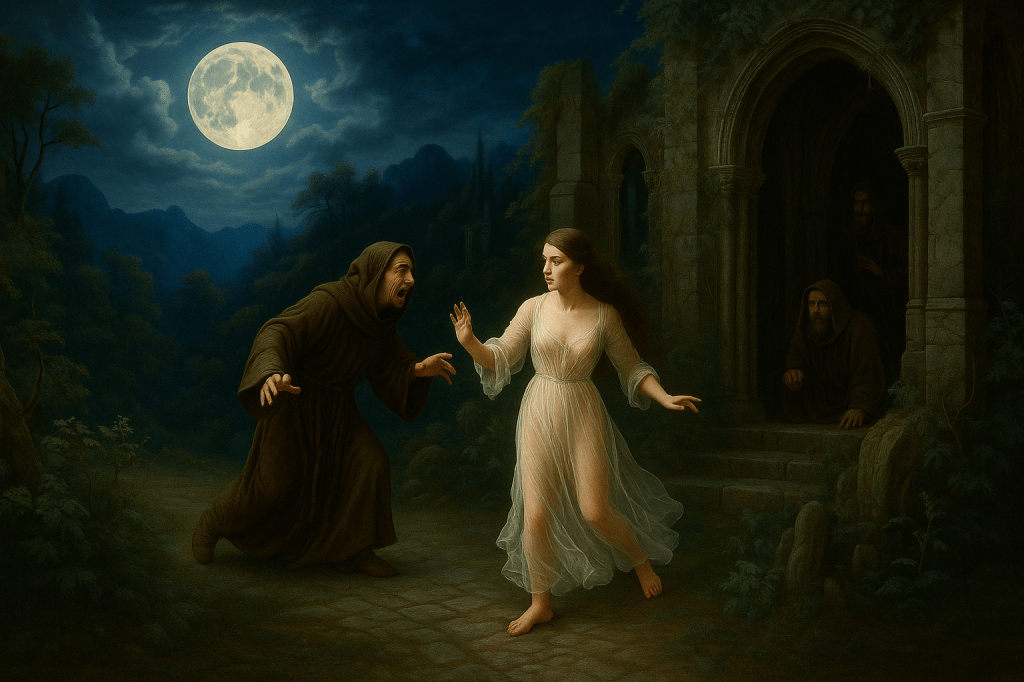
Most of what you’ll read below was penned during a rather protracted hospital stay in the early 2000s. With nothing but time and an overabundance of iodine baths on my hands, I voraciously devoured Radcliffe’s novel and then furiously scribbled this critique. It was, admittedly, a bit rough around the edges in its original form, a raw and impassioned reaction to the Gothic excesses I encountered. However, I have since had the luxury of refining it, savouring the process anew – though thankfully without the antiseptic ambiance. Enjoy.
Ann Radcliffe’s novels are known for going more than slightly overboard with verdant descriptions. Her penchant for lavish and intricate depictions of landscapes, architecture, and atmospheric conditions is a hallmark of her writing style. In The Italian, as well as in her other works like The Mysteries of Udolpho, Radcliffe’s descriptive passages are so lush and detailed that they often overshadow the plot itself. However, I adore them all.
Radcliffe doesn’t merely set the scene; she immerses the reader in a sensory experience, painting every leaf, shadow, and beam of moonlight with meticulous care. This approach, while creating a vivid and immersive atmosphere, can sometimes feel excessive, turning a simple walk in the garden into a multi-page exploration of the interplay between light and foliage.
For instance, a typical Radcliffe passage might describe a forest not just as dense and dark, but as a place where “the thick canopy of interwoven branches created a dim, green twilight, where the sun’s rays barely filtered through, casting dappled patterns on the moss-covered ground, and the air was filled with the scent of pine and the distant, melodious warbling of unseen birds.” It’s an evocative image, to be sure, but multiply this level of detail by several pages, and it becomes clear why some readers might find it a bit much.
In summary, Radcliffe’s verdant descriptions are a double-edged sword: they contribute to the richly atmospheric quality of her novels but also have a tendency to overindulge in the picturesque, occasionally bogging down the narrative with their luxuriance.
The Italian, published in 1797, is a quintessential Gothic romance that sweeps readers into a whirlpool of melodrama, sinister monks, and moonlit terror. It’s a deliciously absurd concoction of the sublime and the ridiculous, served with a side of overwrought prose and a sprinkle of implausible plot twists.
Let’s start with the title: The Italian. One might expect a story of rich cultural tapestry, vibrant with the flavours of pasta, passion, and piazzas. Instead, Radcliffe offers us a smorgasbord of clichés, where Italy is reduced to a land of perpetual twilight, ominous monasteries, and characters whose emotional range swings between two settings: distressed and more distressed.
Our protagonist, Vivaldi, is as wooden as a marionette in a Venetian puppet show, propelled through the narrative by forces beyond his control – primarily the author’s whimsical pen. His love for the ethereal Ellena is instantaneous and absolute, described with such florid intensity that one wonders if his passion is for the woman or the art of hyperbole itself. Radcliffe’s lovers exchange sighs and declarations with the fervour of high-stakes opera performers, leaving readers to marvel at their capacity for sustained hysteria.
Enter the villain, Schedoni, a monk so nefarious he might as well twirl a mustache and cackle maniacally. He lurks in the shadows, his cloak flapping ominously like bat wings, plotting dastardly deeds with the gleeful abandon of a cartoon villain. One almost expects him to be foiled by a meddling dog and its teenage companions. His motivations are murky at best, driven by a cocktail of greed, revenge, and sheer malevolence. Schedoni is less a character and more a walking embodiment of Gothic tropes, ticking off every box from the How to Be Sinister handbook.
Radcliffe’s prose is an extravagant spectacle in itself. She crafts sentences of such baroque complexity they seem designed to entangle readers in a labyrinth of subordinate clauses and arcane vocabulary. Descriptions of landscapes are so lavishly detailed they could double as travel brochures for the melancholic tourist. Each moonbeam, shadow, and gust of wind is meticulously catalogued, as if Radcliffe were being paid by the word, or perhaps had a deep-seated phobia of succinctness.
The novel’s pacing is another marvel of Gothic excess. Radcliffe employs the hurry up and wait technique, where frantic action scenes are interspersed with languorous stretches of introspection and description. It’s a rhythm that mimics a fever dream, where moments of heart-pounding terror dissolve into slow-motion sequences of overwrought beauty. One minute Vivaldi is fleeing for his life, the next he’s contemplating the delicate interplay of light and shadow on a ruined abbey.
Then there’s the infamous explained supernatural device Radcliffe employs. Ghostly apparitions and eerie noises abound, only to be rationalised away with Scooby-Doo-esque revelations. The ghostly wail? Just the wind through a crevice. The mysterious figure? A simple monk in disguise. It’s as if Radcliffe wants to have her spectral cake and eat it too, teasing readers with the supernatural only to whip the tablecloth away and reveal a mundane reality.
Yet, for all its absurdities, The Italian holds an undeniable charm. Radcliffe’s earnestness in her Gothic endeavours is endearing, and there’s a certain joy in being swept along by the sheer force of her narrative exuberance. The novel’s over-the-top dramatics and picturesque settings provide a kind of escapism that’s akin to watching a campy horror film: you know it’s ridiculous, but you can’t help but be entertained.
The Italian is a masterclass in Gothic excess, where the line between the sublime and the ludicrous is delightfully blurred. Radcliffe’s novel is a dizzying, melodramatic romp that, despite its flaws – or perhaps because of them – remains a captivating piece of literary confectionery. It’s a book best enjoyed with a suspension of disbelief and a hearty appreciation for the theatrically absurd. So, light a candelabra, settle into your crumbling castle, and let Radcliffe’s extravagant prose whisk you away to a world where shadows loom large and emotions run even larger.
Radcliffe’s novels are truly exquisite, each a delicate tapestry of gothic beauty. To properly indulge in one of her works, one must prepare accordingly: a steaming mug of tea, a plate of your favourite biscuits, a luxuriously comfortable chair, and an abundance of time to lose yourself in her world. Reading Radcliffe is a labour of love, a decadent pleasure that demands your full attention and rewards you with an unforgettable literary experience.


The Romance of the Forest was just as over the top and melodramatic as your description of The Italian. The heroine fainted and cried, cried and fainted, and fainted and cried her way through the story, while all of the other characters let their emotions out freely, too! I wouldn’t say I loved the story, but I certainly remember it, which I always think is the mark of a good book.
Another Radcliffe winner in my opinion. And of course, in the eighteenth century, swooning was often associated with femininity and was somewhat fashionable among women, particularly among the upper classes. The act of swooning, or fainting, was viewed as a sign of delicate sensibility, refinement, and emotional sensitivity, all qualities that were highly valued in women during that time. Swooning was practically a social requirement, the eighteenth-century equivalent of today’s Instagram humblebrag. “Oh, I just can’t handle how sensitive and refined I am! Better fall into a dashing gentleman’s arms and let everyone marvel at my tender constitution.” It all seems so over the top and cringy now, but I love travelling back there with these stories. I do have a little something I wrote a few years ago on The Romance of the Forest – perhaps I’ll polish it soon and post it.
From memory, the heroine of The Romance of the Forest fainted at the most inconvenient times. If readers of the time were impressed by fainting heroines though, she would have been the most admired heroine in literature!
I hope you do find and post your thoughts on this book. Comparing notes with other readers is usually quite educational for me, also enjoyable.
Well, I’ll do my best and get around to it. I’ve got hundreds of posts lined up to get through and usually depends on how tired I am, or am not. I’ve had this blog for around fourteen years with much of what I’ve written hidden away in ‘draft’. Polishing and posting them recently has been very therapeutic.
All in good time 🙂