Merrylegs, the diminutive, doting dog in Dickens’ Hard Times, is one of those characters who, though small in stature, lingers in the mind like a stubborn piece of fluff on a dark coat. Now, I confess, when I first read the novel, I didn’t pay Merrylegs much attention. After all, when set against the likes of Thomas Gradgrind’s staunch utilitarianism and Louisa’s silent suffering, what hope has a little dog for a slice of the analytical pie? But upon reflection – and perhaps, with a smidgeon of guilt – I realise Merrylegs is a masterstroke of subtlety in a novel otherwise brimming with moral anvils.
First off, let’s talk about that name: Merrylegs. It conjures up images of exuberance, of a creature that has no choice but to embody joy itself, as though Dickens decided to offset the novel’s unrelenting bleakness with a four-legged therapist. And yet, Merrylegs isn’t merely a cheery canine cameo. The dog is a living, wagging paradox: a creature of unconditional love in a world that does its utmost to squash precisely that virtue.
Merrylegs is, in many ways, a mirror of Mr. Jupe (Sissy Jupe’s father) himself: both devoted, both endearingly hapless, and both tragically caught in a world where their love and loyalty seem hopelessly undervalued. If Jupe’s performances are faltering, Merrylegs’ small presence serves as a counterweight, a reminder of the undying loyalty that underpins the father-daughter bond central to Sissy’s story. And yet, Merrylegs’ position in the narrative is tinged with heartbreak. His master, crushed by the weight of failure and despair, disappears from the circus and leaves Merrylegs behind (not to mention Sissy) – a canine orphan in a world all too harsh for those who love without condition.
It is this abandonment that makes Merrylegs such a poignant figure. Here is a dog whose devotion is so unyielding that even after being beaten – a detail Dickens slips in with that gut-wrenching subtlety of his – he continues to lick the hand of his master. This image, I confess, lingers in my mind long after the circus wagons roll away. It is an image that stings, not only for what it says about Jupe’s decline but for what it reveals about Merrylegs’ capacity to forgive. Who among us can claim such grace? (Certainly not me – I hold grudges against inanimate objects when they stub my toe.)
In fact, Merrylegs’ unconditional love is one of the most striking contrasts in Hard Times. In a novel dominated by the cold arithmetic of Gradgrind’s utilitarianism, where human connections are measured in terms of profit and efficiency, Merrylegs’ pure, instinctive affection feels almost like rebellion. He doesn’t calculate the worth of his master; he loves him, full stop. And when Mr. Jupe disappears, leaving Sissy to fend for herself in the cruel machinery of Coketown, Merrylegs becomes a quiet symbol of the love that remains even in absence.
I can’t help but wonder, though – what did Dickens intend us to feel about this little dog? Is Merrylegs meant to represent the simple virtues of loyalty and love, which endure even in the most trying circumstances? Or is he a more tragic figure, showing us how unconditional love can be exploited, even squandered? Dickens was a master of emotional complexity, and Merrylegs seems to embody both interpretations. His licks, post-beating, are both a comfort and a rebuke. They say: “Look what I am capable of, and now look at what you have done.”
Of course, Merrylegs also serves as a foil to the cold, mechanical relationships elsewhere in the novel. Against the rigid, joyless upbringing imposed on Louisa and Tom Gradgrind, Merrylegs represents a world of instinct and spontaneity – a world that Dickens clearly cherishes. In this way, the dog becomes an echo of Sissy herself, whose warm heart and imaginative spirit stand in stark contrast to the utilitarian ethos around her.
So, Merrylegs, though small and largely silent, is far from insignificant. He is a beacon of love in a world that often forgets what love truly means. He reminds us that loyalty does not waver when times grow hard, even if it is sometimes misplaced or underappreciated. And if that’s not worth a reflective chuckle and a pat on the head, I don’t know what is. Bravo, Merrylegs – you’re a better creature than most of us can ever hope to be.
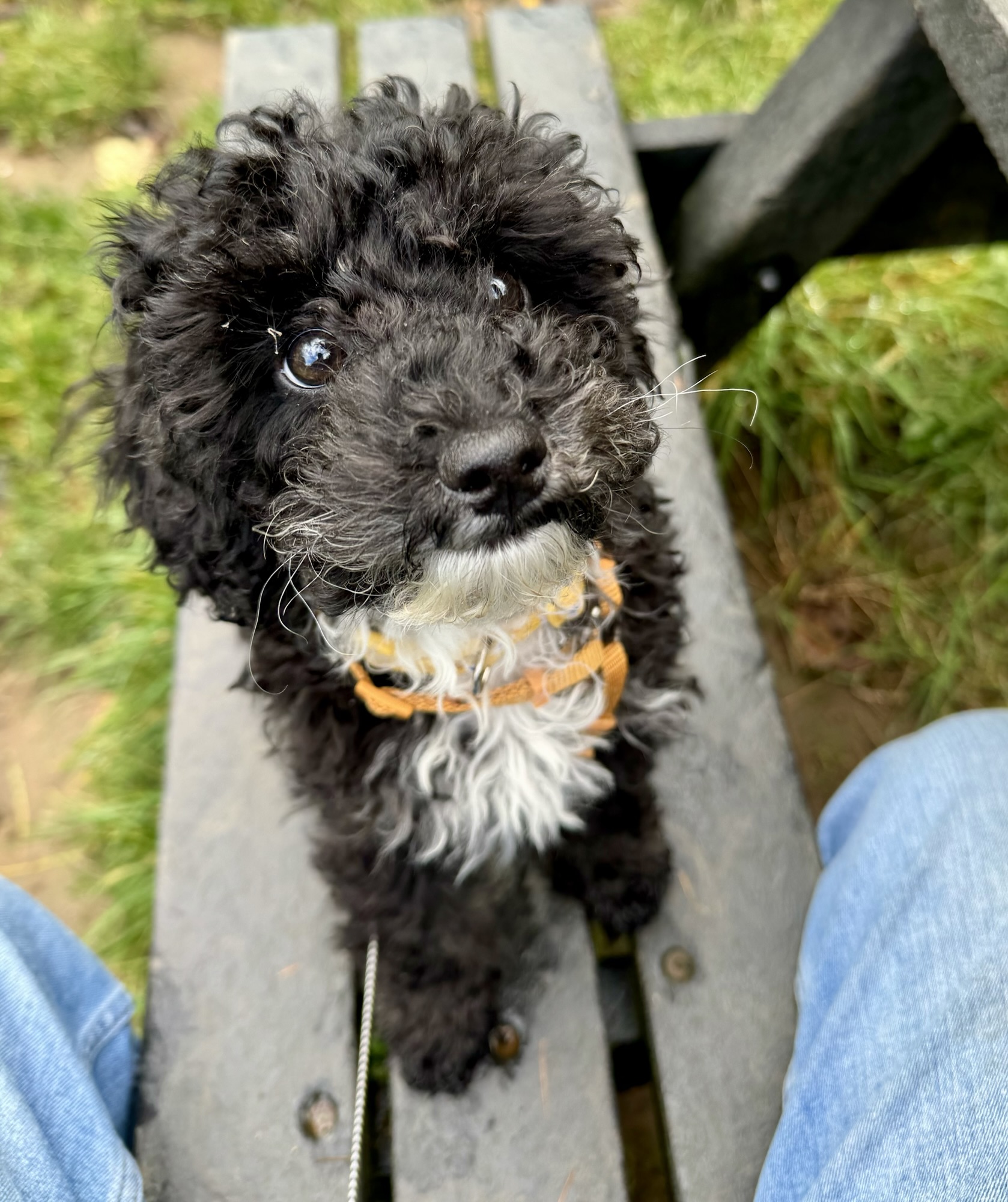
Now, I must confess, Merrylegs stirs something deeply personal in me. You see, I have a cockapoo puppy, Milly (pictured above) – she’s just 4.5 months old, full of life and utterly beautiful. She’s the kind of creature who bounds into a room and instantly fills it with joy, as though she carries a piece of sunshine in her fluffy little frame. She means the absolute world to me, and I honestly can’t imagine life without her.
When I think of Merrylegs and his unwavering devotion, I can’t help but see a reflection of my own puppy’s boundless love. She greets me every morning as though I’m the most important person in the universe, her tail wagging with an enthusiasm that no human greeting could ever match. It’s humbling, really – this pure, instinctive affection that asks for so little in return. Like Merrylegs, she doesn’t measure love in terms of what she receives; she simply gives it, freely and unconditionally.
That’s what makes Merrylegs so poignant to me. He embodies a kind of love that I see every day in my little pup – a love that forgives our flaws, overlooks our failings, and offers comfort without hesitation. Dickens, whether he knew it or not, captured the essence of what makes dogs such extraordinary creatures. Through Merrylegs, he reminds us of the grace that animals bring into our lives, and of the responsibilities we bear to cherish and protect them in return.

 Wording