
Apparently, I’m boring. Old-fashioned. Out of touch with the times – all because I choose to read classic literature. Imagine that! How terribly narrow-minded, how deliciously myopic, to dismiss an entire world of profound thought, timeless insight, and exquisite artistry simply because it doesn’t come with a glossy cover and a trending hashtag. It’s an opinion, I suppose, albeit one born of someone whose reading habits seem confined to modern, frivolous fluff – the kind of books that demand little effort, ignite no real thought, and cater to the most undemanding of intellects. Am I being unfair? Perhaps.
In truth, I’m the first to acknowledge that modern literature has its gems – works that are fresh, thought-provoking, and undeniably brilliant. To deny that would be foolish, and I like to think myself above such self-inflicted blindness. I’ll even confess to indulging in a contemporary read every now and then, dipping my toes into the sparkling shallows for a bit of diversion. But let’s be honest – dipping is one thing; wallowing in mediocrity is another entirely.
So, here’s my rebuttal to that oh-so-pejorative label of ‘boring’ and ‘old-fashioned.’ If taking delight in the richness of Austen’s wit, the moral intricacies of Dostoevsky, or the searing social critiques of Orwell makes me outdated, then I’ll wear that badge with pride. Because classics aren’t just books – they’re conversations across centuries, bridges to ideas that transcend time, and challenges to the complacency of modern thought. To dismiss them is to rob oneself of a richer, deeper understanding of what it means to be human. And frankly, I’d rather be called old-fashioned for appreciating that than praised for consuming whatever the literary equivalent of fast food happens to be this week.
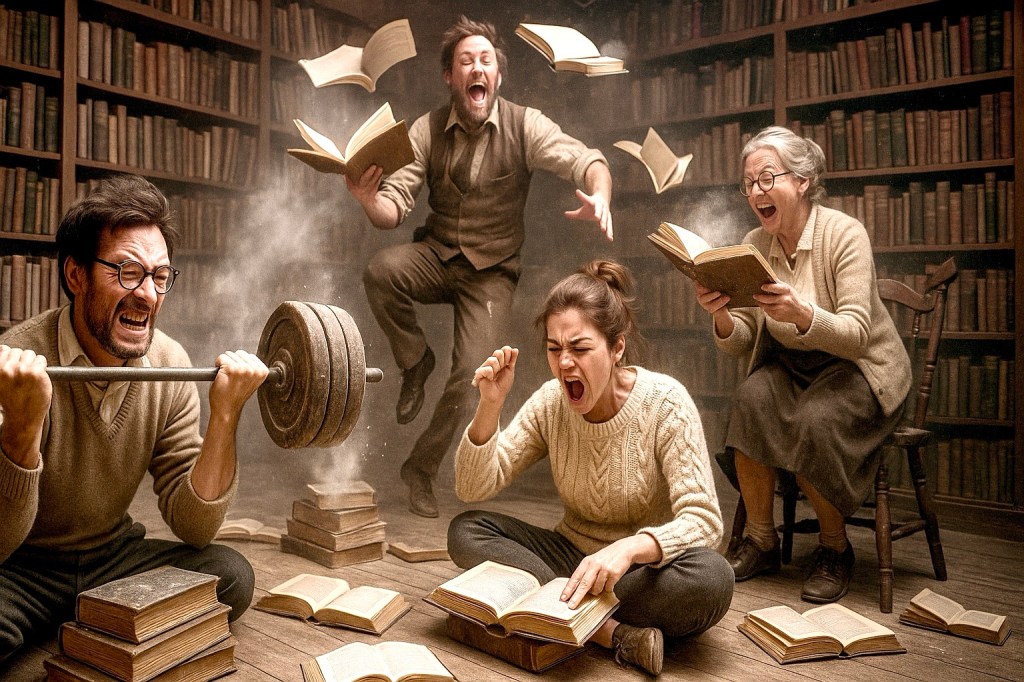
If you’ve ever held a hefty tome like War and Peace in one hand while balancing a cup of tea in the other, you’ll know that reading classic literature isn’t just a workout for the mind; it’s practically Pilates for the wrists. But beyond the physical exertion of lugging around Les Misérables or deciphering Dickens’ labyrinthine sentences, there’s something profoundly enriching about immersing oneself in these so-called ‘classics’. They do more than kill time or furnish an excuse to avoid small talk at parties – they shape us, challenge us, and remind us that we are more complicated than we’d like to admit.
Let’s begin with the mind. Reading classic literature is the mental equivalent of a Spartan race. These works demand attention, patience, and a willingness to endure sentences that sprawl across half a page. Take James Joyce’s Ulysses, for example. It’s not so much a novel as a psychological endurance test. Every sentence is packed with puns, references, and streams of consciousness that mimic the ceaseless chatter in our own minds. And therein lies the genius: while grappling with Joyce’s dense prose, we’re forced to confront the complexity of our own thoughts. How often do we filter our inner monologues for clarity? Not often enough, I suspect. Joyce reminds us of the chaos within and asks, “Are you brave enough to face it?”
But it’s not just about the mental calisthenics; classic literature also teaches us to ask uncomfortable questions of ourselves. Consider Dostoevsky’s Crime and Punishment. On the surface, it’s a thriller about a man who murders an old woman, but delve deeper, and it’s a psychological exposé of guilt, morality, and the human capacity for self-justification. As I read it, I couldn’t help but ask myself: “What would I do if pushed to the brink? Would I rationalise a terrible deed for a perceived greater good?” Not that I’m planning to dispatch any pawnbrokers, but the very act of engaging with such dilemmas sharpens one’s moral compass.
And let’s not ignore the psychological benefits. According to literary scholar and psychologist Keith Oatley, reading fiction – especially challenging fiction – activates regions of the brain associated with empathy and theory of mind. Essentially, reading about Anna Karenina’s forbidden romance or Elizabeth Bennet’s sharp retorts rewires us to understand people better. It’s a bit like therapy, except instead of paying £80 an hour, you pay £6.99 for a dog-eared copy from a charity shop.
On the bodily front, you might scoff at the idea of literature influencing your health. But consider this: reading classic literature has been shown to reduce stress levels. A 2009 study by the University of Sussex found that just six minutes of reading can lower heart rate and muscle tension. Now imagine the effects of six hours with Tolstoy! Though I’ll admit, if you’re reading Kafka, your stress levels might spike initially – but only because you’ll start wondering if you, too, are just a cog in an absurd, bureaucratic machine.
But the best part? These classics connect us to a larger human experience. When I read Shakespeare, I’m reminded that people have been making bad romantic decisions for centuries. Hamlet dithers about avenging his father, just as I dither about cancelling a Sky subscription (which I’ve now done). These moments of recognition make us feel less alone, as if the great minds of the past are leaning over our shoulders, whispering, “It’s all right; we’ve been there too.”
Of course, reading classics isn’t without its perils. There’s always the temptation to skim, to give up, or, worse, to pretend you’ve read something when you haven’t. (Yes, I’m looking at you, people who claim to ‘love’ Moby-Dick.) But the rewards for persistence are vast. These books change you. They demand introspection. They build resilience. And occasionally, they deliver a brilliant one-liner, like Mr. Bennet’s sardonic quip in Pride and Prejudice: “For what do we live, but to make sport for our neighbours, and laugh at them in our turn?”
So, classic literature is good for both the mind and body because it makes us think harder, feel deeper, and carry heavier books. It challenges our perceptions, sharpens our empathy, and sometimes even makes us laugh. It’s a reminder that the human condition, as messy and confusing as it is, remains eternally worth exploring. So the next time someone asks why you’re reading something ‘boring’, you can smugly reply: “Because it’s good for my soul – and my biceps.”
When people dismiss classic literature – yes I’m still venting – in favour of what I can only describe as trashy modern rubbish – the kind of books with embossed titles, paper-thin characters, and a plot so predictable it might as well come with a roadmap – I can’t help but feel a pang of despair. It’s like watching someone turn down a homemade feast for a bag of crisps. These classics are the bread of our intellectual sustenance, rich and nourishing, while much of what passes for popular modern fiction is the circus – flashy, indulgent, and ultimately hollow.
I’ve heard the arguments against classics often enough. “They’re boring.” “They’re too hard to understand.” “Why bother with Middlemarch when you can read something ‘relatable’?” To which I say: relatable? Really? Is it more ‘relatable’ to consume stories so formulaic you could predict the ending before you’ve finished the blurb? Does a paperback romance teach you more about love than Jane Eyre? Does yet another thriller about a missing woman bring you closer to understanding human nature than Frankenstein?
People who dismiss classics often assume they’re stuffy, elitist relics of a bygone era. But that’s like calling a museum full of priceless art just a collection of old stuff. The classics endure because they’re universal. Yes, they’re challenging, but that’s the point. A good classic makes you work for its rewards, and in doing so, it stretches your mind, expands your empathy, and shows you the world in a way you’ve never seen before.
And let’s be honest: a lot of the modern fluff people champion instead is written to be consumed, not savoured. It’s escapism stripped down to its barest, laziest form. The literary equivalent of binge-watching reality TV. It demands nothing from you, and consequently, it gives you nothing back. You finish the book, you forget it existed, and on you go to the next shiny thing. Compare that to reading Great Expectations – a novel that lingers in your mind, poking at your thoughts and your conscience long after you’ve turned the last page.
I’m not suggesting we should all be reading Paradise Lost on the bus to work or that there’s no room for light, contemporary reads (I, too, enjoy a bit of mindless fun on occasion). But to dismiss classics wholesale is to miss the point of literature itself: to challenge, to inspire, to connect us to something larger than ourselves. The classics endure because they matter. They’ve outlived empires, trends, and the endless churn of mediocrity because they speak to what it means to be human.
So, when someone scoffs at my well-thumbed copy of Anna Karenina and suggests I pick up the latest ‘unputdownable’ bestseller instead, I can’t help but think: this isn’t a battle between books. It’s a battle between substance and spectacle, between enduring truths and disposable entertainment. And I’ll take Tolstoy over tawdry any day.
Oh, and don’t even get me started on the modern biographies cluttering up the shelves of high street bookshops. It’s as if the world collectively decided that a list of facts and a smattering of ‘juicy details’ qualifies as insightful life storytelling. I can barely walk past a display without being accosted by titles like The Untold Truth of X or The Real Life of Y, as if a person’s entire existence can be boiled down to a series of Instagram-worthy soundbites. These biographies, typically about celebrities, entrepreneurs, or so-called ‘influencers’, are as empty as the promises of their authors. Often, they resemble an awkward cocktail of gossip, adulation, and shallow analysis – an exercise in fluff rather than understanding. The result? Books that offer little more than an affirmation of the mundane, a hollow recounting of fame and fortune without any real examination of what it means to live a life, truly.
Now, contrast this with something like The Remains of the Day by Kazuo Ishiguro, a true literary classic, and a poignant exploration of duty, regret, and the search for meaning. The novel tells the story of Stevens, an English butler who has dedicated his entire life to service, only to realise, too late, that in doing so, he has neglected the human connections that could have truly defined his existence. The beauty of Ishiguro’s work lies in its subtlety and restraint. With each page, you’re drawn deeper into Stevens’ internal world, his unflinching dedication to a now-questionable cause, and his inability to reconcile the past with the present. It’s a quiet tragedy, where the true heartache lies in what is left unsaid and undone. By the end of the novel, you’re left reflecting not just on Stevens’ life, but on your own choices – your own unspoken regrets.
The Remains of the Day, and I do have a review yet to come, is a masterpiece because it doesn’t merely recount the story of one man – it explores universal themes of time, loyalty, and the unspoken consequences of our decisions. It’s a poignant reminder that sometimes the most significant parts of our lives are the ones we fail to fully live. And isn’t that what the very best literature does? It leaves us better equipped to understand our own journey, with all its complexities and nuances.
In the end, I believe that if I’m going to spend my precious time reading, I want more than just a quick distraction or a shallow thrill. I want a book that challenges me, makes me think, makes me question – something that lingers in my mind long after the final page. Because life is too short for trivialities. The true value of literature lies not in the ease of its consumption, but in the depth it offers, in the wisdom it imparts, and in the way it forces me to confront the world – and myself – in all my complexity. Reading is therapy. And I would know.

 Wording
I’m already looking forward to your review of The Remains of the Day. My definition of a classic is a story that takes up residence in your mind or heart and this book certainly achieved that in mine (mind and heart).
Well it’s almost ready. Have you seen the movie with Anthony Hopkins? I have it and I’ll have another look at it sometime. It definitely has depth, and well worth the time.
I have seen the movie, which was fabulous, but I preferred the book. You know when you get those big, heaving sobs that completely overwhelm you? Well, luckily I didn’t finish reading this book on a train, because I would have completely disgraced myself.
Oh, I know those sobs only too well – along with that typical lump in the chest right before the eyes fill! A valuable lesson though, not to read anything ‘too’ heavy on public transport.