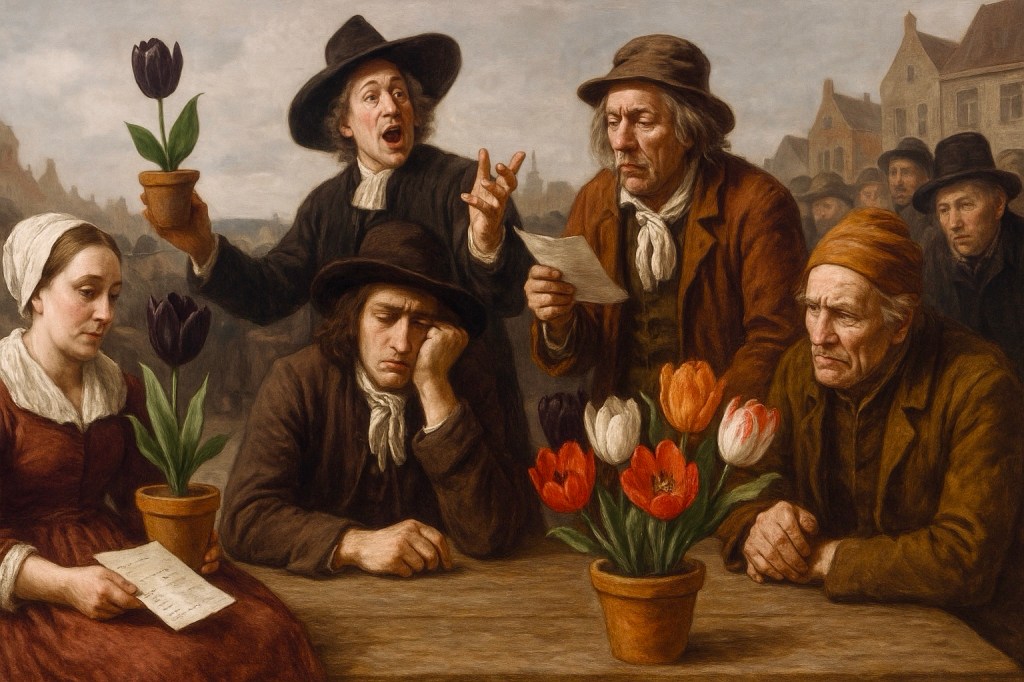
The Black Tulip by Alexandre Dumas – a novel that dares to ask the pressing, existential question: ‘What if horticulture were as riveting as a murder mystery?’ Set amidst the whirling chaos of 17th-century Dutch politics and the delirium of Tulip Mania, (fascinating part of history, you must look into this) one might expect a gripping tale of intrigue, betrayal, and botanical ambition. Instead, what we get is a peculiar hybrid of a love story, a prison drama, and an extended gardening manual.
Allow me to dissect this odd little tale, one petal at a time.
The setting: Tulip mania? More like tulip monotony. Holland during the tulip craze seems like an inspired choice – a fertile ground for exploring themes of greed, obsession, and the ephemeral nature of beauty. But instead of a rich tapestry of societal commentary, Dumas offers us an oddly provincial drama centred on one man’s flower fixation. I mean, really, is this the gripping tale of the human condition I signed up for, or is it the origin story for Gardeners’ Question Time?
The political intrigue that opens the novel – complete with a grisly murder of real-life historical figures, the De Witt brothers – is promising, I grant you. But then, as if Dumas suddenly remembered he was supposed to write about tulips, we’re whisked away from political carnage to Cornelius van Baerle’s greenhouse. Talk about a tonal shift. It’s like starting Gladiator only to find yourself in an episode of The Great British Bake Off – seems a little odd to mention Master Chef here, given Mr. Wallace’s past peccadilloes – just pretend I didn’t mention that: for more, see current UK news scandal.
Cornelius, our protagonist – hero or floral enthusiast extraordinaire? Here’s a man who, in the grand tradition of literary heroes, stands up to corruption and fights for justice… wait, no, sorry. He’s just trying to grow a black tulip. That’s it. His noble quest involves pottering about in his garden and being tragically misunderstood by society – or at least by his jealous neighbour, Isaac Boxtel, who somehow manages to be both laughably petty and alarmingly menacing. A man so consumed by envy, he’d probably steal your courgettes at a village fête.
Cornelius’ downfall, we are led to believe, is his naïve devotion to his tulip bulbs, which he cherishes more than his freedom, his reputation, and arguably, his sanity. Is this meant to be endearing? Because I, for one, found myself muttering, “Prioritise, man!” under my breath as he pined for his imprisoned flowers.
Enter Rosa, the prison guard’s daughter, and Cornelius’ love interest – love blooms (sort of). Now, I have no quarrel with a good romantic subplot, but this one feels as if it was added as an afterthought, perhaps to distract us from the relentless tulip-talk. Rosa is sweet, devoted, and woefully underdeveloped as a character. Her sole function seems to be smuggling tulip bulbs into Cornelius’ cell and batting her eyelashes at him. Feminists, avert your gaze.
Their romance, if one can call it that, blossoms in the most uninspired of ways – through prison bars and whispered sweet nothings about horticulture. I mean, I’m all for unconventional courtships, but there’s only so much excitement one can muster for amorous discussions about soil quality.
Now, let’s talk about the eponymous flower. The black tulip is supposed to be a metaphor, I suppose – for unattainable perfection, the futility of human ambition, or perhaps just Dumas’ own desire to pad out his word count. Whatever the case, it’s hard to care about a plant when human lives are being ruined over it. By the time Cornelius finally succeeds in cultivating his prized bloom, I felt less elated and more relieved that the book was nearing its end.
Dumas is, of course, a master storyteller, but The Black Tulip feels like it was written during a particularly distracted afternoon. The plot meanders, the characters are either caricatures or underbaked, and the pacing is as uneven as a badly pruned hedge. There are flashes of his trademark wit and drama, but they’re buried under layers of botanical minutiae and sentimental drivel.
The Black Tulip is a curious little novel: a peculiar potpourri – part political thriller, part pastoral romance, and part horticultural guidebook. While it’s not without its charms, it suffers from an identity crisis and an overabundance of tulips. If you’re a die-hard Dumas fan or a passionate gardener, you might find it delightful. For the rest of us, it’s best approached with tempered expectations and perhaps a strong cup of tea.
On a more serious note, I’d recommend this book, as you just know that anything Dumas has written is worth a look. So, and not so seriously, if you’re looking for a novel that doubles as a bedtime read and an insomnia cure, then it’s harmless enough, but let’s just say I won’t be planting my own black tulip any time soon.
Instead of Tulips, why not invest in delicious beverages and Buy Me a Coffee

 Wording
I have this book (unread) on my shelves but despite the title, did not know that the story featured actual tulips! I thought ‘The Black Tulip’ was a dashing hero’s alias, sort of like The Scarlet Pimpernel.
Oh, then you’re in for a surprise!
I have an interesting book on social manias and moral panics over history, and the Tulip craze is in there to some depth. If I remember, I’ll dig it out and tell you the title, should you want to have a look. Fascinating stuff – a little tiresome in places, though still worth a peep.
Sounds interesting. Yes please, if you remember.
Happy New Year, Rose, to you and yours
Happy New Year to you, too Robert, and wishing you interesting reading during 2025.