Last year, I stumbled upon this little gem on Amazon, priced at the princely sum of 23p. Naturally, I couldn’t resist – who could, at such a bargain? It brought back a flood of memories from years ago when an English teacher handed me a tattered old copy, its pages barely holding together. Where that copy wandered off to, goodness only knows – probably lost to the sands of time or buried under the clutter of life.
This particular treasure had been languishing in draft form for quite some time, waiting patiently for its moment in the spotlight. Recently, I decided it was high time to sink my teeth back into these writings and savour them afresh. As this subject is right up my street, I couldn’t resist penning my thoughts. So, without further ado, here’s my take.
I must confess, tackling Blaise Pascal’s Pensées felt a bit like accepting an invitation to a dinner party hosted by a deeply religious but utterly brilliant friend. You arrive expecting a polite chat about theology and philosophy, only to find yourself cornered by the host, who alternates between dazzling insights and existential dread. It’s exhilarating, slightly terrifying, and by the end of the evening, you’re not entirely sure whether you’ve been enlightened or traumatised.
First, let’s get one thing straight: Pascal’s mind was extraordinary. He was a mathematician, physicist, inventor, and philosopher who managed to revolutionise probability theory and pen some of the most piercing reflections on the human condition. Frankly, it’s a bit much. He’s the sort of overachiever who makes the rest of us feel like we’ve wasted our lives watching reruns of Fawlty Towers.
But onto the Pensées themselves – a fragmented, chaotic collection of thoughts that were supposed to form a grand apologetic for Christianity. Alas, Pascal died before finishing it, leaving us with what can only be described as the world’s most profound set of Post-it notes. The fragments range from the sublime to the baffling, and reading them is a bit like rummaging through the attic of a genius: you’ll find treasures, cobwebs, and the occasional unsettling revelation.
Pascal’s wager: Theology meets gambling. Let’s start with the big one: Pascal’s Wager. This is where Pascal essentially says, “Look, believing in God is the safest bet. If He exists, you win eternal bliss; if He doesn’t, you’ve only wasted a bit of time praying and avoiding debauchery.” It’s clever, I’ll grant him that, but it does reduce faith to a kind of cosmic insurance policy. Imagine explaining your belief to God at the pearly gates: “Well, I wasn’t convinced, but I figured it was worth a punt.”
And yet, there’s something disarmingly pragmatic about it. Pascal knew that most people aren’t philosophers; they’re gamblers, hedging their bets in the game of life. Still, I can’t help but feel that reducing the divine to a roulette wheel is a bit unseemly. Surely God deserves more than being treated like a high-stakes game at the Monte Carlo casino?
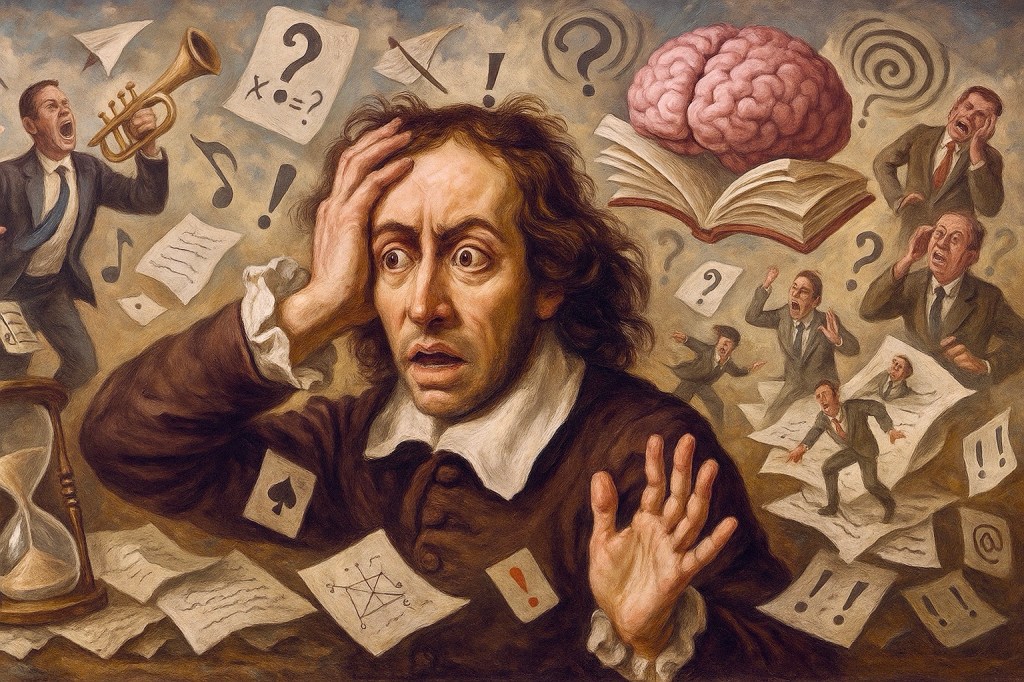
Divertissement: The art of avoiding reality. One of Pascal’s sharpest insights is his concept of divertissement – the idea that humans distract themselves with trivial pursuits to avoid confronting the horror of existence. ‘The sole cause of man’s unhappiness,’ he writes, ‘is that he cannot stay quietly in his room.’ It’s a damning indictment of our Netflix binges and endless scrolling through social media, and it’s hard to argue with.
But here’s the thing: Pascal didn’t live in the age of TikTok. He didn’t have to endure people filming themselves eating raw onions for likes. Would he have been so quick to condemn divertissement if he’d had access to a really good box set? I’d like to think even Pascal might have found solace in The Last of the Summer Wine.
The Greatness and wretchedness of man. Pascal is at his best when he’s dissecting human nature. He sees us as caught between two infinities – the grandeur of the cosmos and the grim reality of our mortality. We’re capable of astonishing achievements, yet we’re also petty, vain, and hopelessly deluded. It’s a bit like being told you’re both a demigod and a worm, which, if I’m honest, is exactly how I feel after reading the Pensées.
There’s a particularly memorable fragment where Pascal observes that we’re the only creatures who know we’re going to die, and we spend our lives trying to forget it. It’s bleak, but also oddly comforting. At least my existential dread has a pedigree – it’s practically a badge of honour to be miserable, according to Pascal.
Faith and reason: a delicate dance. Pascal’s relationship with reason is, shall we say, complicated. He acknowledges its power but insists it has limits. ‘The heart has its reasons, which reason knows nothing of,’ he writes, which sounds lovely until you realise it’s a poetic way of saying, “Logic won’t save you, mate.”
This is where Pascal loses me a bit. I appreciate his honesty about the limits of rationality, but his leap of faith feels like a particularly perilous jump. It’s as though he’s saying, “We’re all doomed, so you might as well believe in God.” Inspiring? Perhaps. Reassuring? Not exactly.
Final thoughts: a brilliant, maddening masterpiece. Reading Pensées is like having an intense conversation with a friend who’s both a genius and a bit of a buzzkill. Pascal’s insights are dazzling, but his relentless focus on humanity’s misery can leave you gasping for air. Still, there’s no denying the power of his vision. He forces you to confront the big questions – about faith, mortality, and the meaning of life – and he does so with a wit and intensity that’s hard to resist.
Would I recommend Pensées? Absolutely. But be warned: it’s not light reading. You’ll need a strong cup of tea (or perhaps something stronger) to get through it. And when you’re done, take a moment to appreciate the small pleasures of life – whether it’s a good laugh, a warm puppy, or a really excellent scone. Pascal might disapprove, but even he must have had his moments of divertissement.

 Wording