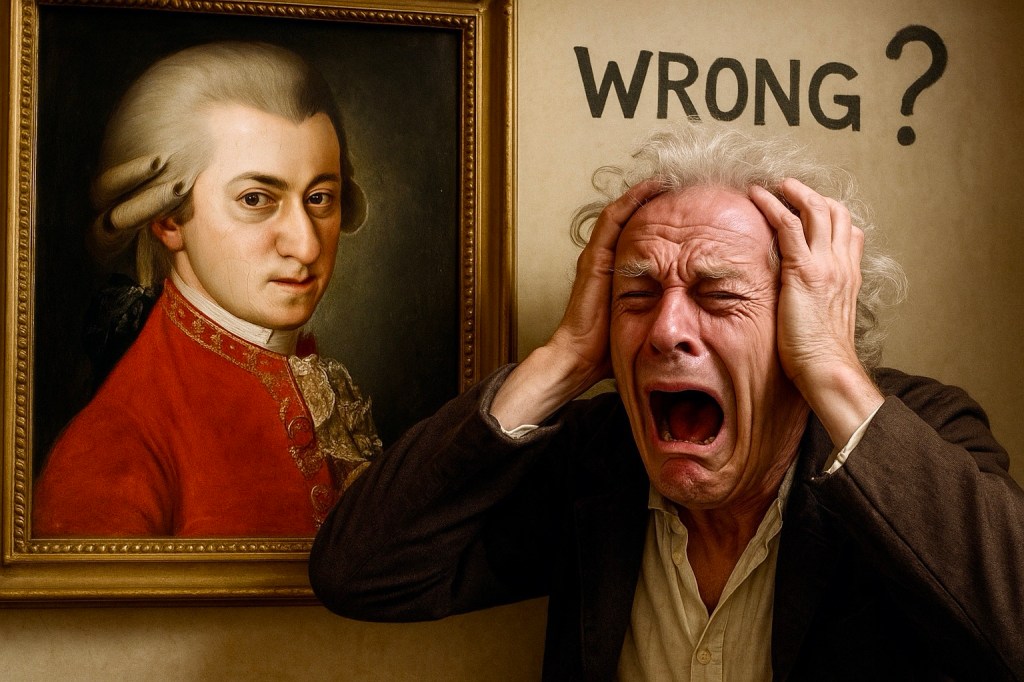
I want to take issue with Mozart. Not his music, but his creative ideal.
“When I am, as it were, completely myself, entirely alone, and of good cheer – say, traveling in a carriage or walking after a good meal or during the night when I cannot sleep – it is on such occasions that my ideas flow best and most abundantly.”
When I read this quote, ostensibly a celebration of creativity’s boundless potential, I find myself wrestling with a darker, more cynical interpretation. At first glance, Mozart’s words appear to extol the virtues of solitude, comfort, and the unbidden flow of ideas. Yet, the more I dwell on it, the more I wonder if this idealised vision of creativity is not, in fact, a kind of self-deception – a romanticised illusion that we cling to in order to justify our moments of idleness or indulgence.
Mozart describes being “completely myself, entirely alone, and of good cheer” as the perfect conditions for inspiration. It is an enviable sentiment, but I cannot help but feel it is also naive. How often do such perfect circumstances align in reality? For most of us, life is not a series of serene carriage rides or leisurely walks after satisfying meals. Instead, it is a relentless grind, a cacophony of demands, and a constant negotiation between our obligations and our desires. To imagine that creativity waits patiently for such ideal conditions feels almost delusional. Might I be fooling myself to believe that my own lack of productivity stems from a lack of such conditions? Do I, like Mozart here, place too much faith in an ideal that is rarely, if ever, attainable?
Moreover, there is something troublingly elitist about this sentiment. The imagery of a carriage ride or the quietude of a sleepless night suggests a life of privilege, one where the struggle for basic survival does not intrude upon the creative process. For those whose lives are marked by hardship or ceaseless toil, creativity must emerge in the cracks and crevices of their existence, not in the luxury of good cheer. To hold up Mozart’s experience as a universal truth feels disingenuous, if not outright dismissive of the countless creatives who have forged their work in far less hospitable conditions.
Even the notion of ideas flowing ‘best and most abundantly’ in moments of ease seems suspect to me. Does creativity not often spring from discomfort, from tension, from the gnawing restlessness of an unresolved thought or an unrelenting emotion? When I am ‘of good cheer,’ my mind is content to wander aimlessly, but when I am troubled – when the weight of life presses down on me – my thoughts sharpen, and my ideas take on a desperate urgency. Perhaps Mozart’s ‘good cheer’ is nothing more than a veneer, a way to distance himself from the darker, messier truths of his creative process.
Finally, I cannot ignore the almost smug assurance with which this quote is delivered. To suggest that inspiration flows so naturally, so effortlessly, feels like a kind of mockery to those of us who struggle with the creative process, who agonise over every word, every note, every brushstroke. Is it not possible that this idealised vision of creativity is less a reflection of reality and more a self-soothing myth? A way for Mozart to reconcile his genius with his humanity, to convince himself that his talent was not the product of toil or torment but of divine providence?
In the end, I am left wondering whether I am the fool for questioning this quote or for ever believing in it at all. Perhaps the truth lies somewhere in between – that creativity is neither the effortless bounty Mozart describes nor the tortured struggle I often perceive it to be. But even so, I cannot help but feel that this quote is more a dream than a reality, and I am wary of losing myself in its seductive, yet ultimately hollow, promise.
Just saying.

 Wording
This quote does make Mozart sound like a cheerful, optimistic fellow. I think his music is generally happy, too, so perhaps he was genuine when he said those words. I enjoy ‘thinking time’ when I’m out walking or driving a long distance, too, not that my creativity would ever be comparable to Mozart’s, but I take his quote to mean that when he is quietly walking or travelling, his imagination is free to wander.
So perhaps Antonín Dvořák was a miserable bugger then! 😁
Going Home is so sadly nostalgic he must have been homesick for somewhere! I’m not as familiar with his work but suspect the private lives of composers must be full of terrible lows and over-the-top emotional highs, which they used to create music that makes listeners feel something.
I think most artists create according to their mindsets – creatives are a unique lot I’m certain.