The following quote is from Peter Høeg’s short story Reflection of a Young Man in Balance, which is part of his collection, Tales of the Night (“Fortællinger om Natten” in Danish). The collection explores themes of love, identity, and existential reflection, often with a lyrical and philosophical style. However, as I’m using this quote in abstract, let’s assume that I’m expressing Høeg’s own thoughts, separate from the actual story. I thought this quote was more than ‘frank’, and I was more interested in this than the story itself.
Peter Høeg once wrote, with a wryness that could curdle milk, “It is with mild indifference that I view the fact that I live in a world which talks so fast that it needs must breathe through its arse. Words no longer make any impression on me. I am an abandoned building – let us just say a forsaken and forgotten observatory. The world blows through my shattered windows without leaving so much as a trace of itself.” Now, if that isn’t the most eloquent middle finger to modern communication, I don’t know what is.
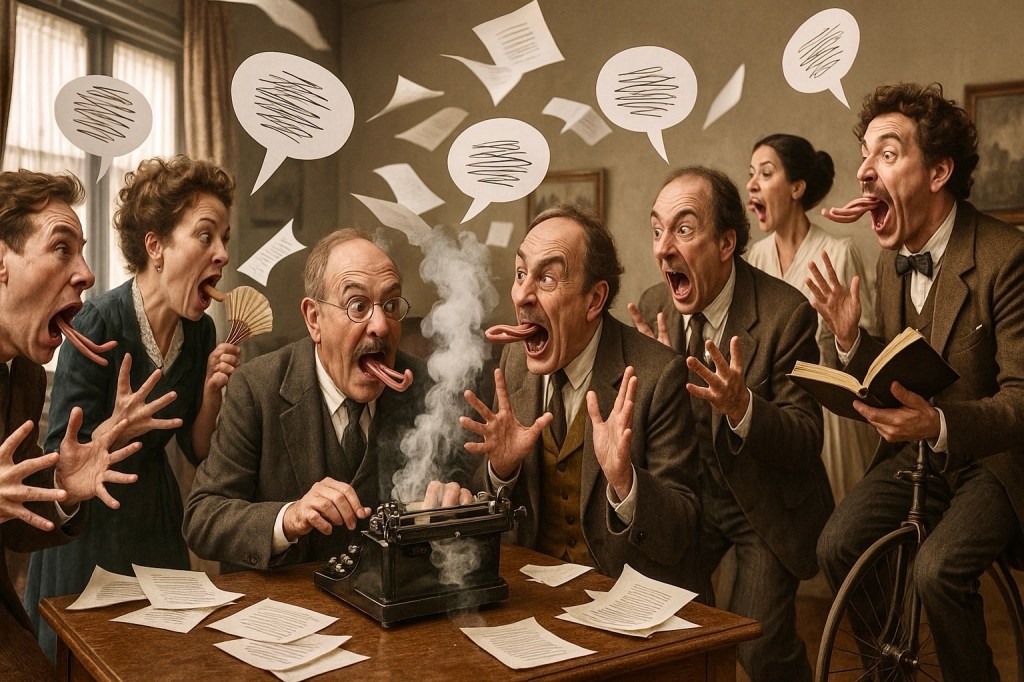
Høeg’s remark is, in many ways, the quintessential commentary on our overstimulated, underwhelming existence. We live in a time when words are everywhere and nowhere at once – when people yammer so ceaselessly they must have developed a peculiar respiratory technique, not unlike the circular breathing of a didgeridoo player, except more southward. It’s a grotesque image, yes, but that’s the point. If Høeg is to be believed, the world is so busy jabbering that it has lost its capacity for meaningful expression. And I, for one, find this mildly reassuring. After all, what better explanation for the ceaseless noise around us than an anatomical necessity?
But Høeg is not merely taking pot-shots at the pace of modern conversation. There’s a melancholy undercurrent to his words – a sense of detachment, almost as if he’s watching the world from a distance, shielded by a pane of glass that nothing can penetrate. He likens himself to “an abandoned building… a forsaken and forgotten observatory.” It’s a beautiful metaphor, and not just because of its desolation. Observatories, by their nature, are places of perspective. They’re designed for looking outward, for taking in the vastness of the cosmos, for finding meaning in distant lights. Yet here, Høeg’s observatory is abandoned, its windows shattered, and the universe it was meant to observe sweeps through it without consequence.
I can’t help but feel that Høeg is tapping into something profoundly relatable. How often have we all felt like that forsaken observatory? Like the world is whizzing by so fast that it barely registers our existence? In an era of social media soundbites and hyperactive news cycles, meaning is often lost in the static. People shout into the void, more concerned with being heard than with having anything to say. And those of us who would prefer a slower pace – a considered conversation, perhaps, or a reflective silence – are left watching it all rush by, untouched and unmoved.
There is a certain liberation in this indifference, though. Høeg claims to view it all with “mild indifference,” not bitterness or despair. And here lies the genius of his observation. By refusing to engage with the world on its frenzied terms, he retains a measure of control. If nothing makes an impression on him, then he is, in a sense, invulnerable. He becomes the observer, the one who watches but is not watched, the one who listens but is not heard.
I would go so far as to suggest that Høeg’s indifference is an act of rebellion. To remain unmoved by the chaos of modern life is, in itself, a kind of victory. It is to refuse to be swept up in the hysteria, to remain grounded and aloof while the world breathes through its nether regions. It is, in short, a refusal to play the game.
And yet, there’s a sadness to this detachment as well. For all its defiance, Høeg’s indifference is also a form of resignation. By describing himself as an abandoned building, he acknowledges his own isolation. The observatory, after all, is not merely detached; it is “forsaken and forgotten.” It was once a place of significance, a point of perspective, but now it stands empty, purposeless. There is no one left to look through its shattered windows, no one to witness the world passing by.
This, I think, is the real tragedy of Høeg’s observation. In a world that talks too fast, those who choose not to join the cacophony are often left behind, unseen and unheard. In shielding themselves from the noise, they risk becoming invisible. And perhaps that is why his indifference is only “mild.” For all his detachment, he recognises what he has lost in the process – the sense of connection, of belonging, of significance.
So, what are we to make of all this? Should we rail against the world and its arse-breathing chatterboxes? Should we retreat to our own observatories and watch the madness from afar? Or should we try, somehow, to find a middle ground – to speak deliberately, to listen carefully, to find meaning amidst the noise?
I don’t pretend to have the answer. But I suspect that Høeg would approve of the question. For all his indifference, he was clearly paying attention. And maybe that, in the end, is the best any of us can do: to watch the world rush by, to notice its absurdity, and to reflect – however mildly – on what it all means.
I’m currently away from my laptop at the moment, so I’ll make any corrections on my return. In the meantime, try breathing through your nose and mouth, and not your arse.

 Wording