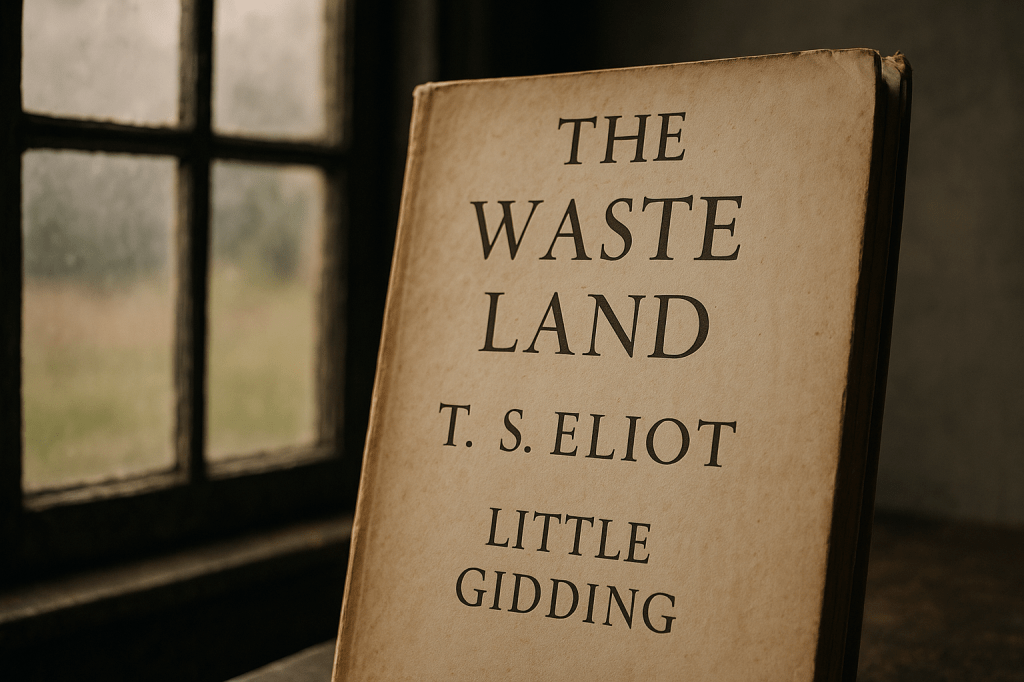
T. S. Eliot’s Little Gidding is the grand finale of Four Quartets, a poem of spiritual reckoning and renewal that reads like a soul’s dark night before the dawn. It is a tapestry woven with threads of history, theology, and poetry, each stitch pulling the reader deeper into Eliot’s meditative vision of time, suffering, and redemption. The poem is, in many ways, a furnace – burning, refining, purging – until what remains is something purer, something closer to divine love. In my reading, Little Gidding is Eliot at his most mystical, his most introspective, and, perhaps, his most profound.
A conflagration of time and eternity. Eliot’s treatment of time is both disorienting and revelatory. He does not see time as a simple progression, as if history were a straight road leading from one event to another. Instead, he bends time back on itself, making past, present, and future collapse into a single moment of eternal significance. The poem’s most famous lines encapsulate this cyclical understanding:
We shall not cease from exploration
And the end of all our exploring
Will be to arrive where we started
And know the place for the first time.
This is no mere paradox for the sake of intellectual gymnastics; it is a spiritual truth. It suggests that understanding is not linear but recursive, that we must tread old ground with new eyes before we can truly see. Experience, in Eliot’s hands, becomes a spiral staircase – each turn bringing us back to the same place, but from a higher perspective.
This vision of time is deeply influenced by both Christian eschatology and Dantean cosmology. The journey towards divine understanding, like Dante’s ascent through Paradiso, is not a single ascent but a revisitation of old truths in new light. The fire of Pentecost, which Eliot invokes throughout the poem, is not a fleeting moment in history but a perpetual reality. Time does not march – it dances, flickering like a flame that never truly dies.
Fire and the refinement of the soul. Fire in Little Gidding is not merely destructive; it is alchemical. Eliot’s fire is the fire of purgation, the fire that consumes dross and leaves behind the essence of what was always meant to be. He frames this starkly:
The only hope, or else despair
Lies in the choice of pyre or pyre—
To be redeemed from fire by fire.
Here, I’m faced with a choice, but it is not an easy one. The repetition of “pyre or pyre” strips me of any illusions – I’m going to burn, we all are, one way or another. The question is whether we will be destroyed by the flames or purified by them. Eliot, ever the modern mystic, forces me to confront a terrible truth: suffering is inevitable, but it can be transfigured.
This is the fire of the Holy Spirit, the Pentecostal tongues that don’t consume but illuminate. It is also the fire of history – the Blitz, the bombed-out churches, the wreckage of human arrogance. Eliot wrote Little Gidding during the Second World War, and the flames of London’s burning must have danced behind his eyelids as he composed it. The war, for Eliot, is not just a catastrophe but a reckoning. Civilisation itself must pass through the fire. Some things will perish; others will be reborn.
The ghosts of poets past. Perhaps the most haunting section of the poem is the meeting with the ‘familiar compound ghost.’ This spectre – part Dante, part Yeats, part all the poets and thinkers who came before – is Eliot’s Virgil, his guide through the smouldering ruins of time. The ghost’s words are sharp as a whetted blade:
Last season’s fruit is eaten
And the fullfed beast shall kick the empty pail.
For last year’s words belong to last year’s language
And next year’s words await another voice.
There is a mournful inevitability to these lines. The past, no matter how revered, cannot nourish the present indefinitely. The old words, like the last season’s fruit, have been consumed. This is both a lament and a challenge – Eliot, as a poet, must find a new voice, a new language for a world reduced to rubble. The ghost’s lesson is one of impermanence: even poetry, which seeks to preserve, must ultimately be transient.
The passage also speaks to the nature of artistic legacy. The ghost is an amalgamation of voices – no single poet stands alone. Eliot, ever the literary magpie, acknowledges that he is both inheritor and innovator, caught between past and future, drawing from the ashes of the old to forge something new.
The rose and the fire. The final movement of Little Gidding is its most beautiful and most enigmatic. Eliot leaves me with a vision that is simultaneously terrifying and redemptive:
All shall be well and
All manner of thing shall be well
When the tongues of flame are in-folded
Into the crowned knot of fire
And the fire and the rose are one.
The repetition of Julian of Norwich’s All shall be well is an extraordinary moment of grace. Eliot, whose early poetry is so often laced with despair (The Waste Land is a spiritual drought), ends Four Quartets with something close to hope.
Yet it is a difficult hope. The fire does not vanish; it is not extinguished. Instead, it is transfigured, bound into the shape of a rose – a symbol of divine love, of eternity, of Christ himself. The image is both delicate and fierce, a thing of beauty that has passed through the furnace unscathed.
This final image leaves me with a profound sense of awe. It suggests that suffering and love are not opposites but two faces of the same reality. The purification by fire is not meaningless; it leads somewhere, even if that destination is beyond my comprehension.
Final thoughts: a hard-won revelation. Reading Little Gidding is like walking through a burning city at midnight, searching for the dawn. It is a poem of reckoning, of hard-won wisdom, of standing at the crossroads of history and seeing, through the flames, the possibility of redemption. Eliot does not offer easy comfort – there is no promise that suffering will simply vanish. But he does suggest that, in the end, there is a unity beyond time, beyond destruction.
The fire and the rose are one.
It is a vision that lingers, like the last embers of a dying fire, glowing in the dark.
The Waste Land: A Descent into the Modern Inferno
The Waste Land is a poem of collapse. To me, it is the shattered mirror of the modern world, reflecting fragments of lost civilisations, fractured identities, and the spiritual aridity of the twentieth century. If Little Gidding is the solemn, reflective fire of purification, then The Waste Land is the infernal blaze of a world already reduced to ashes. It does not guide me gently towards revelation but drags me, kicking and bewildered, through a landscape of desolation, where voices from antiquity and modernity speak over one another in a cacophony of ruin. When I read it, I feel as though I am standing in the aftermath of an explosion, sifting through the wreckage for meaning.
April: the cruellest month of all. The opening line strikes me like an assault on expectation:
April is the cruellest month, breeding
Lilacs out of the dead land, mixing
Memory and desire, stirring
Dull roots with spring rain.
Conventionally, April is a time of rebirth, of renewal, of green shoots breaking through the soil. But Eliot, ever the iconoclast, takes that expectation and inverts it. Spring does not bring life but suffering – awakening dead roots that would rather remain buried. I cannot help but hear something distinctly Dantean in this: just as The Divine Comedy begins in a dark wood where the straight path is lost, The Waste Land begins with a world that resents its own potential for resurrection. The past is not merely remembered – it is a burden, a weight that pulls me back.
This opening sets the stage for one of the poem’s key conflicts as I see it: the tension between renewal and decay. Can the waste land be revived, or has it already passed the point of no return? Eliot offers me no easy answers.
Fragments shored against my ruin. One of the most striking aspects of The Waste Land is its disjointedness. The poem lurches between voices, languages, and literary references with an almost aggressive disregard for continuity. For me, it is a modernist labyrinth, echoing with voices from the Bible, Chaucer, Dante, Shakespeare, the Upanishads, Wagnerian opera, and the trenches of the First World War. Eliot does not offer me a single, cohesive narrative; instead, he bombards me with fragments, demanding that I piece them together – or accept that coherence may never come.
This fractured form mirrors the poem’s themes. The modern world, in Eliot’s eyes, is a ruin – spiritually, culturally, and emotionally. Civilisation has crumbled, leaving behind only ‘a heap of broken images.’ What once seemed sacred is now defiled, what once seemed eternal now lies in pieces. And yet, I find something deeply human in this attempt to gather up the fragments, to construct meaning from the wreckage. Eliot’s own words, in the poem’s closing lines, acknowledge this desperate impulse:
These fragments I have shored against my ruins.
Here, I see the poet as a kind of archaeological figure, digging through the rubble of the past to salvage whatever wisdom remains. It is a bleak task, but perhaps not a hopeless one.
The unreal city: modernity as a living death. Eliot’s depiction of urban life in The Waste Land unsettles me. The ‘Unreal City’ that emerges – part London, part Babylon, part Dante’s infernal vision – is populated by the walking dead. The famous passage in which crowds of commuters flow over London Bridge reads like something lifted from Inferno:
A crowd flowed over London Bridge, so many,
I had not thought death had undone so many.
The repetition of ‘so many’ feels almost incantatory, as though the speaker is overwhelmed by the sheer mass of lifeless figures. This is no longer a city of the living but a procession of the damned. For me, it is a vision of modernity as a kind of purgatory, where individuals are stripped of identity, reduced to a mechanical shuffle. The irony, of course, is that in this world of endless communication – telephones, internet, newspapers, public voices – no one truly connects.
Sex without love, love without meaning. One of the poem’s most harrowing sequences, in my view, is the depiction of a loveless sexual encounter between a typist and a ‘young man carbuncular.’ The passage is delivered with brutal detachment:
The time is now propitious, as he guesses,
The meal is ended, she is bored and tired,
Endeavours to engage her in caresses
Which still are unreproved, if undesired.
Here, I see intimacy stripped of tenderness, connection reduced to mechanical obligation. The woman neither consents nor resists; she merely endures, passive and empty. If love was once a sacrament, here it has become a transaction, drained of any spiritual significance.
This is one of Eliot’s most damning indictments of modernity: a world in which human relationships have become hollow performances. The old myths of romance and passion are exposed as illusions, their power long since faded.
The thunder that never speaks. And yet, The Waste Land is not entirely without the whisper of redemption. In its closing sections, the poem turns eastward, drawing on Hindu and Buddhist scripture. The thunder speaks in Sanskrit, offering a final, enigmatic command:
Datta. Dayadhvam. Damyata.
(Give. Sympathise. Control.)
These words – drawn from the Brihadaranyaka Upanishad – suggest a path forward, a way out of spiritual desolation. They are calls to action, instructions for healing. But do they come too late? Can a world as spiritually parched as this one receive them? Eliot leaves the question unanswered.
The final lines of the poem, with their echoes of Dante, Shakespeare, and the Fisher King myth, strike me as some of the most haunting:
Shantih shantih shantih.
This closing invocation – ‘the peace which passeth understanding’ – is a final paradox. Is it an answered prayer, or a mockery of one? Is peace even possible in a world so thoroughly shattered? I find myself suspended between ruin and redemption.
Final thoughts: a testament to brokenness. Reading The Waste Land leaves me disoriented, as though I have been flung into a world where nothing holds together and meaning itself seems to have fled. It is a poem that does not guide but confounds, that does not reassure but unsettles. And yet, for all its bleakness, I find it one of the most extraordinary poetic achievements of the twentieth century.
Eliot does not offer me easy hope. The waste land is real, and it is vast. But there is something almost defiant in his attempt to gather up the fragments, to salvage meaning from the wreckage. For me, the poem is a monument to brokenness, but also to the enduring human impulse to search, to question, to persist – even in the face of despair.
In the end, The Waste Land is a warning, a lament, and a challenge. It forces me to ask: am I content to wander through this desolation, or can I, somehow, find the strength to rebuild?

 Wording