
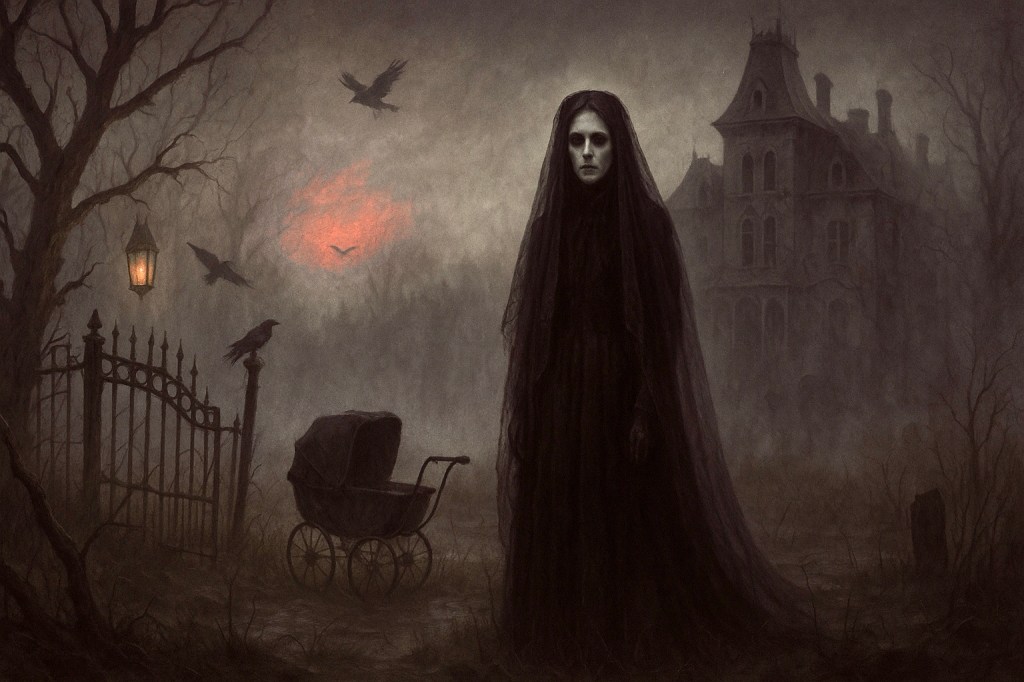
They say curiosity killed the cat, but if you ask me, it merely got the cat thoroughly spooked and left it clinging to the curtains like a caffeinated spider. Such is the effect Susan Hill’s The Woman in Black has on a reader: you pick it up thinking you’re in for a quaint little ghost story, and before you know it you’re eyeing every coat stand in the house with deep suspicion.
Now, let’s get the bones on the table. The Woman in Black isn’t some modern, jump-scare jamboree where the furniture flies about like it’s got a grudge. No, Hill’s novel creeps up on you with all the subtlety of a spider lowering itself onto your pillow at three in the morning. The horror is as slow-burning as a wet log on a campfire, and that’s precisely where its genius lies. It doesn’t shout; it whispers. And somehow, whispering is ten times worse.
Susan Hill, bless her, writes like a magician pulling rabbits out of increasingly sinister hats. Her prose is so crisp and proper it could butter your scones and pass you a napkin afterwards. She’s mastered that peculiarly British art of making the mundane terrifying. A door slamming in the wind, a mist rolling in off the marshes, a dog barking in the night – things that would barely turn your head on an average Tuesday – suddenly throb with menace, as if the very landscape has decided to give you the evil eye.
The setting, Eel Marsh House, deserves its own passport. It’s one of those gothic houses that seems designed less for living and more for brooding dramatically against a stormy sky. Imagine every gloomy country house you’ve ever seen in a BBC period drama, then tip it into a bog and shake vigorously. There’s your backdrop. It’s as inviting as a dentist’s waiting room and about as cheerful.
Our narrator – a decent, buttoned-up fellow – comes across as the sort of man who’d apologise if he trod on your foot and then write you a thank-you note for your understanding. He goes about his business with a stiff upper lip and a sturdy briefcase, blithely ignoring every warning sign as if they were merely offering him a cup of tea rather than hinting at unspeakable terror. If foreboding were rain, he’d be standing outside without an umbrella, smiling bravely.
The plot, which I won’t spoil, coils itself around you like a cat settling in for a nap – deceptively cosy at first, until you realise it’s got claws. Hill’s structure is tighter than a taxman’s wallet, and her pacing is the literary equivalent of slowly turning up the gas under a pot until the lid rattles and you’re too afraid to lift it.
Themes? Oh, there are themes. Grief, guilt, the past refusing to stay politely buried – they bubble away under the surface like old soup. Hill isn’t interested in cheap tricks; she’s out to prove that the scariest thing of all isn’t a monster under the bed, but the things we carry with us, stuffed into the dark corners of our minds like moth-eaten jumpers we’re too sentimental to throw away.
And the atmosphere! It drips with dread as if the air itself has been marinated in ghostly whispers. Every page feels like it’s been left out overnight in the fog. Reading it late at night is like inviting a stranger into your home, turning off the lights, and hoping for the best.
Now, I know some people might turn their noses up and say it’s all a bit old-fashioned, like grumbling that your roast dinner doesn’t come with a side of quinoa. But therein lies the charm. The Woman in Black doesn’t need to reinvent the wheel; it polishes it lovingly, sets it creaking ominously down the lane, and leaves you wondering whether you really want to follow.
In short, Susan Hill’s The Woman in Black is a masterclass in restraint, a gothic ghost story as chilling as a winter’s morning in an unheated bedsit. It’s proof, if ever proof were needed, that fear is often far more effective when it tiptoes rather than stamps, and that sometimes, the dead are more tenacious than a cold caller at tea-time.
If you haven’t read it yet, do yourself a favour: draw the curtains, turn the lights low, and settle in with a cup of something strong. But don’t say I didn’t warn you when you find yourself eyeing the coat rack as if it’s about to lunge.
After all, it’s always the quiet ones you have to watch.

 Wording