Foreword: A Note on Silence
There are some things you are not supposed to say. That killing people, however nicely, is still killing people. That terminal illness does not grant others the right to pre-empt God. That what Parliament calls dignity might look suspiciously like abandonment in disguise.
But here I am. And here, I will say it.
The following pieces were written in anger, grief, and memory. They are not politically correct. They are not balanced. They are not polite. But then, neither is death. And what Parliament has done this week is not policy, but a metaphysical scandal dressed in clinical whites.
This is my protest. My lament. And, God willing, my warning.
It is a curious thing, isn’t it, that in this great island democracy – this land of queues and kitchen-table politics – we’re trusted to vote on whether we want our sausages stamped ‘Approved by Brussels,’ but not on whether the state should have the right to help kill us.
We had a referendum on EU membership. We were consulted about AV voting reform. In Scotland, they held a full national referendum on whether or not to exist. But when it comes to the legalisation of assisted suicide, arguably the gravest moral question since the abolition of slavery, our political class doesn’t even flinch. They just wave it through like it’s a parking bylaw.
And we are told – by the same grinning political chimps who couldn’t organise a three-point turn without a think tank – that this is progress.
But let’s be very clear: this is not policy. It is philosophy, written into law. It’s a statement not about how we die, but what we are. Whether suffering has meaning. Whether human life, once diminished or inconvenient, becomes optional. That is not a health issue. That is not ‘end-of-life care.’ That is a civilisational cornerstone being wrenched out and replaced with a pillow over the face.
And yet we, the people who will live and die under this regime, are not consulted.
Why?
Because they know we might say no.
Because out here in the real world – away from the anaesthetised corridors of Westminster and the café-smooth ethics of Guardian columnists – we have seen suffering, and we know that pain does not negate worth. Because we’ve held the hands of dying relatives, and we’ve known the strange holiness of their final days. Because we’ve watched people change their minds, find peace, reconcile, or simply linger – and be loved while doing so.
The elite find this uncomfortable. They prefer their moral dilemmas to come pre-packaged and bloodless, like NHS sandwiches: cold, grey, and best consumed without reflection. And if the public vote the wrong way? Well, they can’t have that. We might ruin the narrative.
So the decision is kept among the well-spoken and the well-fed – those who, by and large, will never know what it is to be voiceless in a hospital bed, wondering if your doctor thinks your continued existence is poor form.
A referendum would demand that the nation look long and hard into the face of death – and not just death, but the administration of death as mercy. It would require real debate. Not television platitudes or soft-lit campaign videos, but a public reckoning with first principles: with God, with mortality, with the possibility that suffering might sometimes be endured, not eradicated.
But the government doesn’t want reckoning. It wants control. It wants the power to define death, and then to distribute it.
And here’s the darkest irony of all: even those who voted for the Bill think they are doing the decent thing. They believe they are offering choice. But choice without conscience is nothing. Choice without the voice of the people is tyranny with better PR.
I have said it before and will say it again: when a society permits its government to define whose life is worth continuing, it is not long before that same government decides whose life is worth beginning.
We should have had a referendum.
Because the only thing more terrifying than a government that believes it can kill mercifully…
…is one that doesn’t need your permission to do it.
What Rough Beast – Reflections on the Assisted Dying Bill
“Woe unto them that call evil good, and good evil; that put darkness for light, and light for darkness.”
— Isaiah 5:20
There are moments in parliamentary history that deserve not applause but ashes. This is one of them. With a perfunctory flick of their collective wrist – and not, I suspect, without some back-patting and biscuit-dunking in the committee rooms – the House of Commons has voted to permit the legalised killing of the terminally ill. Not euthanasia, not ‘assisted dying’, but death dressed up in euphemism, like a hangman in a tuxedo.
What once required euphemism now demands a eulogy, and God help us all if we offer either.
Let us not mince words: this is a moral obscenity. A civilisational regression disguised as compassion. A legislative wolf in pastoral drag. I watched the vote pass with the kind of wide-eyed horror one reserves for funeral clowns or televised exorcisms. You’d think we were discussing tax bands or bin schedules, not the ritual dismemberment of millennia-old moral principles.
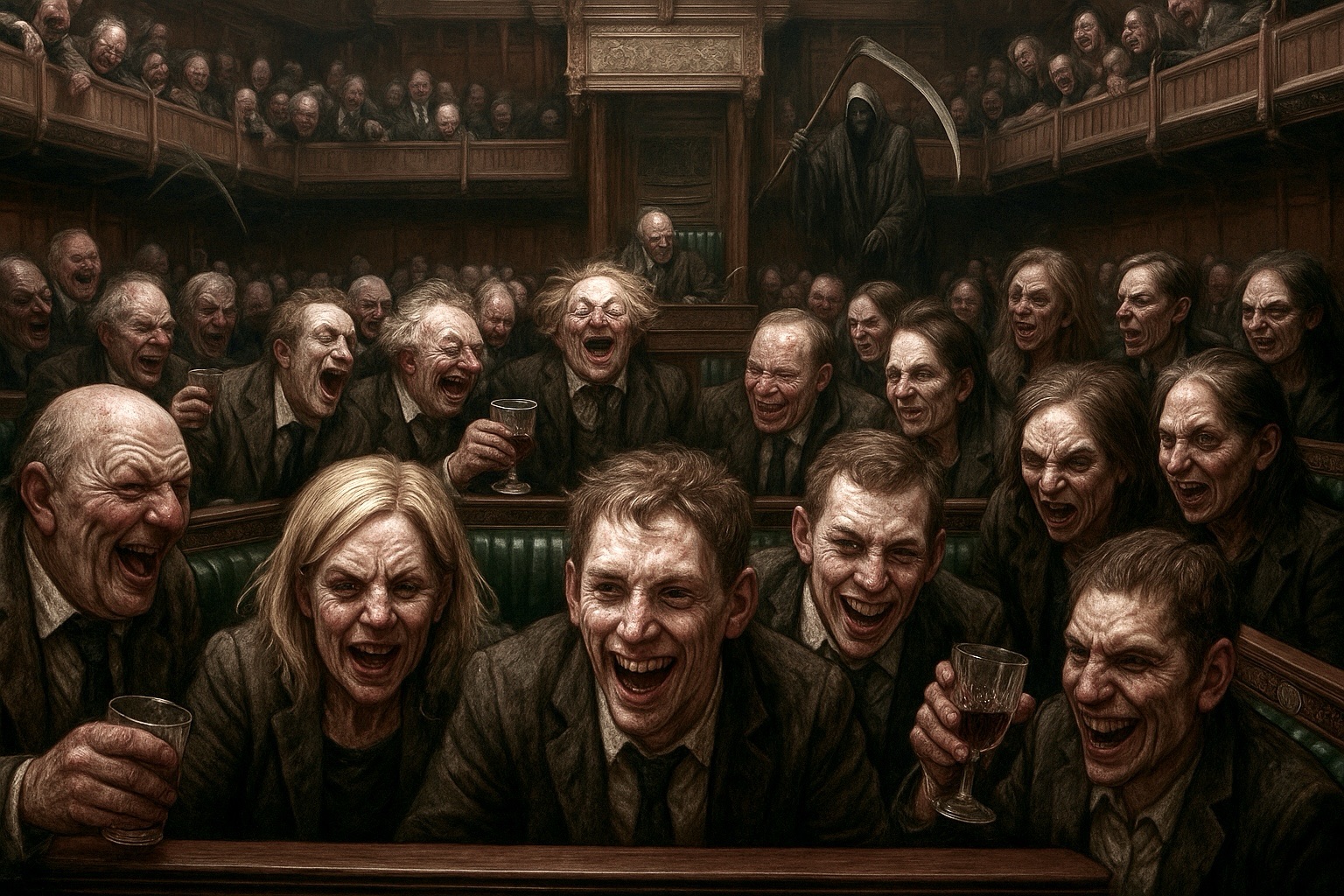
The House was full of well-fed MPs wringing their hands in feigned solemnity, parroting phrases like “dignity in dying” and “autonomy at the end of life” – as if death were a brunch reservation to be handled politely. I’ve buried enough people to know that dying is rarely dignified, and never convenient. It is the moment when man is made utterly dependent – on others, on God, and if he’s lucky, on love. To inject death into that dependency and call it mercy is not progressive; it is perverse.
And yet the Commons, with its usual vapid mixture of careerism and cowardice, declared it a triumph of liberal sensibility. I say it’s the sort of ‘triumph’ one finds in Dante’s Inferno – where logic has been burned to ash, and compassion has been hollowed out and refilled with poison. We have mistaken pain for evil and convenience for virtue. It’s the same warped utilitarianism that led Bentham to have himself stuffed in a cabinet, presumably to inspire future generations of similarly disembodied ethics.
The tragedy is not merely legal; it is existential. We have traded the sanctity of life for the sanctity of choice, as though the two were interchangeable. They are not. The former is rooted in Judeo-Christian civilisation, the Imago Dei, the idea that life is not ours to dispose of like a soiled napkin. The latter is rooted in postmodern narcissism, where all things must bend to the individual will – even reality itself. We are no longer people enduring suffering. We are consumers opting out of the product.
Camus said the only serious philosophical question is whether or not to kill oneself. But even he, the great absurdist, held that defiance in the face of suffering was nobler than surrender. There is no nobility in this bill – only cowardice masquerading as compassion, and clinical death masquerading as choice.
The ancient world knew better, even without morphine drips and palliative sedation. The Stoics taught us to endure. The early Christians died in arenas rather than renounce the sacredness of their witness. And now? Now our MPs – those flaccid avatars of a culture in decay – would rather hand you a cocktail of barbiturates than a cross or a hand to hold.
The final insult, of course, is the language. “Assisted dying.” It’s as dishonest as “reproductive health” or “compassionate release.” This is not dying. Dying happens whether we like it or not. What we are now enabling is execution by prescription, death with a smiley face emoji. A sort of NHS-endorsed Harakiri for the elderly and inconvenient. Orwell, thou shouldst be living at this hour; the Ministry of Death has announced its rebranding.
I have met people who wanted to die. I have met others who changed their minds after a cup of tea and a bit of sunlight. I have stood by hospital beds while grown children wept over once-estranged parents. And I have buried people who would have missed the most meaningful weeks of their lives had this barbarity been legal ten years earlier.
What a monstrous thing it is to sever the thread of suffering from the human condition -as if to suffer were a mistake, and not the very crucible of our humanity. Even Christ, in the Garden of Gethsemane, did not reach for the cup of hemlock. He trembled, and He prayed, and He went on. But then, our Parliament is more Epicurus than Ecclesiastes these days, and the only ‘Cup’ they seem interested in is whatever gets raised at the Commons bar after the vote goes through.
Let me be plain: there is nothing dignified about killing a man because he is inconvenient, to himself or to others. There is no mercy in pre-emptive death. It is a decision made not out of love, but out of fear – a fear of suffering, of ugliness, of helplessness. It is a culture that fears weakness so much it would rather die than be seen weeping.
And so, I grieve – not just for the dying, but for the dead soul of this country. Britain once stood firm against the tides of barbarism. Now it has welcomed them into law. I am not angry because I am a religious man or because of my faith. I am angry because I’m human. This bill is not progress; it is rot dressed as reform.
As Yeats put it, “The best lack all conviction, while the worst are full of passionate intensity.” Well, they were passionate, alright. Passionate about sterilising suffering, euthanising weakness, and burning the moral compass for warmth. It is not just legislation – it is an exorcism of everything sacred from the public square.
And if you think that line is too dramatic, ask yourself this: if we can kill the dying in the name of compassion, what’s next? The depressed? The disabled? The despairing?
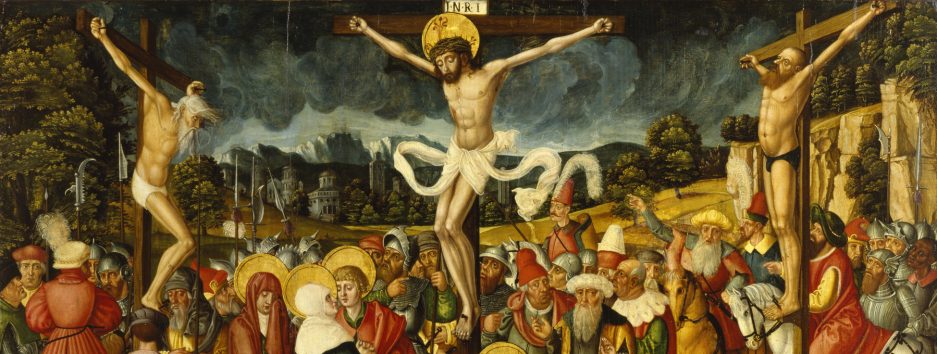
Afterword: The Road to Golgotha
There’s something sacred about letting suffering play out – about not interfering with the final agony. In Christian thought, it’s where the veil is thinnest. But to Parliament, it’s just a management problem. Something to streamline. Something to end.
We are told this is compassion. But no amount of anaesthesia can dull the fact that this Bill moves us one step closer to a world where death is not just inevitable, but administratively encouraged.
In such a world, we do not get Christ.
We get Caiaphas.
EPILOGUE: Death Without Limits
When killing becomes a kindness, and birth is optional
There was another vote in the Commons very recently.
Quiet. Quick. Barely a headline.
It was a proposal to maintain the possibility of prosecuting mothers who abort after 24 weeks – past the line where the child kicks, responds to light, hears music, and might survive outside the womb.
The House said no.
Not just no to the proposal –
No to limits.
No to accountability.
No to protecting the unborn even at the doorstep of life.
They said: Let her kill the child.
Right up to birth.
And I use that word – kill – deliberately.
Because there comes a point when termination is a euphemism too far.
There comes a point when a nation’s conscience is so eroded that it can’t even tell when it’s bleeding.
This isn’t medicine.
This isn’t mercy.
This is the cult of death.
A culture that once cradled life now turns its scalpels on the smallest and the weakest.
And we’re told it’s compassion.
We’re told it’s choice.
We’re told, as ever, to mind our tone.
But what kind of civilisation cannot defend a baby from being destroyed hours before birth – and in the same breath, offers assisted suicide as dignity?
The old philosophers warned us: A people who abandon the beginning of life, and the end of life, will soon forget everything in between.
The Logic of Death
Make no mistake: this is all one logic. It is the same black thread pulled through every vote, every pamphlet, every slow-motion slide into medical nihilism.
- First we said: Let us kill the unborn who are unwanted.
- Then we said: Let us kill the sick who are suffering.
- Now we say: Let us not punish anyone for doing either.
It is not freedom. It is fatalism in drag – parading as progress while the graves deepen.
We Are Not Evolving. We Are Retreating.
This is not evolution. It is regression.
A society that prides itself on ‘being kind’ now permits infanticide and streamlines suicide, while tutting about carbon emissions and using the right pronouns for pets.
We are living through a moral psychosis – where cruelty wears a halo, and killing is applauded if you say it softly enough.
And I, for one, will not go along with it.
Not My Silence. Not My Signature.
So no – I will not call this civilised.
I will not call it progress.
And I will not be told to sit quietly while Parliament declares open season on the unborn, the unwanted, and the unwell.
I will write.
I will speak.
And if they call that cruel, so be it.
Because there is nothing more cruel than a culture that has learned to kill…
and forgotten how to weep.
Epilogue II: The Whisper of Pressure
And now, as if to prove the point, we find Lord Curry of Kirkharle quoting Matthew Parris in The Times to the effect that the elderly and infirm are a ‘drain on resources,’ and that it would be good if they felt some pressure to end their lives early. There, naked and unashamed, is the very serpent we warned of: the utilitarian arithmetic that reduces mother and grandfather to line-items on a spreadsheet, the quiet whisper of death disguised as common sense.
Legalise assisted suicide, and this chill logic is no longer a murmur at the margins but a doctrine at the centre. It’s not compassion that is being advanced, but convenience; not dignity, but disposal. I almost expect to find the ledger balanced not against the suffering of the patient, but against the pension pot, the hospital bed, and the GDP forecast.
And thus we see how quickly the rhetoric of ‘choice’ becomes the rhetoric of obligation, and how the gospel of life is exchanged for the ledger of death.
If you found this edifying, your support is appreciated: Buy Me a Coffee
Disclaimer: This essay reflects the personal views and moral opinions of the author. It is intended as commentary on public policy and cultural debate, not as a statement of fact about any individual.

 Wording
Well written.
I am concerned for when this happens in my country. I know it is coming and I fear for what it will do to people as they systematically dehumanize those who need our protection the most.
Thank you, I appreciate that.
I had drafted something about a mouth ago but wanted to wait and see what was happening as I knew these votes were coming.
Has this kind of thing been passed in the EU already? I know we’re about 10 years or so behind the EU culturally, but didn’t know if Brexit had slowed things down for you folks at all.
I’m not trying to be callous, but we’ve got so many issues here in the US that it can be hard to get the pulse of the rest of the world.
I was of the understanding that some states in the US had already adopted this policy? I’m not sure, but I think I saw some kind of legislation similar to ours in New York last year sometime.
To be honest, we were sold out on Brexit – pro-brexit supporters call it BRINO – Brexit In Name Only. And that’s almost correct. Our PM, Starmer the Farmer Harmer is trying his best to cosy back up to the EU. And of course, Northern Ireland were treated horribly in the deal that Johnson made with the EU. The whole thing is a mess.
It could very well be. With all the furor of the national news, most State based news is lost in the noise, deliberately sometimes, as far as I’m concerned. I’ll have to look into that.
I am sorry to hear that. But thanks for telling me.
I don’t watch TV, haven’t done for a long time. I watch some YouTube and that’s about it. I’ve no love for rubbish. I do try and find independent sources for news though, which are few and far between. I often feel that life’s a lot quieter without the hum of mainstream media nonsense. I like the quiet. All the best.