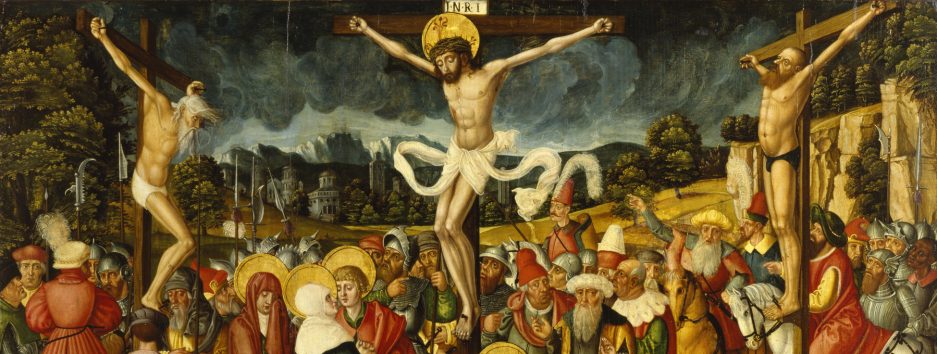
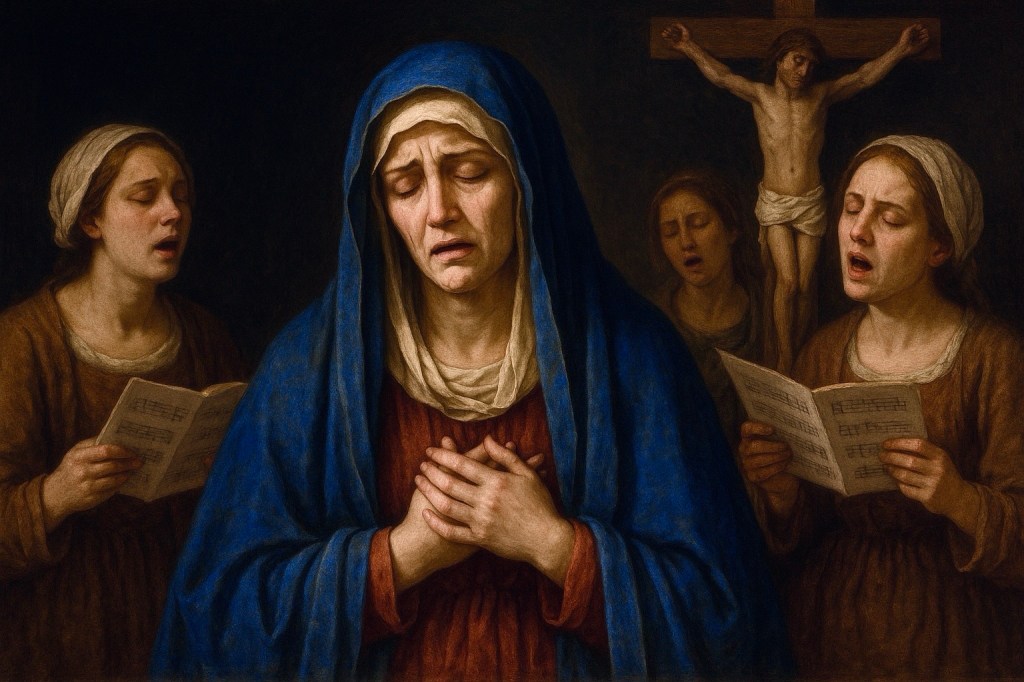
The Stabat Mater is not a hymn so much as it’s a wound set to music – a gash in the human heart where grief spills out in metre and Latin vowels. It’s Mary beneath the cross, yes, but it’s also every parent who has ever outlived their child; every person who has stood by helpless as love bled out in front of them.
The image is appalling in its simplicity. She stands. That’s all. Not screams, not faints, not a holy ecstasy – but standing. And in that upright frame is the full weight of the Passion. “Stabat Mater dolorosa” – the Mother stood in sorrow. Christianity, ever theatrical in its theology, here becomes minimalist: a mother, a cross, and silence.
But this is no meek Madonna draped in Renaissance blue. This is the Theotokos, the God-bearer, watching the flesh she gave to God be torn from the bones. And for all our cultural sanitising of Mary – turning her into little more than a Nativity set accessory – Stabat Mater reminds us she is the original witness of the agony. She is Mater Dolorosa, the mother of grief, and through her, we are forced to confront a theology not of triumph, but of trauma.
A Liturgy of Pain
Written in the 13th century, likely during the rise of flagellant movements and late-medieval mysticism, Stabat Mater echoes with that era’s obsessive intimacy with pain. The Crucifixion was no longer a distant doctrinal event, but something to be contemplated bodily: wounds counted, nails imagined, blood tasted in the imagination like sacramental iron.
There’s almost a theatre of suffering at play in the text – Mary is not only watching Christ die, she’s inviting us to stand beside her. This is not theology for the mind, but a dark gospel for the senses.
Fac me tecum pie flere,
Crucifixo condolere,
Donec ego vixero.
Let me weep with thee,
Mourn the Crucified with thee,
As long as I shall live.
This is not a hymn sung about grief. It’s a hymn sung through grief.
Musical Settings: Grief’s Greatest Hits
The Stabat Mater has inspired a long list of composers, from Palestrina to Pergolesi, from Dvořák to Arvo Pärt. The settings range from the tender to the terrifying. Pergolesi’s 1736 version, written as he was dying of tuberculosis, is perhaps the best known – its sorrow feels intimate, almost whispered, like a deathbed confession.
Dvořák, meanwhile, gives us an oratorio of thunderous lamentation, a Slavic howl of maternal anguish. And Poulenc, writing after the death of a dear friend, channels something sharp and modern into the ancient lines, making grief feel both sacred and scandalously raw.
And isn’t that the point? Grief never really ages. It’s always contemporary. Always ours.
Existential Resonance
In an age like ours – where death is hidden behind hospital curtains and filtered Instagram tributes – the Stabat Mater feels almost indecent. It dares to show grief standing, upright, exposed. No soft lighting, no platitudes, no “thoughts and prayers.” Just the sheer absurdity of a mother outliving her child, and the even greater scandal that God did nothing to stop it.
Here lies the existential horror: not that God was silent, but that God chose to suffer with us. Christ crucified. Mary shattered. And us, invited into the wreckage, to learn the strange alchemy of salvation by suffering.
Perhaps this is why the hymn endures. It’s not about understanding suffering – it’s about sharing it. Or more precisely, standing with it.
He Stood in Grief
I watched my dad stand in grief.
Not with loud wailing or torn clothes, but in the quieter, lonelier theatre of loss – where there is no music and no audience, only the raw silhouette of a father whose child has died. And not just any child, but his firstborn son. My eldest brother. The one whose name was spoken in the house like a spell, long after he was gone.
There is something deeply unnatural about a parent burying their child. It tilts the world off its axis. The seasons grow confused. Time misbehaves. It is an act that shouldn’t exist – a reversal of Genesis, as though the clay has rejected the breath that formed it. I watched my father live in that reversal. He stood, and in that standing was a grief no less holy, no less brutal, than the grief of Mary beneath the Cross.
The Stabat Mater taught me to recognise that posture. *“Stabat mater dolorosa” – *the sorrowful mother stood. What else can be done, after all, when language fails and heaven is silent? You stand. And the standing is everything. Not because it is strong, but because it is faithful. Because there is nowhere else to go when the tomb has taken the one you love.
I never asked him what it felt like. I couldn’t. There are silences you do not break. But I saw it on his face, year after year – that haunted, private vigil that no sermon or sympathy could soften. Every birthday became a funeral in miniature. Every mention of his son’s name a quiet Stations of the Cross.
And though my father was no theologian, he lived a truth older than doctrine: that the heart breaks in liturgies of its own. That sorrow can be a sacrament. That to mourn your child is to become, however briefly, like God – watching your beloved suffer, and being unable, unwilling even, to interfere.
If the Virgin could stand, then so did he. And in that standing was love. And in that love, a kind of resurrection, even if only the slow kind – the sort that doesn’t raise the dead but raises the living enough to keep going.
it’s also every parent who has ever outlived their child
Further Reading and Reflection
‘The Dream of the Rood’ offers a similar pairing of beauty and violence, with the Cross as narrator. Like Stabat Mater, it invites us not to look away.
Simone Weil once wrote: “The extreme greatness of Christianity lies in the fact that it does not seek a supernatural remedy for suffering, but a supernatural use for it.” She would have wept with Mary.
Oscar Wilde, never one to shy from a paradox, might have appreciated the aesthetic horror of Stabat Mater – a hymn where suffering is sublime, and beauty is born through blood.
If you enjoyed this – though goodness knows why – why not support me and Buy me a Coffee

 Wording