Art imitates life, or so I’m told, but in The Good Samaritan by Vincent van Gogh, life doesn’t just inspire the art – it bleeds into it. You can feel the strain in every brushstroke. This isn’t a tranquil tale of neighbourly virtue. This is what compassion looks like after the cameras stop rolling. After the sermon ends. After you’ve said, “I’ll help” – and now you’re stuck with the consequences.
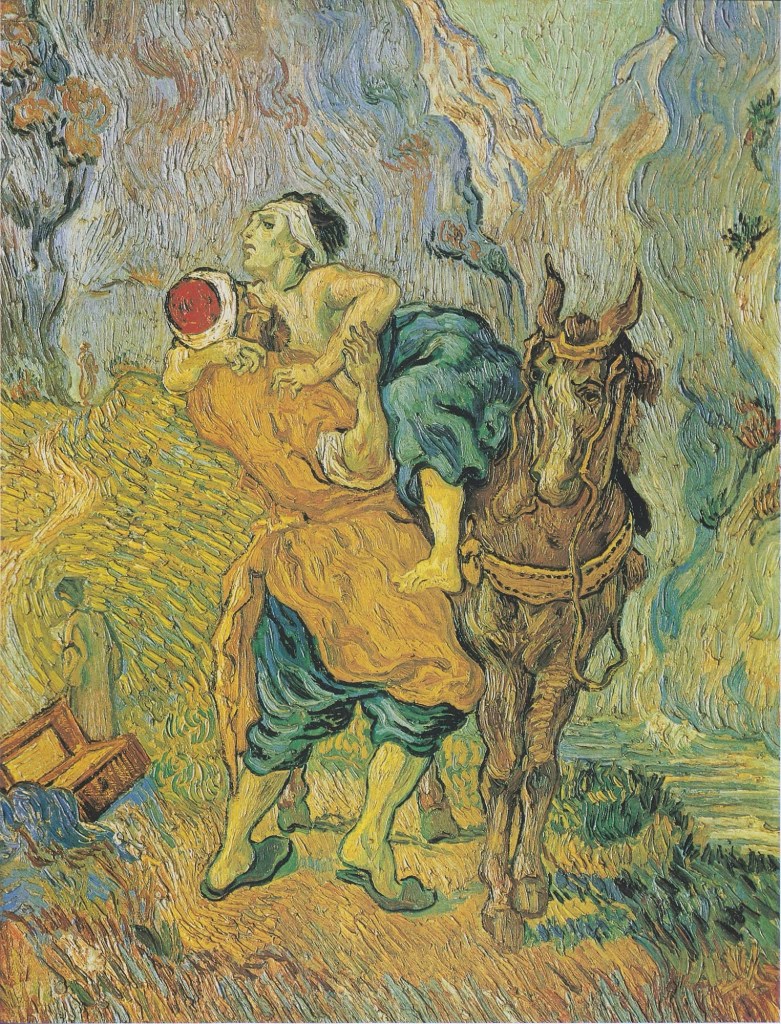
We aren’t looking at the fabled moment where the Samaritan stumbles upon the man in a ditch. That’s long since passed. No moral dilemma, no debate about duty or danger. No Levite muttering, “Sorry mate, bit late for all that.” Instead, Van Gogh shows us the next bit – the bit we always skip. The man is already slung over the Samaritan’s back like a sodden sack of bones. The donkey stands ready, blank-faced. The path ahead is rough and unrewarding.
And my God, the Samaritan is struggling. You can feel the bend in his knees, the twist of his spine. This is compassion with a slipped disc. Mercy with shin splints.
Painted in 1890, during Van Gogh’s time in the asylum at Saint-Rémy, this work borrows its composition from Eugène Delacroix – but the emotion is all Vincent. Where Delacroix gave us Romantic heroism, Van Gogh gives us psychological realism. No glorious martyrdom here – just blistered humanity. The Good Samaritan is good not because he’s noble, but because he keeps going when every muscle screams to quit.
And that, to me, is the deeper truth of this painting. We talk a lot about the impulse to help, to save, to be good. But we rarely talk about the sheer bloody slog after that moment. The carry. The follow-through. The long walk with someone else’s pain strapped to your shoulders, when the world has moved on and the moral applause has faded.
Look at the background. It seethes and swirls, as if the very air is alive with anguish. The trees twist like souls in torment. The earth ripples with agitation. Van Gogh wasn’t just painting figures – he was painting feeling. The burden of empathy, the toll of kindness.
It’s deeply psychological, too. Van Gogh often painted copies of works by masters he admired, but this one feels different. Personal. There’s a part of him in the carrier – and, no doubt, a part of him in the carried. The helper and the helpless, locked in a grim embrace. He understood what it meant to be both: the one collapsed and the one still trying.
Spiritually, this is Golgotha by way of Provence. There’s no halo, no divine light. Just one man dragging another toward the faint hope of recovery. And isn’t that what love really is? Not a feeling, but a decision – made over and over again – despite exhaustion, inconvenience, and the absurd indifference of the world.
We live in an age that loves to signal virtue, but flees the slog of actual sacrifice. We share hot takes, not heavy loads. This painting reminds me that goodness isn’t in the choosing to care – it’s in the carrying. The unphotogenic, tendon-snapping, soul-draining carrying.
And Van Gogh knew this better than most. He carried his own griefs like this – faith, failure, loneliness, love that came to nothing. A Samaritan without a map, forever trudging toward some imagined inn. He never quite got there. But maybe in this painting, he showed us the road.
Not the glamorous beginning. Not the happily-ever-after.
But the middle bit.
The hard bit.
The bit that makes you holy.
Title: The Good Samaritan (after Delacroix) Artist:
Vincent van Gogh Date: May 1890
Medium: Oil on canvas
Dimensions: Approximately 49.3 × 40.3 cm
Style: Post-Impressionism
Location: Kröller-Müller Museum, Otterlo, Netherlands
Subject: The parable of the Good Samaritan (Luke 10:25–37) — a man helps a wounded stranger after others have passed by Source of
Inspiration: After a lithograph by Eugène Delacroix, who painted The Good Samaritan in 1852 Created During: Van Gogh’s time at the Saint-Paul-de-Mausole asylum in Saint-Rémy-de-Provence, during the final months of his life
Provenance:
The painting was executed in the spring of 1890, shortly before Van Gogh left the asylum and returned to the north of France. Van Gogh was deeply influenced by Delacroix and often copied his works, particularly during his confinement, as a form of both artistic study and psychological stability. After Van Gogh’s death, the painting remained within private collections before eventually becoming part of the Kröller-Müller Museum collection in the Netherlands, which now holds one of the largest Van Gogh collections in the world.

 Wording